
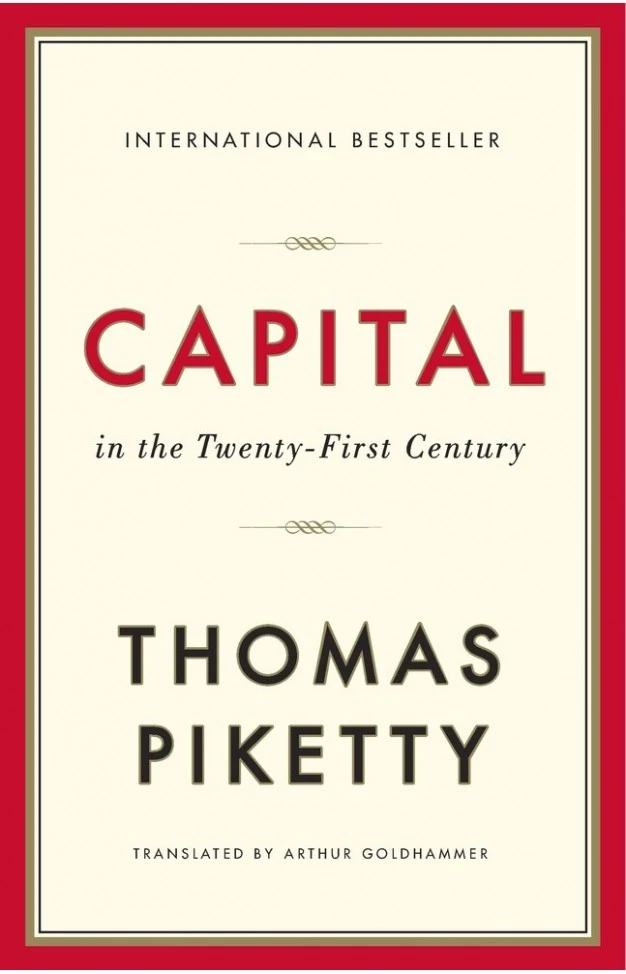
For more than two decades, Thomas Piketty has been one of the world’s most influential thinkers on inequality. His monumental work, Capital in the Twenty-First Century, is likely one of the best-selling non-fiction books in the last two decades. It reshaped public debate in Western democracies, made countless casual observers interested in r>g model and reintroduced Balzac to the world.
In recent years, Piketty has turned his attention outward, writing on Pakistan, India, Brazil and the broader Global South. When we sat down for a long conversation, it became clear that this shift is not incidental. It reflects a deeper evolution in his thinking about capitalism, democracy and the future of global justice.
I began by asking him about a puzzle that animates much of contemporary politics: why have class and material conflicts faded from democratic agendas, replaced by identity, religion and ethnicity?
Thomas Piketty responds by undoing the premise of the question with a gentle but firm correction: “Well, first, I think, you know, class conflict is still very prominent, everywhere.”
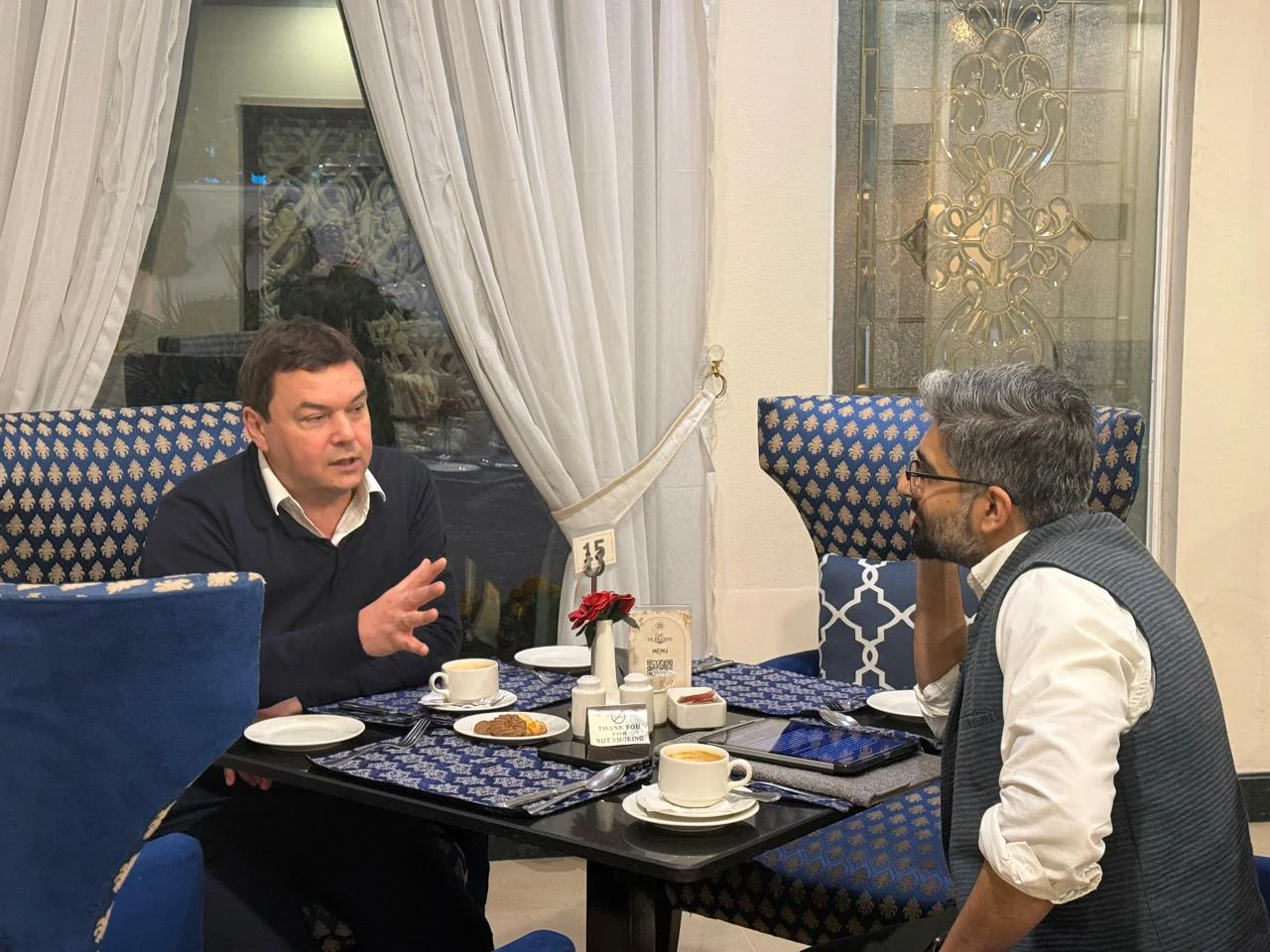
The problem, he argues, is not the disappearance of class but the disappearance of political ambition. “We have stopped talking about ambitious platforms for redistribution and reducing class inequality.” When political elites spend decades insisting that there is only one viable economic policy, only one way to organise the economy, the boundaries of politics shrink accordingly.
“If you tell the public opinion for 20 or 30 years that there’s only one economic policy that is visible…then, of course, 20 years later, 30 years later, the entire public discussion is about border control and identity, because this is the only space that you leave to politics,” he continued.
It is a diagnosis that feels familiar across contexts. Piketty’s argument is that Western democracies have lobotomised their own economic imagination. They built half a politics and left the rest to be occupied by grievances.
He traces this narrowing back to the early 1990s, when the collapse of Soviet communism produced a wave of ideological certainty. “In the 1990s, when I was a young student, I was a much stronger free market believer than I have become today,” he says. “I was very against Soviet communism and all sorts of left-wing people who were too left-wing for me.”
He still rejects Soviet authoritarianism, but he now sees how the moment produced an overcorrection. “We have gone far too far…in believing that free markets were going to solve everything.” The financial crisis of 2008 and the pandemic of 2020 exposed the limits of that faith, but instead of a renewed social-democratic agenda, many countries saw the rise of nationalism.
“Nationalism is always sort of the easier way to try to direct the anger and disappointment of the electorate,” he says. Trump’s message — “the artwork of Americans has been stolen by Mexicans, by the Chinese” — is absurd, but effective. “There’s no limit to nationalism…if you have enough rhetorical talent, you are able to go very, very far.”
Yet Piketty insists on optimism. He believes social democracy must reinvent itself, and that its next chapter must be global. The old model, he argues, succeeded too well in the rich world.
Political innovation, he insists, must come from the South as much as from the North. “The global wealth tax…in terms of real political initiative, it came from Brazil. It didn’t come from Europe.” He wants Pakistan, India, South Africa, Brazil and Indonesia to put ambitious proposals on the table — on worker rights, global taxation, climate justice.
“Everybody, in a way, has become a social democrat,” he muses, noting that even right-wing parties now pay lip service to welfare spending. “They will never try to divide the size of the state by three or four or five to pre–World War I government.” The challenge now is to extend that logic beyond the North. “The real challenge is to bring it to a global dimension…to make it truly global in perspective.”
Climate change, he believes, will force this shift.
Last year, Piketty wrote a short piece for Le Monde, entitled ‘Rethinking the World Without the U.S.’, in which he argued that the U.S.–German leadership has failed to address the climate crisis. When I ask him what a global ecological transition would require, he answers with a two-track strategic logic that runs through much of his work: national action and international coalition-building.
“You have to have your own agenda of what you can do by yourself,” he says. “But at the same time, you should, of course, put a lot of energy into building coalitions.” For Europeans, that means articulating a model distinct from the United States — “they should not try to imitate the U.S. in artificial intelligence, in extractivism, in ethno-nationalism.”
But it also means sharing power and wealth. He brings up the EU–Mercosur trade agreement, stalled partly because of concerns about deforestation in Brazil. “This doesn’t make any sense,” he says of Europe’s objections, “except that then you have to compensate.” If Brazil is clearing forests to satisfy consumption elsewhere, Europe cannot simply demand that it stop. “At some point…they have to propose an explicit global taxation mechanism…part of the tax revenue has to be targeted to the Global South so as to compensate them for the emissions which they are not going to make, and which countries in the north have already done.”
The pattern is familiar: a promise made, half-kept, then left to linger. Piketty’s argument is that the global order must finally finish the job. When the conversation turns to artificial intelligence, he becomes more animated. “We really have to completely change the terms of the debate,” he explains. The problem is not the technology itself but the ownership structure behind it. “A big part of it is based on a sort of complete privatisation of knowledge that was produced collectively.”
He is scathing about what he calls “this new alliance between Silicon Valley and Trumpism,” which he sees as a frontier of extractivism — private property rights created out of public knowledge. “That’s not at all the direction to go.” If AI is to be useful, he argues, its gains must be shared and its energy demands scrutinised. “Creating more and more data close to nuclear reactors…are these really the needs of mankind?”
For him, as for anyone with a commitment to social justice, the more urgent task is expanding worker rights. He points to Sweden and Germany, where workers have up to 50 percent representation on corporate boards. “I think this is something which I would like to see everywhere.” A few years ago, he notes, Elizabeth Warren, Bernie Sanders and Jeremy Corbyn pushed for similar reforms. “This was very close to happening,” he says. If adopted in India or Brazil, it could spread globally.
When the conversation turns to artificial intelligence, he becomes more animated. “We really have to completely change the terms of the debate,” he explains. The problem is not the technology itself but the ownership structure behind it. “A big part of it is based on a sort of complete privatisation of knowledge that was produced collectively.”
Political innovation, he insists, must come from the South as much as from the North. “The global wealth tax…in terms of real political initiative, it came from Brazil. It didn’t come from Europe.” He wants Pakistan, India, South Africa, Brazil and Indonesia to put ambitious proposals on the table — on worker rights, global taxation, climate justice. “Even if they are not adopted next year…the fact that they are perfectly stated and they come to the ears of global citizens in the north” matters.
As the conversation winds down, I ask him about his own political evolution. His work has always been critical of inequality, but in recent years he has spoken more openly about decommodification and democratic socialism. He pauses before answering.
“I would not put it as more radical,” he replies. “I’m not sure what you call it is the right term, but I feel more of a democratic socialist than I used to represent myself 10, 20 or even 30 years ago.”
Part of this is generational. “In the 1990s, I was very liberal…the zeitgeist at the time was such a failure of Sovietism.” But part of it is empirical. His research on colonial extraction challenged deeply held assumptions in mainstream economics. “Everybody now sort of agrees with the data,” he says. What angered some economists was his simulation showing that if the wealth extracted from India had been invested domestically, India could be as rich as Britain.
“I have just been able to escape from this radical, mainstream view of the world,” he says with a shrug.
In the end, Piketty’s argument is not that the world is broken beyond repair. It is that the world is full of half-kept promises — of welfare states that never globalised, of technologies built on public knowledge but privately owned, of democracies that narrowed their own horizons. His optimism lies in the belief that these promises can still be completed, if the political imagination expands to meet them.

Umair Javed teaches sociology at LUMS. Twitter: @umairjav