A woman tries to run away. She starts wearing push-up bras, changes her teeth, gets a haircut and buys some off-brand makeup and clothes. She switches her accent, rids herself of the inflection of past tongues that still mum her speech and learns urban colloquialisms. She uses men or is used by them, it remains unclear which. She runs and trips, she fucks and cusses, she fights and takes beatings—all because she wants to reject history. But history thickens like quicksand, choking every move she makes. The past, all sinew and steel, never forgiving, clamps its hand around her neck. She runs and runs, only to realise: “on this earth, we all come from men”.
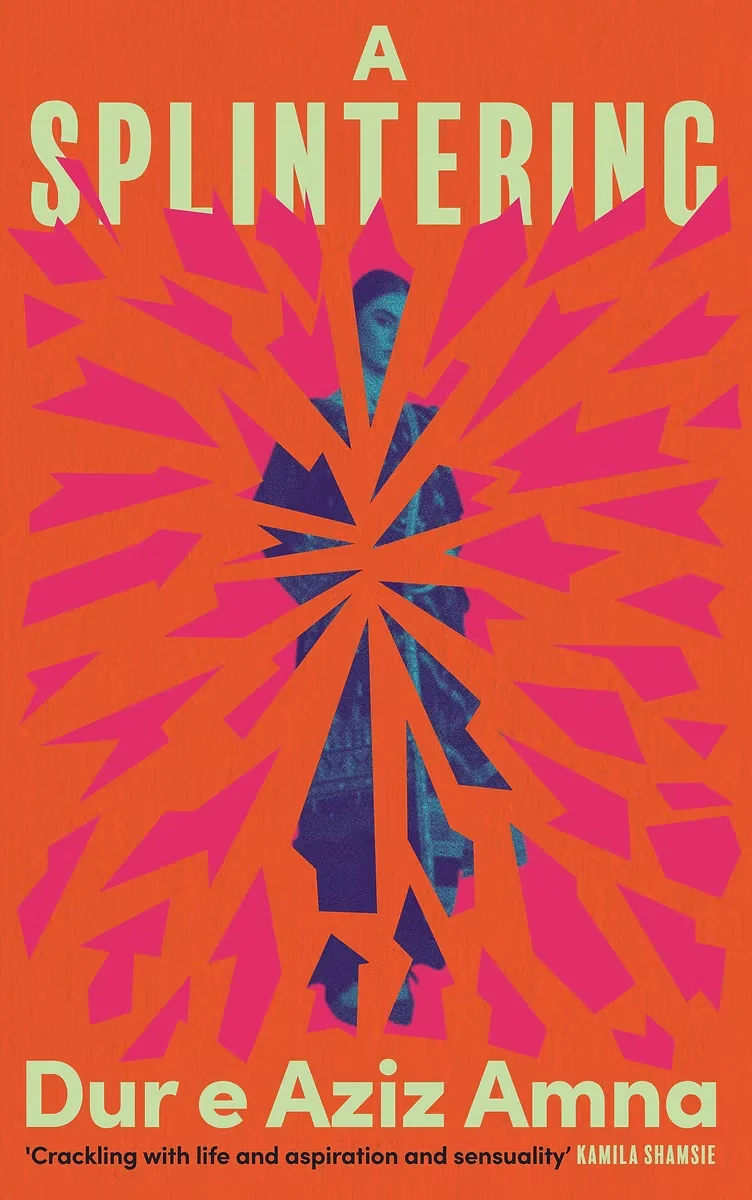
In A Splintering, Dur e Aziz Amna writes about Tara, a woman who, like her name, is chasing a star or trying to become one. Hailing from a fictitious village ‘Mazinagar’ on the outskirts of Rawalpindi, Amna’s hometown, Tara (one of 5 siblings, 4 sisters and their prized older brother, Lateef) is obsessed with getting out. She dreams of worlds that outsize the chaddor and chardevari of her parental home, dreams that themselves grow bigger with each leap she makes. While her sisters accept, in one way or the other, their wretched fates, Tara is deadset to rewrite her life’s story, no matter what it takes. She is willing to put her physical being—her body—on the line, literally. In her defence, there is not much else she can mortgage. In a cruel twist of fate, Tara, attempting to become a madam, becomes a madame.
But it is not only when she comes to be a whore—as she repeatedly calls herself after ‘choosing’ to sleep with men for money—that Tara sells her body. Even her first attempt to leave ‘Mazinagar’, her marriage to the lazy, ‘socialist’ Hamad, is sex work. As Kate Millett notes, “All women are prostitutes, marriage is prostitution.” And it is not only the men that own her body. When she gets pregnant, Tara realises her “body also belong[s] to the women [she knows]”. But this is a spurious comparison; there are a few scattered throughout the text. Her mother-in-law may control the number of menstrual pads Tara gets each cycle, but it is Hamad who slaps her when she ties her tubes and Lateef who might kill her for demanding her share in property. Are the watchdogs of patriarchy the same as its monarchs? No, but Amna makes little effort to distinguish between them.
Throughout the novel, Tara daydreams about possible lifeworlds that are presently out of her reach. In each, she is the man. This might be because of her patriarchal childhood, overshadowed by her brother’s masculine excesses, or the fact that only rich women get to act out the ‘feminine’—an idea that Black feminists have often underscored in their analyses of women and work. At one point Tara remarks, “At the hands of my brother, I had dealt with the violence and surveillance focused on women, but I had never innately felt like one.” It is only when she is pregnant with her first child, or much later when Ashraf ignites her latent sexuality that she feels like a woman. Despite trying to ‘invent’ the woman she wants to be, Tara is only effeminised vis-à-vis the man or the child’s gaze (very Lacanian). And even though she is not some ‘stupid bitch’ waiting to be saved, ultimately it’s masculine affirmation she seeks. Oh, wait. It’s money… but is it really?
While reading A Splintering, I often found myself asking: is this a feminist novel? Despite my criticisms, the answer is a resounding yes. As Bonnie Honig notes in A Feminist Theory of Refusal, “when refusal, especially women’s refusal, is pathologised, that calls for a counter reading and scrutiny”. And Amna’s novel is an instantiation of feminist refusal. Tara, in negotiating heteropatriarchal norms and performing a self-crafted form of femininity (no matter how limited) is refusing. And refusal too, Honig underscores, “betrays a deep attachment to [the world], if not to the world as it is, then surely to a more just world that is not yet.”
Tara is not a protagonist one can easily sympathise with, and as an upper-class Pakistani woman, I would be lying if I claimed empathy. She is crass, selfish and vulgar, but so are all of us. Indeed, Amna’s point, to some degree, is that poverty (whether literal or the indigence of unfreedom) makes self-interested Darwinian beasts out of everyone. As much as Tara’s story is about being a woman, it is also a story of class. Is it a socialist novel? I am not sure. If there is a socialist streak in the book, it is not the class reductionist kind that Tara’s no-help husband, Hamad, espouses. But, it is a kind of realist critique of having or not having wealth and its social repercussions, especially on women. As Dur e Aziz Amna writes, “One is always taunted by the rich and haunted by the poor.”
Much like Tara, Hira—the protagonist of Amna’s debut novel American Fever—was not immediately accessible to a reader like myself, in part because of her age. A teenager sent on a scholarship program to rural Oregon, Hira differs from Tara both in her socio-economic background and broader outlook, yet the same restless ambition and the thread of feminist refusal connect the two. The difference is tonal: in American Fever, Amna channels the voice of teenage years she once knew, while in A Splintering, Tara’s raw desires (for sex, money, and men) make her at once resistant to normative recognition and impossible to ignore. I found the latter more exciting as a reader because it explored themes that transcended the adolescent yearnings of a 16-year old Hira.
Throughout the novel, Tara daydreams about possible lifeworlds that are presently out of her reach. In each, she is the man. This might be because of her patriarchal childhood, overshadowed by her brother’s masculine excesses, or the fact that only rich women get to act out the ‘feminine’
Even though Amna references everything from the housing market boom of the early 2000s, to the influx of Afghan refugees after the Am-Pak anti-Soviet military intervention, to the Iraq War and Abu Ghraib prisoners, the 2005 earthquake and the Second Intifada, it is ultimately her astute sense of the (extra)ordinary ways in which deprivation is felt, smelt, and reproduced that makes A Splintering worth reading. As Millett wrote in her reintroduction to The Prostitution Papers, “There are times when life is more important than the reporting of life, when the human experience overshadows all purposes: literary or political.”
Modern life, in all its forms (bare or otherwise), however, is politicised. Agamben makes this point in Homo Sacer. This is doubly true for women, whose lives are often mislabelled “apolitical” precisely because they are relentlessly policed and controlled. Tara’s life and her persistent refusals are political acts—not as manifestos, but in the stubborn way she keeps reaching for a self the world denies her. Even in moments of self-betrayal or compromise, Tara insists on having more. Amna compels us to sit with that complexity: a woman neither martyr nor heroine, but a human being navigating the debris of history.

Iman Iftikhar is an MPhil in Political Theory at the DPIR at Oxford. A Rhodes Scholar from Pakistan, Iman did her undergraduate degrees in History and Philosophy from Yale University before joining Oxford. As an MPhil student, Iman works on critical theory, history of political thought and postcolonial feminism(s) with a focus on South Asia. She is also the Chief Editor at South Asian Avant-Garde (SAAG) magazine and a returning fellow at Kitab Ghar Lahore.