Among the most premier festivals of Urdu letters, the Jashn-e-Rekhta of New Delhi is on the wane. Faced with a depleting readership, an ever increasing perception that Urdu is the language of ‘imperialists’ and its literature the domain of an arrogant, thankless minority, organisers of the festival leaned this year on Instagram influencers in an attempt to revive broader Indian interest in Urdu. These organisers have long been criticised for undermining Urdu’s nastaliq, of emphasising Devanagri and romanisations; that their programming is usually limited to celebrations of Urdu at its most benign and Bollywood-like is also a claim made against them. But this year’s reels and their mutations of everyday speech into decorous, ahistorical plays with language — the organisers’ endorsements of these as representing ‘refined’, ‘proper’ Urdu — are a serious, programmatic failure. Imagine if Shakespearean syntax became how the Booker Prize advertised the English language, or if all contemporary English prose and poetry had no discernible impact on how its literature was being projected — that the very institutions responsible for the promotion of English would so greatly reduce its scope and breadth.
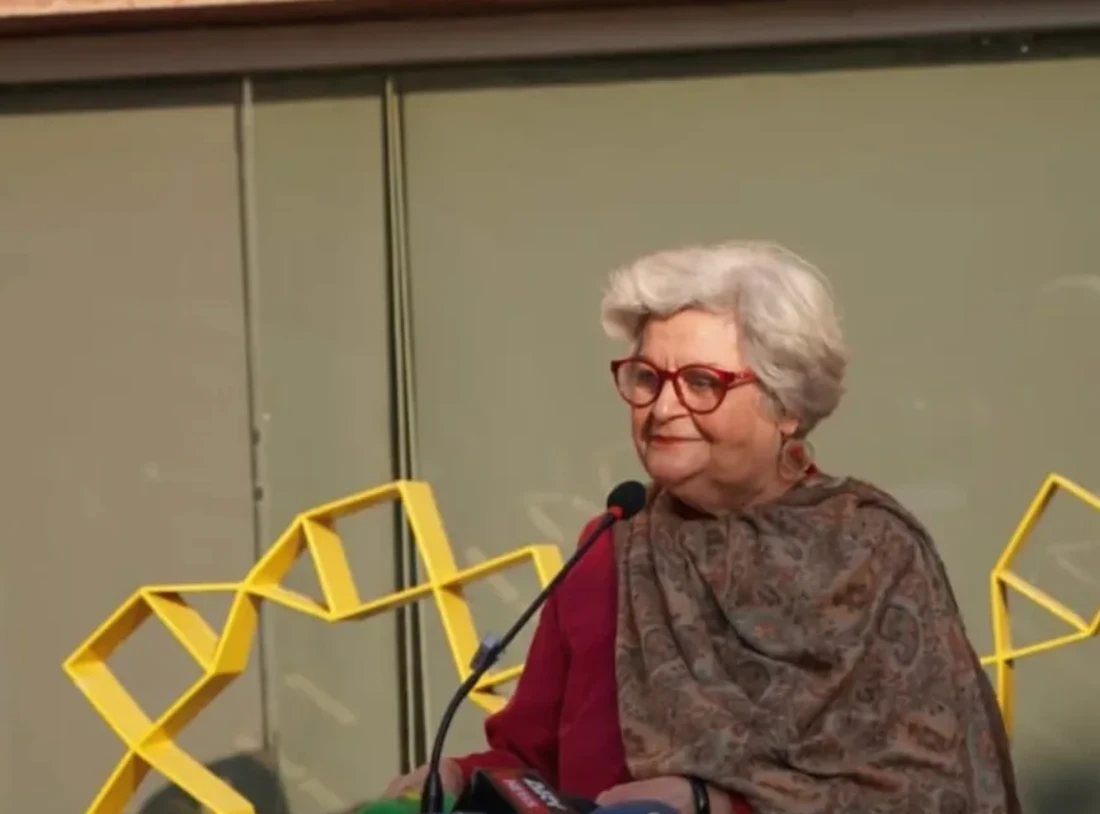
The Faiz Festival can not, at least, be accused of presenting Urdu as some artefact of a bygone, aesthetic past. Rather, in Lahore, Urdu appears quite alive, safe from calls for resuscitation. The 2026 iteration of the Faiz Festival attracted massive audiences, most of its events filled to the brim, perhaps more so than any other literary or cultural event to have utilised the Alhamra Arts Complex in the past several months. A few weeks prior, in a near-empty hall, the Urdu literary critic Nasir Abbas Nayyar quipped that he and his fellow panellists were mistaken that Jaun Elia was ‘the Gen-Z poet’. Yet the low audience numbers for Urdu-adjacent events at the Lahore Literary Festival are a problem of its branding and messaging, for even niche events — such as one featuring historians Ishtiaq Ahmed and Tahir Kamran on ‘Pre-Partition Punjab’s Contribution to Cinema’, or Nayyar’s conversation with the now 90-year old Zehra Nigah on Faiz’s contemporaries in ‘Faiz aur unn ke humassar shauraa’ — were packed at the Faiz Fest. And while the inclusion of Pakistani television celebrities and screenwriters may explain why the festival attracted such large numbers in the first place, halls dedicated to Faiz’s lesser known pursuits, such as his time conceiving cultural policies for the Pakistani government or his work as an English-language columnist, were also well-attended. Moreover, as panellists were not only writers or academics, but also lawyers, translators, journalists and fine artists, the festival seems to have attracted a range of professionals that other such literary weekends courted less successfully.
The Faiz Festival can not, at least, be accused of presenting Urdu as some artefact of a bygone, aesthetic past. Rather, in Lahore, Urdu appears quite alive, safe from calls for resuscitation. The 2026 iteration of the Faiz Festival attracted massive audiences, most of its events filled to the brim, perhaps more so than any other literary or cultural event to have utilised the Alhamra Arts Complex in the past several months.
Urdu literature took on many forms at this festival. Like Zehra Nigah, flying in from Karachi was Iftikhar Arif; both of them were part of a session on the marsiya as a form in Urdu poetry, titled ‘Khaana-e-Shabbir ki viraani ki shab’. Arif suggested that neither Persian nor Arabic have reached the pinnacles Urdu achieves in these elegies for Karbala; Nigah had elsewhere mused that the children of Shia Muslims are particularly fortunate, for more so than any other children, attending majalis helps them acquire a complex Urdu vocabulary when they are as young as five years old. Nigah also laughed recalling Josh Malihabadi, a poet though partial to communism and otherwise religiously irreverent, nonetheless wrote much verse under the sincere influence of Karbala and its tragedy.
It was in this very conversation that Arif brought up the Ramayana as the most timeless work of literature in South Asia, inviting a comparison between its characters and conception of family with Karbala and the dizzying web of family ties central to its remembrance. As a sample of the seamless intersections being drawn in different panels, this was just one of the many moments of the unselfconscious cosmopolitanism abundant in Pakistani literatures — especially noticeable because it is so absent from most other public discourse. It is also testament to the pleasure of attending literary festivals at all, in which high-brow analyses increasingly restricted to humanities degrees can be witnessed and sometimes participated in by a general public. In another conversation about Faiz’s involvement with the Pakistan Times and Imroz (titled ‘Jo basar gaein hain baatein’) mention was also made of Faiz’s involvement with the Afro-Asian Writers’ Bureau, his editorial practices in Beirut with the Lotus magazine. Faiz’s lifelong friendship with the originally unpublished but perennially popular Punjabi poet, Ustad Daman, was the subject of another panel, titled ‘Lo hum ne Daman jhaarh diya’. It led to the compelling suggestion that the Punjabi language is neglected by ruling elites precisely because of the egalitarian ethos running across its earliest literary forms. Indeed, even as the Hashmi family has been assailed for underplaying the communist aspects of Faiz’s legacy, such critics and readers are being platformed at the festival, and Salima Hashmi’s own recently launched memoir is not coy about Faiz’s commitments to international communism.
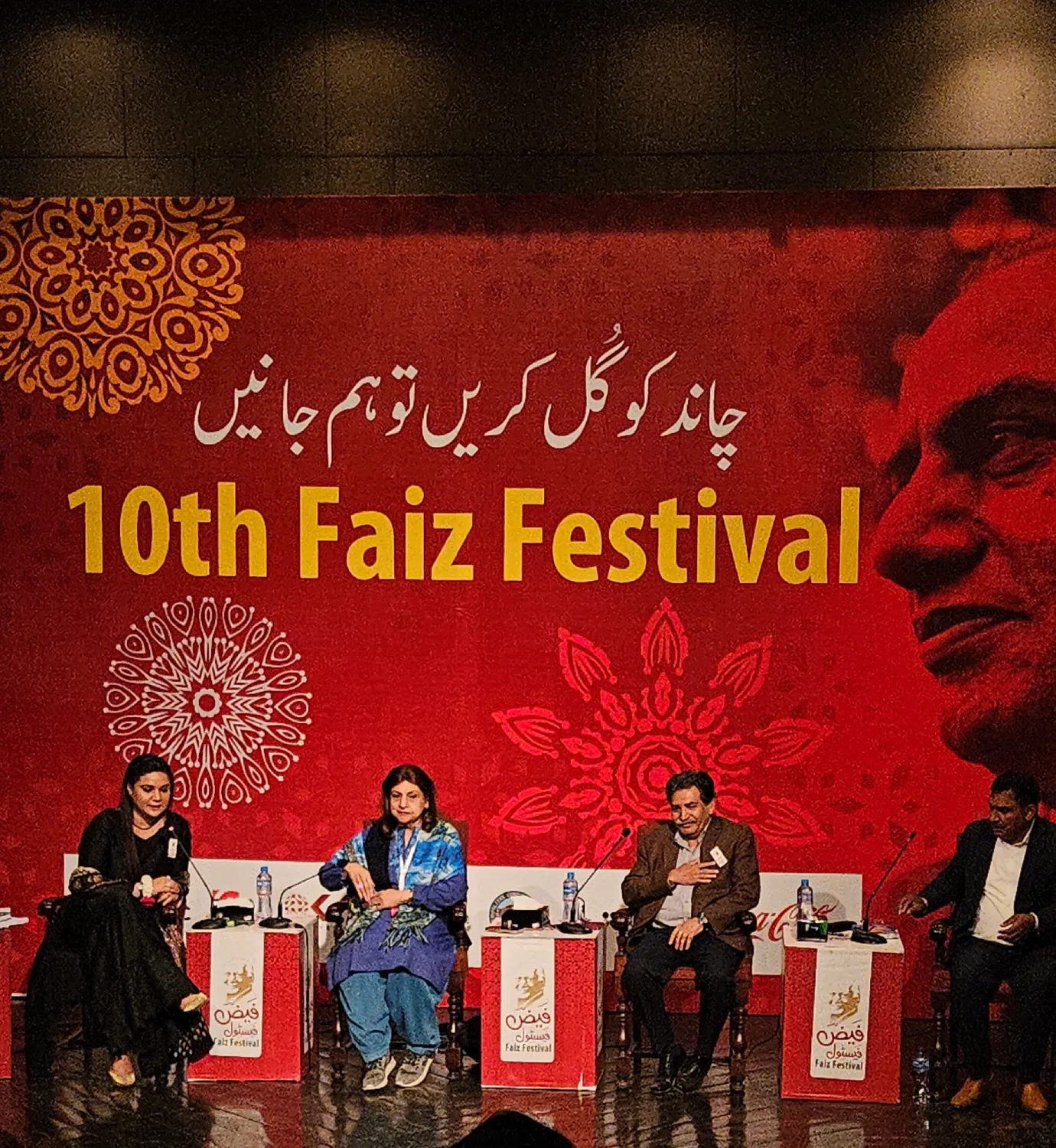
Especially thinking of Urdu literary worlds, however, one does wonder if the priority of all such Alhamra festivals to have in-person panellists ultimately furthers the divide between Pakistani, Indian and Kashmiri creatives and intellectuals. Visa restrictions will remain, but Zoom and projectors have made the practicality of involving intellectuals from across the border more tenable. Even as the Faiz Festival does not especially define itself as a weekend dedicated to a celebration of the Urdu language in quite the same sense as the Jashn-e-Rekhta, it brings together so many of its enthusiasts and interesting active practitioners that such measures would only benefit this partitioned readership.
Faiz’s lifelong friendship with the originally unpublished but perennially popular Punjabi poet, Ustad Daman, was the subject of another panel, titled ‘Lo hum ne Daman jhaarh diya’. It led to the compelling suggestion that the Punjabi language is neglected by ruling elites precisely because of the egalitarian ethos running across its earliest literary forms.
To expand its ambit, the Faiz Fest does also incorporate English and Punjabi-language programming. Launching for a second time at the same venue in Lahore, Mohammed Hanif’s Rebel English Academy still drew large audiences — albeit an odd question on Hanif's characterisations of women was urged unnecessarily. Some discussion also ensued on English-language Pakistani poetry, following a launch dedicated to Adrian Husain’s Knife on the Tide. That said, the festival does not seem to attract the students of the more elite English-medium schools; even as this is not quite the doom of Urdu in India, it does make one wonder if the Lahore bourgeoisie of the decades to come will continue to sponsor and support these events. In fact, while there is a great deal of curation dedicated to how young people should read in English, Urdu’s institutions have not substantially made attempts to attract bookish teenagers — elite or otherwise — to its canon.
One such figure dedicated to expanding the outreach and accessibility of Urdu literature in Pakistan passed on just this November. In a large panel titled ‘Aaj tum yaad behisaab aae’, the educationist Arfa Sayeda Zehra was remembered by her colleagues, former students and friends; even the Muslim religious scholar, Javed Ghamidi, paid moving homage to her life and work through a video message played during the session.
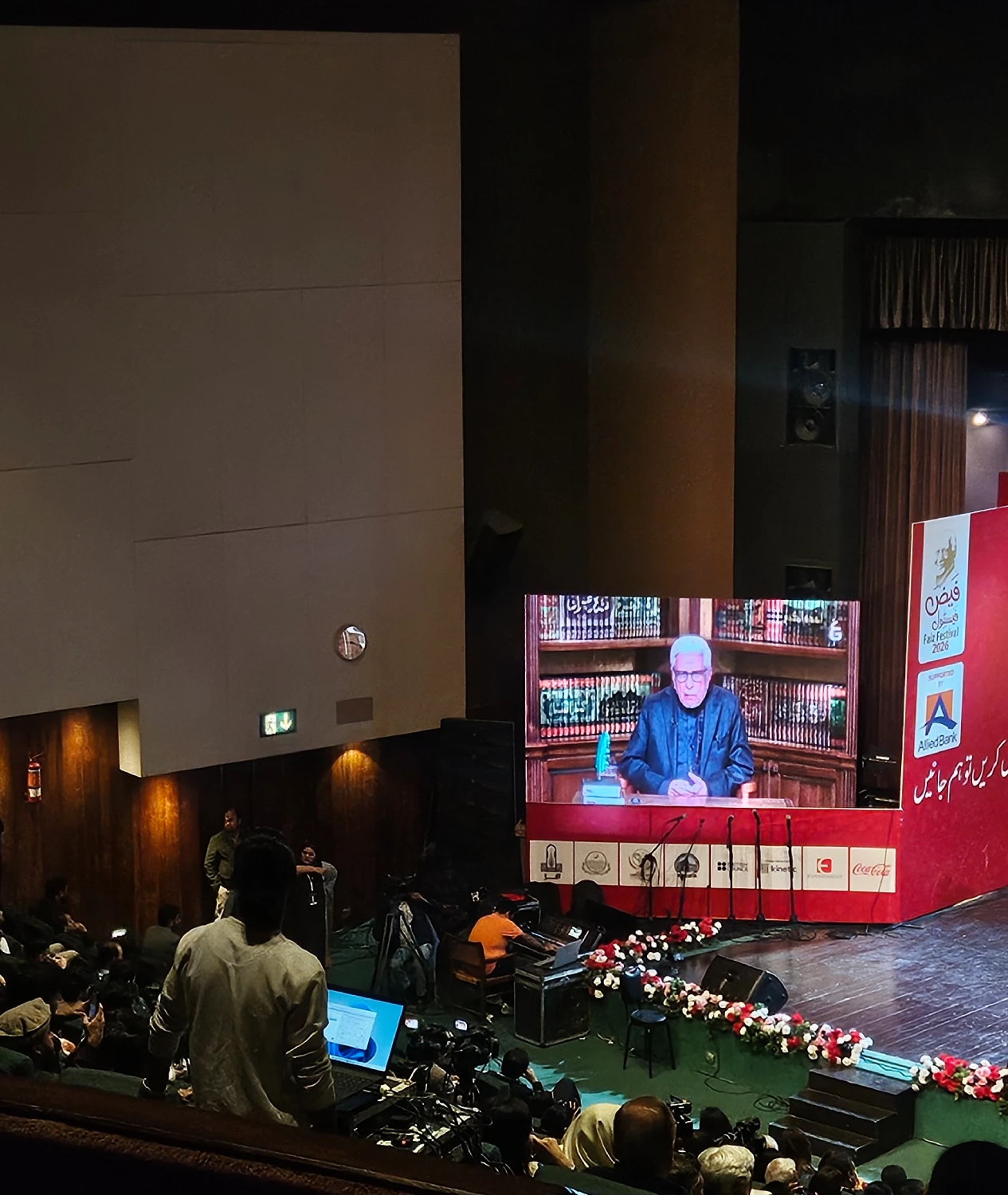
Although Ghamidi is perceived to be a singularly ‘liberal’ authority of this nature, that a religious scholar was at all called upon to share his thoughts on Zehra is an interesting overture, unusual to other Pakistani literary programming. If the principles that motivate a literary festival are in the same spirit as that of a literary educator or educationist, attempting to democratise access to a literature and encourage interest in its world, this is the kind of safe, but creative, measure the Faiz Fest is good at, advancing a sophisticated and somewhat diverse Urdu literary space that seems to be trickling away from New Delhi.
The festival could be more ambitious still. A session featuring Hanif talking about Punjabi satire, titled ‘Wo baat unn ko bohat na-gavaar hai’, could not have been about Punjabi satire: Hanif is not really engaged with Punjabi satire as a tradition, and his moderator seemed unfamiliar with Punjabi-humour writing. Generally however, in the strictly followed 40-minute discussion times for panels, speakers did deliver knowledge of immense quality and depth throughout the weekend.

Rana Saadullah Khan is a writer from Lahore and Islamabad. His work has been published in Lakeer, Jamhoor, The Aleph Review, as well as through UNESCO Pakistan and by the history education platform, Hashiya.