The ninth iteration of Afkar e Taza ThinkFest — an academic and policy focused festival, which aims to bridge the gap between academia and society — took place in Lahore over the weekend (23–25 January). The programme this year featured a mix of panels discussing both local and international law, media, finance, climate change and many pertinent book launches. There, more importantly, seemed to be a strong undercurrent theme of resistance that I was especially drawn to and sought out to pursue over the three-day festival.
On the first day, I had the pleasure of sitting through Mohammed Hanif and Professor Shaista S. Sirajuddin’s “Literature as Resistance”, panel where both panellists discussed the importance of fiction (and poetry) in trying times, what resistance means to each of them and a brief foray into Hanif’s books and how he resists both on and off the pages.
“Poetry makes nothing happen,” Sirajuddin quoted W. H. Auden, and talked about how instead it is a ‘slow drip’ that works itself into people’s bloodstreams and awakens them to ‘more’. That it was far more potent than any other call. On the other hand, they also talked about the cost of such resistance; mentioning Junaid Hafeez and Imaan Mazari, both incarcerated on the basis of their words, and the backlash Hanif himself faced upon the Urdu translation of his novel A Case of Exploding Mangoes.
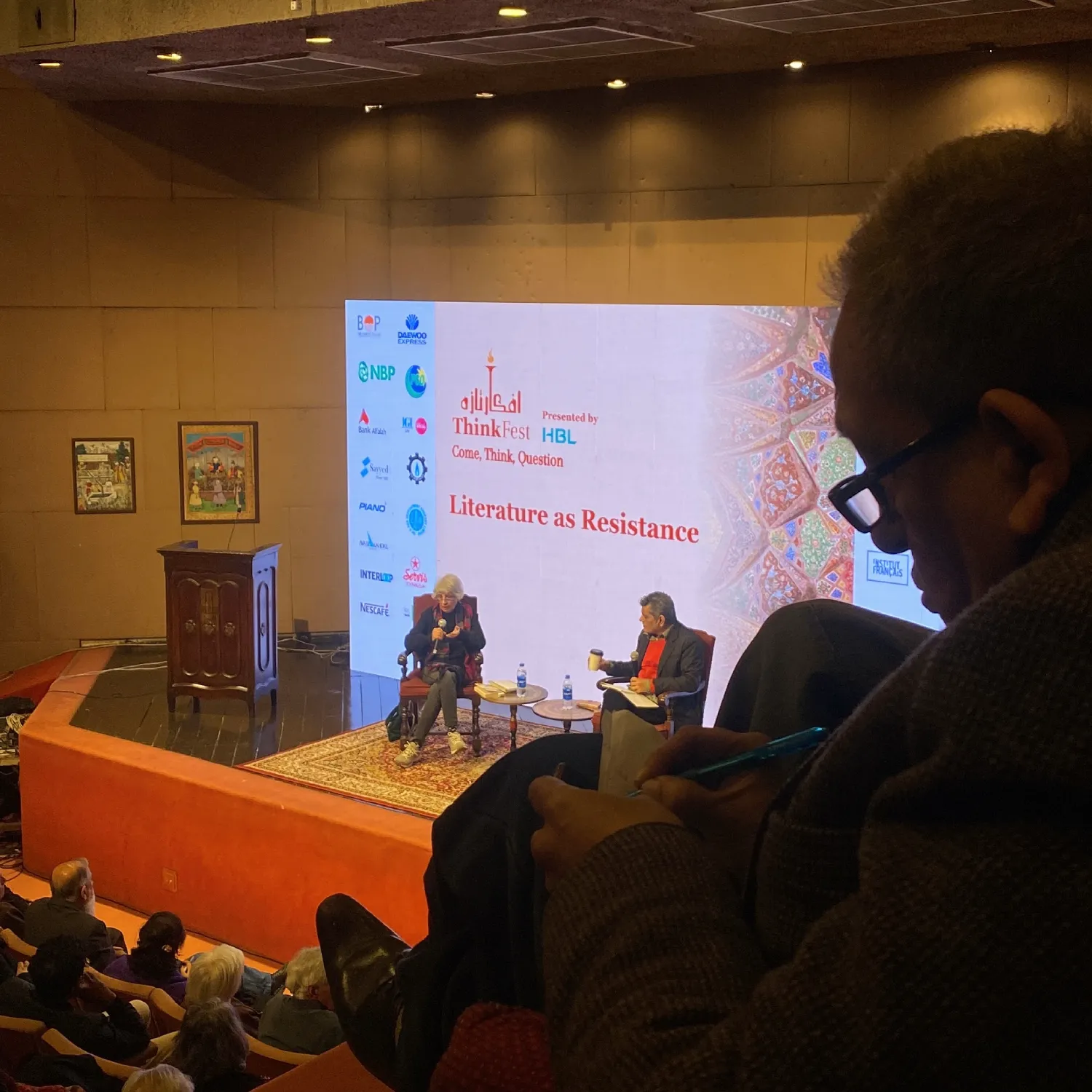
Here, Hanif took a moment to detail how language itself also takes a form of resistance when it is held onto in a landscape that is actively trying to push it out, i.e., in this case, the refrain from Punjabi, both in writing and speaking. Having grown up in Okara, and graduating from a ‘military education’, he talked about being mentored (he mentions his teacher Razia Bhatti) on how to tell a story instead of looking for a particular story to tell. This also included emphasis on tone rather than big, flowery words; Punjabi humour is what seeps into his literary style — a form of combat, using a comedic tone to deliver otherwise somber messages.
“Desi humor is a form of satire. It only works when you’re laughing at the powerful and not at people’s accents,” stated Hanif.
Using comedy as a way to strip the oppressor of their power is also something that came up on the second day at Osama Siddique’s book launch for his latest novel, Who Knows the Bounds of Desire, titled after Noon Meem Rashid’s poem of the same name (in Urdu, “Tamanna Ki Wusat Ki Kisko Khabar Hai”). He talked about satire as dissent, detailing his personal experience in a legal court as one of a jester’s in front of a pharaoh-like figure. His book, which he stated is both a “lament and a confession”, casts a nostalgic and satirical gaze at a city that is alive and changing, along with its people. This aspect of an ‘alive’ city is one the author credits to his inquisitive and solitary nature as a young person, when he used to roam the ruins of Taxila at length in his free time.
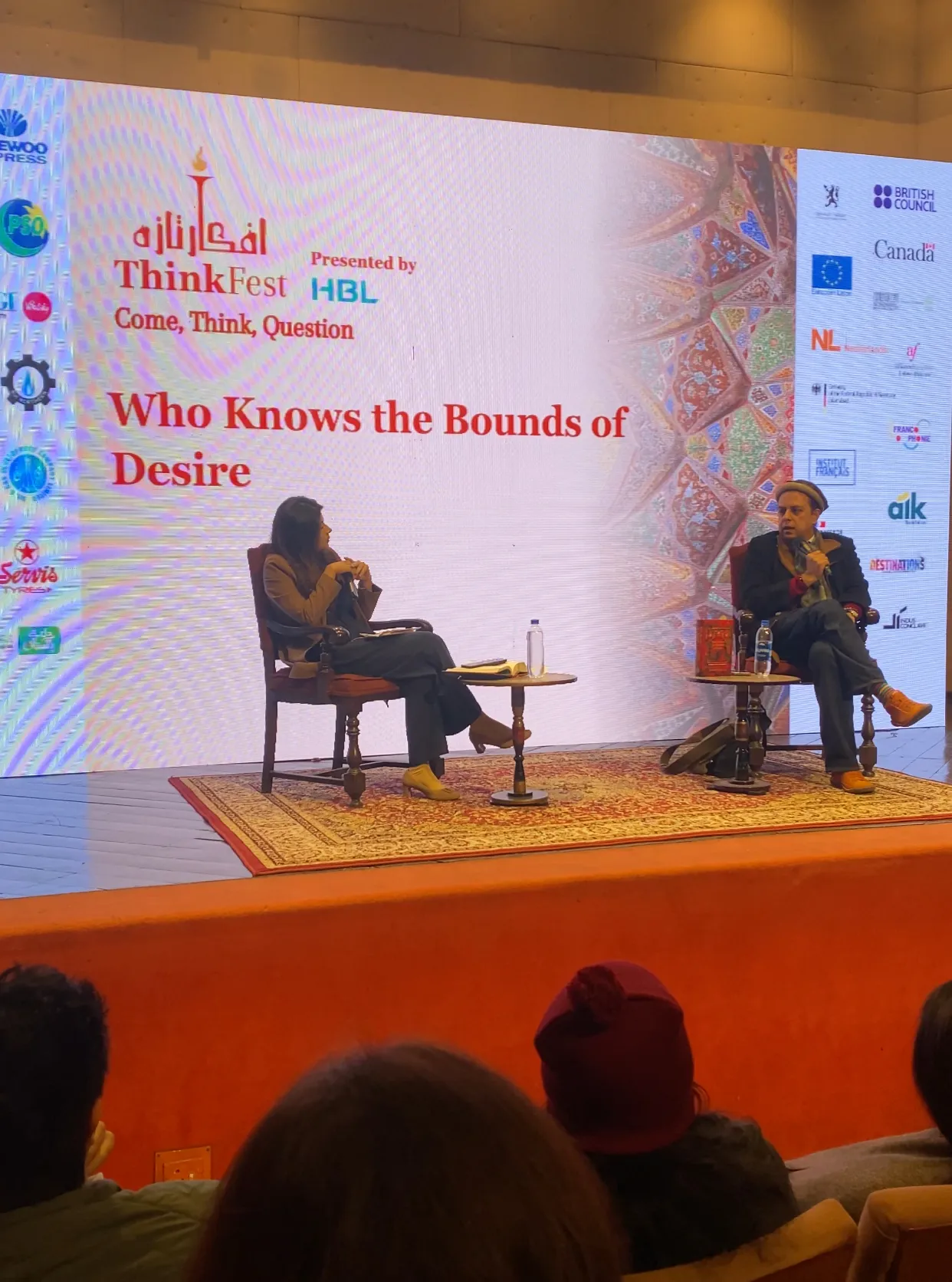
He mentioned how walking those ruins made him wonder about how an entire people and their language and history was wiped, and how one day ours might be as well. In parallel to his personal experience, he also cited Invisible Cities by Italo Calvino as a book that taught him how to look at cities in a way that he didn’t before, as well as authors he reads: Jose Saramago, Orhan Pamuk, Fernando Pessoa. He mentioned incorporating walking as a writing ritual, and that one can seek global literature [imagine not reading Homer, he joked], but must also resist it and be aware of local context and milieu, to carry on telling our stories as well.
Preservation as resistance led me to the launch of Editing Women in the Archives Handbook, a Teesside University and Pakistan Association for Women Publishers and Editors (PAWPE) collaboration, which aims to share insights into the process of obtaining and maintaining an archive of women’s literature and reflections on the challenges faced. The panellists consisted of people attached to the project and handbook; Madeline Clements of Teesside University, Mehvash Amin of The Aleph Review and Neelam Hussain of Simorgh, a women’s resource and publication centre. The panel was moderated by Hassan Tahir Latif (The Aleph Review and The Peepul Press) and joining the conversation was Dr Waseem Anwar of ICPWE at Kinnaird College for Women. Not present, but central to the Handbook are researchers Hira Azmat, Veera Rustomji, Tazeen Hussain and Mahnoor Jalal.
“This Handbook draws on the Editing Women in the Archives project team’s experiences of conducting initial archival research into ‘endangered’ women’s lifestyle, literary and art publications in Pakistan. These were mainly magazines published in the period from the 1960s to the present which we considered as at risk of being lost and in need of presentation; they included SHE: Journal for the Home and Paper magazines, NuktaArt and a variety of books, reports and manuals published by Simorgh,” states the introduction to the Handbook which was available, free of cost, at the launch.
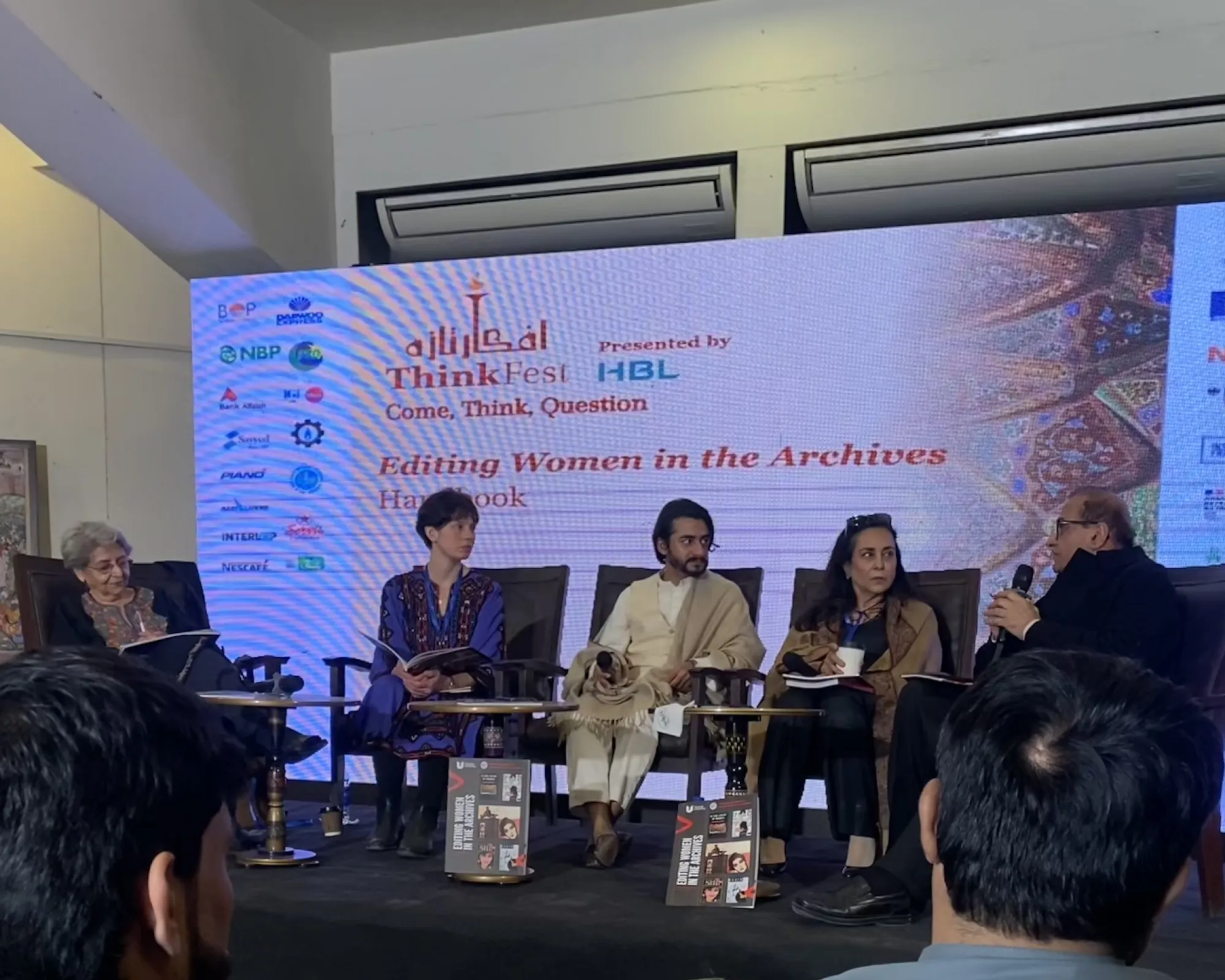
The panel emphasised the importance of archiving, where Neelam Hussain shared personal anecdotes from her time at Simorgh during the Women’s movement, mentioning Trinjin, a publication that disseminated updates on women’s rights, daily news and more. Along with Mehvash Amin, she also talked about the beginning of the women’s publications era where women’s reading material was seen as ‘fluff’ and considered insubstantial, while publications like Trinjin existed in tandem.
To incorporate both political manifestos and ‘sandwich’ them between fluff ([which is also necessary) could be seen as a sort of ‘sleeper cell’ activation of the consciousness, joked one of the panellists. Madeline Clements talked us through the Handbook, as well as the initial Editing Women in the Archives project, and Hassan Tahir Latif emphasised the importance of archiving, particularly for “newer, younger creatives who are divorced from the past” as an invitation to collaborate and gain access, as well as a source to look up to. The panel ended on the open call for the Handbook — a QR code leading to the website for submission of anything that is worth archiving and preserving. “[Aside from resistance material and material from the marginalized] There is a certain cadence that also needs to be preserved,” Neelam Hussain said as she recounted an instance of her coming across her grandfather’s letters to her grandmother. “Do people even feel, let alone talk, like that anymore?”
It is this cadence and its preservation that led Ghazi Taimoor to create Lahore Ka Ravi — a collective that popularised heritage content and walks on Instagram. He along with historian and author Sam Dalrymple and Faizan Naqvi, who heads Lahore Ka Khoji — a platform documenting the architectural heritage of Lahore in the face of rapid development — were panelists on “From Archive to Algorithm: Telling Lahore’s History Today” an insightful and immersive discussion, moderated by Zoe Richards, on the last day of the festival.
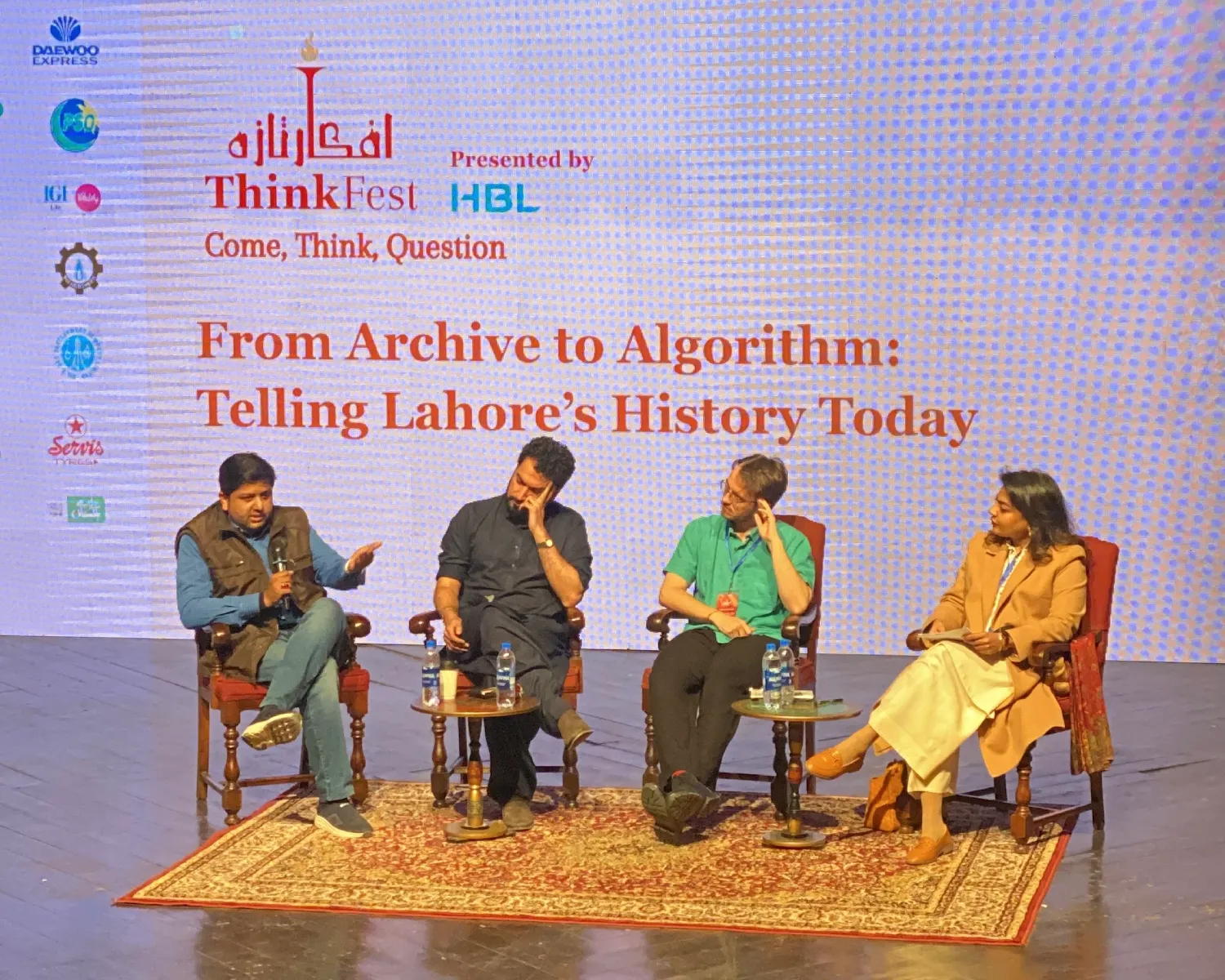
“Close your eyes and recall Lahore. Was what you saw a photo, a memory you have, or something you saw on a screen?”, Zoe asked the audience as an opening prompt. The panel covered everything from the loss of the ‘cadence’ or rhythm of the city’s heritage due to lack of preservation, the blurring of lines between archive and algorithm due to the popularisation of it (which both Ghazi Taimoor and Faizan Naqvi argued had made history more accessible to people), and how depth is conveyed in a time of shorter video durations and attention spans. I found the topic was in a similar vein to the city’s storytelling aspect Osama Siddique had spoken of the day before at his panel, and the point of accessibility and archiving the panellists at the Editing Women in Archives panel had emphasised earlier that day. All panellists seemed to have a unanimous point of view when it came to the reason they did what they did — it was home, they grew up in Lahore (in Sam’s case, right across the border in Delhi) and that the city was a part of their DNA.
“We must tell our stories, before someone else does,” said Ghazi Taimoor. There was also an emphasis on the community aspect of sharing heritage, especially heritage walks, as it brings together people who also feel an affinity for the city’s and its people’s stories. I couldn’t possibly transcribe the buzz and the warmth of the session as panellists took to sharing their personal stories, but I can report that the hall was alive with loud, but polite, acknowledgements of certain anecdotes, shared sentiments and even complaints of the city’s chaos.
Whether through language, through preservation and maintenance of archives, through upholding and traversing of spaces which urbanisation — of both places and peoples — seeks to omit, resist, resist, resist seemed best to summarise my experience at ThinkFest 2026.
Ayza Khan is a business school escapee, currently pursuing her dream of working in publishing. For more of her book takes, find her on Instagram: @ayzonbooks.