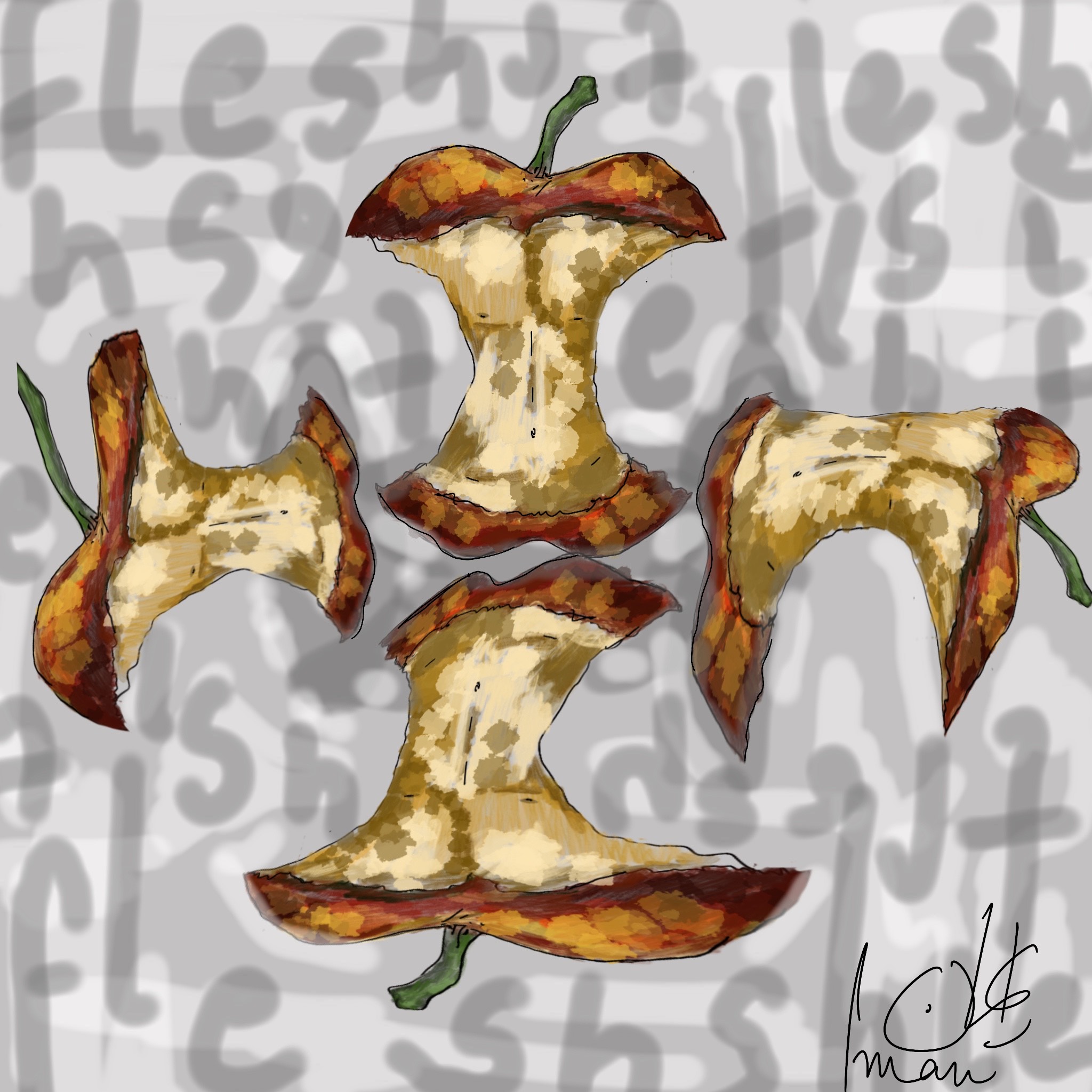
Everywhere the psychoanalytic is on the rise — it has come alive in flesh. The repressed, or rather the suppressed, is returning, just ask Amia Srinivasan. István, a Hungarian man of about 52 years, is a symptom. Or is Szalay the issue? Dua Lipa seems to like the author and politics from a pop icon at a public library is the best this epoch has thrown up, so naturally, I follow suit. Laudatory reviews aside, what is it about a brooding male hero, victim to primitivity and the pressures of the economy, that makes everyone yearn? Must we always be left wanting of men?
In his most recent — now Booker winning — novel, David Szalay has given the man-of-few-words a new lease on literature. István marks the comeback of the taciturn hero; reminiscent of the protagonist of a Camus or even Melville, but adapted for the 21st century ‘short attention span’ reader. This apparently means that the author, as his hero, can get away with saying very little.

Flesh opens with a 15-year old István living in a colourless flat with his mother in some urban township in Hungary. We quickly move through disparate phases in his life before entering a more continuous narrative of his later years: an inappropriate relationship with his “old” and somewhat “ugly” next door neighbor that meets an unfortunate end and a stint in juvie, a few “years” in Iraq and some therapy for PTSD, an undefined move to London, a long stretch in security and then a decade or so of reaping its magnanimous fruits…until naught. The plot is primarily driven by sex and money, although István encounters most of both largely by happenstance. And despite a presumed toughness — he was, after all, a security guard — he is repeatedly subject to the unreasonable demands of others, or perhaps to some unnamed aspect in himself. Yet acknowledging this failure to name should not be confused with taking accountability, a distinction that both István and Szalay fail to observe. However, I am getting ahead of myself.
In his most recent — now Booker winning — novel, David Szalay has given the man-of-few-words a new lease on literature. István marks the comeback of the taciturn hero; reminiscent of the protagonist of a Camus or even Melville, but adapted for the 21st century ‘short attention span’ reader.
According to Szalay, the novel is about two things, both somewhat autobiographically inspired: (1) the experience of living between two places (in this case Hungary and London, and feeling untethered in both) and (2) human beings and especially men’s culpability to the whims of the physical. Neither of these aims are overtly evident in the text, but Szalay has reputedly been one to rely on the unspoken. Per the writer, “What happens in the gaps is as important as the chapters themselves.” And while I can appreciate textuality, at times the gaps leave too much unsaid.
For instance, in a book concerned with London and Hungary, István’s immigration from Eastern Europe amid a quickly changing E.U. is scarcely discussed. It surfaces only in a snide remark, quickly followed by a throwaway apology from an older English woman during a dinner with a minister that István is attending to secure fast-track approvals for his construction company-cum-laundering scheme.
And can we discuss his time in Iraq?
There is a brief moment of guilt over the death of a fellow soldier, but one of the most gruesome wars of the century makes an appearance in Szalay’s novel merely to propel the portrayal of personal trauma. The impersonal political aside, the loss of multiple lives of his loved ones and in some senses István’s own, is bypassed.
What about the male body, though? The actual or alleged protagonist of the work. For a book about flesh, the physical body is rarely described, neither István’s nor that of his lovers. What is often relayed is an unstable control over desire, driven first by the muscular, impulsive urges of a growing boy groomed by a sceptical character, later by a more regulated — though still volatile — adult impulse, evident when István’s boss-turned-wife’s friend offers him a spliff and he momentarily wants to “fuck her there and then”, but opts not to. István does not know himself or his desires. They are not stored in the mind, but lodged in the ambiguous fleshiness of his physical being. It is as if his body, nay himself, is another. As Badiou wrote quoting Rimbaud, “Infinite alterity is quite simply what there is. Any experience at all is the infinite deployment of infinite differences. Even the apparently reflexive experience of myself is by no means the intuition of a unity but a labyrinth of differentiations…I am another.” If the goal is to make the reader feel as István ‘maybe’ does, Szalay succeeds in producing alterity at multiple levels, including an unsettling sense that as reader one does not fully know the text.
For a book about flesh, the physical body is rarely described, neither István’s nor that of his lovers. István does not know himself or his desires. They are not stored in the mind, but lodged in the ambiguous fleshiness of his physical being. It is as if his body, nay himself, is another.
There is a male loneliness epidemic, or so I am told. Who are its victims? Everyone. In Flesh, too, so much is casualty to István’s choices or lack thereof, and somehow none at all. The appeal of the psychoanalytic is clear here: it offers an alibi. If desire originates in the flesh, if action is merely the superficial effect of deeper impulses, then accountability can always be deferred. Man does not choose, but is chosen by his body, his past…the incoherent self. Szalay provides this logic once, and tellingly, “All that burgeoning physicality is held within yourself as a sort of secret, even as it is also the actual surface that you present to the world, so that you’re left absurdly exposed, unsure whether the world knows everything about you or nothing, because you have no way of knowing whether these experiences that you’re having are universal or entirely specific to you.” All one knows is that one does not know. One may benefit, however, from recalling that men’s professed inability to grasp their own desire is how we arrive, again and again, at the present moment.
A reader might suggest that István’s refusal of interiority is a comment on late-capitalist affective flattening, or that Flesh instead offers a clearer view of neoliberalism in action, with personal pathology elevated to the centre and yet yielding little insight. It could even be argued that the novel stages the erosion of responsibility rather than excuses it, but this distinction ultimately proves difficult to sustain. The more pressing question, anyhow, is not whether Szalay has captured male disorientation, but why such disorientation is received as depth. Ellipsis may gesture toward meaning, but it ought not replace it.

Iman Iftikhar is an MPhil in Political Theory at the DPIR at Oxford. A Rhodes Scholar from Pakistan, Iman did her undergraduate degrees in History and Philosophy from Yale University before joining Oxford. As an MPhil student, Iman works on critical theory, history of political thought and postcolonial feminism(s) with a focus on South Asia. She is also the Chief Editor at South Asian Avant-Garde (SAAG) magazine and a returning fellow at Kitab Ghar Lahore.