Mash Hasan turns from the manger, chewing on hay, his face worn and heavy. “I am not Mash Hasan. I am Mash Hasan’s cow.” In Dariush Mehrjui’s The Cow (1969), this moment signals the total collapse of self, and the villagers respond with palpable fear, eyes wide in the stable at this uncanny horror. The village is no stranger to madness: the film opens with its own “village idiot,” a young, lanky man with a cognitive disability, untethered by family, thrown into a pond, chased by children with flaming torches. Reduced to a pronoun, the boy has no name.
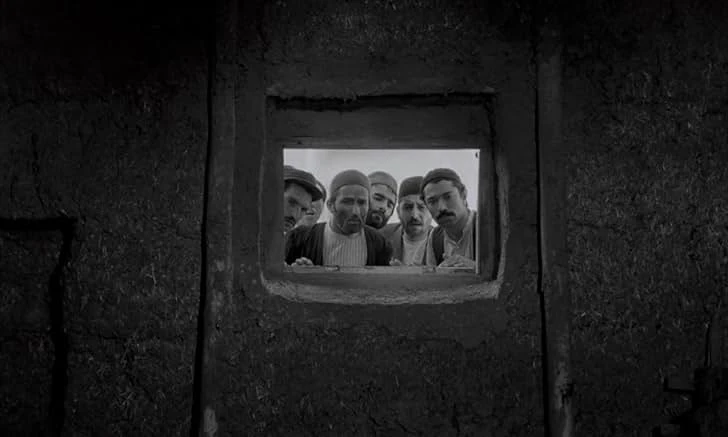
Mash Hasan’s madness, by contrast, is ambitious. He renounces his identity as a human, a man, a man of social standing, to inhabit the form of an animal, a woman, a pregnant woman, a laboring body. The source of fear is not madness itself — for life may continue unchanged, allowing madness to persist unnoticed — but transformation. In Mehrjui’s vision, terror arises when the familiar order is ruptured.
Is The Cow a premonition of the Iranian Revolution? Not exactly. It predates the Shah’s overthrow by a decade. Yet it stages a revolution of some visceral sort.
Mash Hasan loves his cow, the only cow, pregnant, vital to the rhythms of a village of shadow walkers who gossip, sip tea, and linger by the pond. The village is compact, its walls short, thick, and whitewashed, framed for the camera with a deliberate austerity. On the horizon, lurk three foreigners, real or imagined, spectral. At night, the villagers believe, they steal, and what they cannot steal, they kill.
When the cow dies under mysterious circumstances, Mash Hasan mourns with a singular intensity: he begins to eat her hay and sleep where she slept. The villagers, who initially tell him that the cow ran away, watch with mounting horror.
The Cow was among the first films to receive funding from the Ministry of Culture and Arts, yet the Shah objected to its portrayal of an impoverished nation, peopled by superstitious villagers. In 1971, the film was smuggled to the Venice Film Festival, where it won the FIPRESCI Prize. After the Revolution, it was reported that Ayatollah Khomeini considered the film so significant that he refused to impose a ban on cinema.
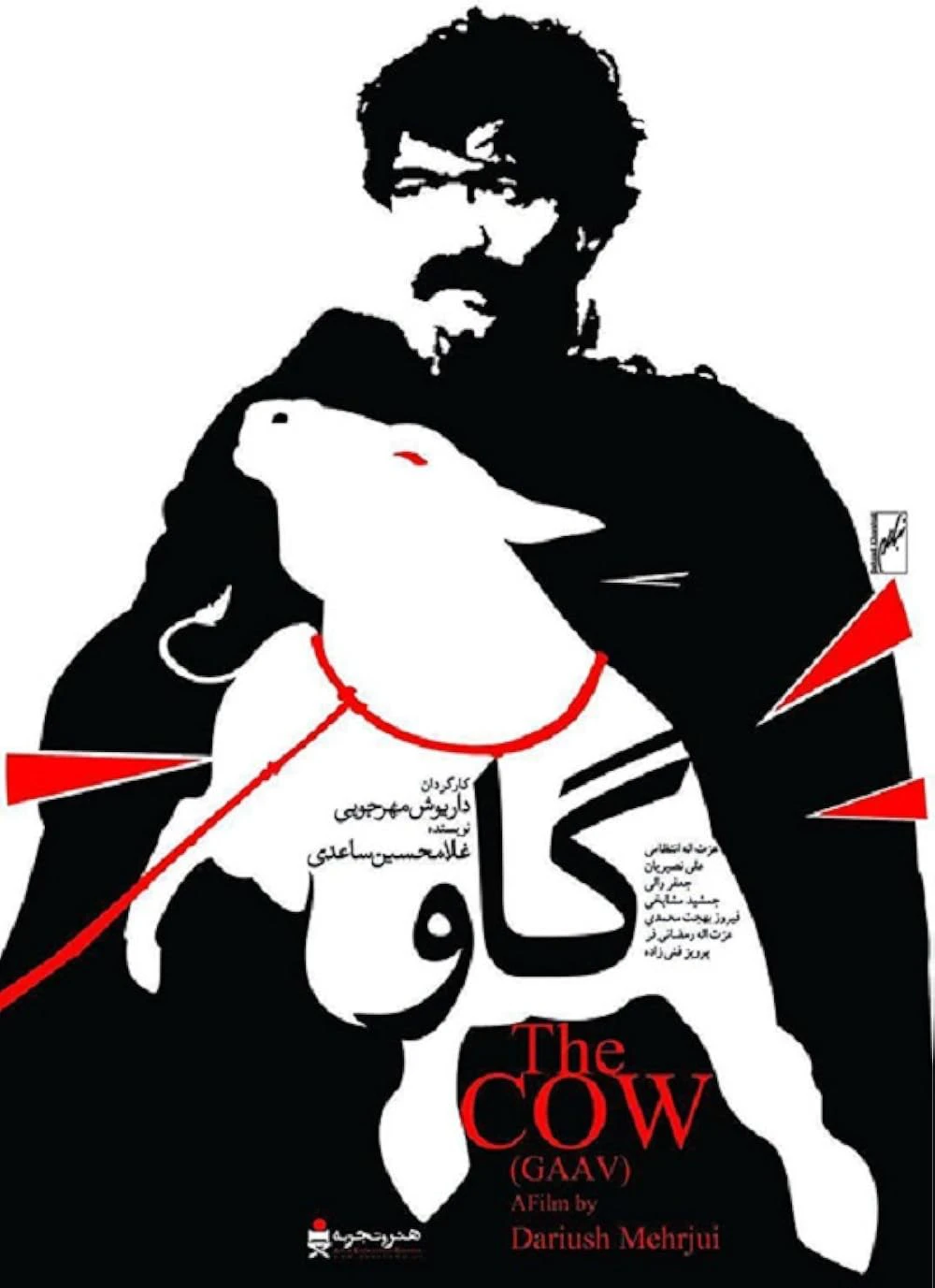
It is no coincidence that The Cow was written by the prolific leftist writer Gholam-Hossein Saedi, adapted from his own short story. Saedi, formerly a member of the communist Tudeh Party of Iran, had been imprisoned and tortured by the Pahlavi regime’s secret police, SAVAK. Yet, as with many revolutionaries who had fought the Shah, the Islamic Republic continued its assault on progressive artists and writers. Fearing for his life, Saedi fled to Paris shortly after the revolution.
After the Revolution, it was reported that Ayatollah Khomeini considered [Mehrjui’s The Cow] so significant that he refused to impose a ban on cinema.
Mehrjui, who had supported the Pahlavis’ overthrow, made The School We Went To (1980), his first film after the Revolution. Although financed by the government’s education ministry, the film’s release was halted after its initial screenings, presumably because censors saw the tyrannical high school principal as a thinly veiled reflection of the clerics now in power.
Perhaps no clearer lens exists through which to apprehend Iran’s complexity than the contrast between its pre- and post-revolutionary cinema, a cinema in which Mehrjui was a defining voice. In recent decades, Iranian films have become celebrated for their devotion to the quotidian. Confronted with the Islamic Republic of Iran’s exacting censorship, banning the depiction of women’s hair, for instance, or any critique of the state, filmmakers have forged an astonishingly inventive cinematic vocabulary, turning constraint itself into a source of imaginative possibility.
In the age of Letterboxd and Criterion cinephilia, one might argue that filmmakers from Abbas Kiarostami and Majid Majidi to Asghar Farhadi and Jafar Panahi boast far more visually striking filmographies than Mehrjui. Previewing a retrospective of his films in 1998, American critic Godfrey Cheshire observed, “Mehrjui deals regularly, knowingly, and provocatively with Iran’s middle and upper-middle classes. His characters drive BMWs, wear chadors that are distinctly chic, and argue (endlessly) over art, religion, divorce settlements, and real-estate deals.”
This is evident in his 1990 psychological drama Hamoon. Whereas The Cow is haunting — its tense close-ups and expansive full shots making roofs of the sky and walls of the horizon — Hamoon trades this stilted intimacy with space and expression for the neurotic and the absurd.
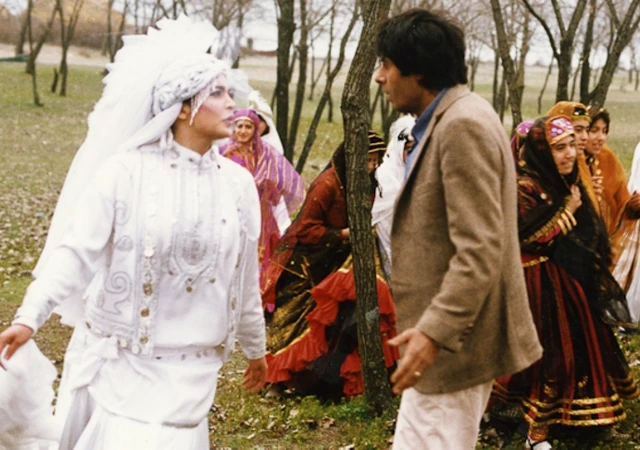
The film follows Hamid Hamoon, a bumbling, narcissistic PhD scholar, in the throes of a divorce from his wife, Mahshid, a mercurial artist from an upper-class family. Through flashbacks, we learn of Mahshid’s psychosis, as she tells her Western-educated psychiatrist that she wants a divorce, (“Hamoon made everything worse”), and complains bitterly about men and the Iranian Government's treatment of women. “It's common to all Iranian men to tyrannise,” the psychiatrist tells her.
Visually, the film conveys a sprawling sense of country: urban landscapes give way to mountains, vast fields, the sea, and asphalt roads, elongated by the camera from the backseat as Hamid traverses his temporary home, the court, his office, and memories of the past — all largely in search of his mentor, Ali.
That Hamoon, though seemingly more conventional and mainstream, was widely screened in Tehran and became one of the year’s most popular and award-winning films, does not mean it lacks the signature Mehrjui flair. Laden with Hamid’s absurd dreams and sudden freakouts, Mehrjui injects a darkly comic edge into his protagonist’s growing thirst for vengeance. In one gritty sequence, Hamid is sent to sell spectrophotometers to hospitals. When a doctor balks at the cost, Hamid desperately implores patients and nurses for blood, without success. At last, he collapses on the bathroom floor, plunges a needle into his own arm, and sinks into another hallucinatory dream, his blood pooling across the tiles.
Perhaps no clearer lens exists through which to apprehend Iran’s complexity than the contrast between its pre- and post-revolutionary cinema, a cinema in which Mehrjui was a defining voice.
As in The Cow, Mehrjui’s guiding principle in Hamoon is madness, running alongside a pervasive sense of anti-imperialism and disillusionment. In The Cow’s case, the film is often read as a meditation on Iran’s pursuit of modernity through the White Revolution of 1963. Mash Hasan’s village — and the death of its sole cow — offers a striking counterpoint to the reforms’ promised prosperity and progress. In effect, the cow’s death becomes the death of futurity.
As Mash Hasan begins to inhabit the cow, the villagers, stricken with anxiety, try to take him to the city for medical help. They tie him up and drag him through the rain, pushing, prodding, until he becomes an immovable weight. Leader of the group, Mash Islam, seemingly possessed, strikes Mash Hasan with a stick: “Move it, animal.” When Mash Hasan finally returns to himself, he gazes at the villagers in pure horror before leaping from the cliff to his death. As the villagers stand atop the summit, their silhouettes echo the three spectral foreigners.
Is the threat, then, born of proximity to the city? Did Mash Hasan’s cow not die when he ventured outside the village? Is the urban not the spatial apex of modernity — a modernity reasserted, remember, by the 1953 MI6- and CIA-backed coup?
Conversely, in Hamoon, this movement between village and city explodes into a network of social and economic capital across the country. Hamid, a modestly paid English professor, has no roots. His fixation on Abraham stems from his mentor, Ali; his favourite texts are Abraham in the Fire, a poetry collection by Ahmad Shamlou, and JD Salinger’s Franny and Zooey. The title of his dissertation, “Abraham’s Love and Faith,” rings hollow — he knows neither love nor faith. His mother died early, and his father was a “conservative moron,” but Hamid is not.
At work, his boss hands him a report. “Do you know what this means for us economically?” Hamid replies, “It means the exploitation of cheap labor in Third World countries.” When his boss gestures to Korea, Indonesia, Taiwan, and the promises of Sony, Hitachi, Suzuki, Hamid laments, faintly, the loss of love and spirituality. Like Mash Hasan with his cow, there is something uncanny in Hamid’s obsession with love: if the former has no future, the latter has no past. “It’s hard to say, but I never loved you,” Mahshid tells him.
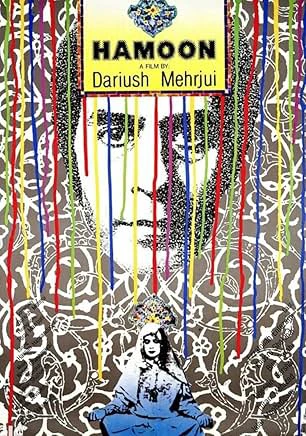
In the second volume of Social History of Iranian Cinema, film scholar Hamid Naficy emphasises the unification of lover and beloved as a recurring motif in Iranian films, reflecting the country’s mystical philosophy and poetic traditions. Both The Cow and Hamoon engage with this intertextual continuity within the broader Persian canon. Yet in post-revolution Tehran, Hamoon situates Hamid’s madness in his inability to embrace the madness of faith, as exemplified by figures like Ali and Abraham. Caught between unavailing ritual and corrosive modernity, Hamid embodies the residue of a failed revolution.
When he insists that he loves her, Mahshid snaps: “I won’t listen to your crap about unity and being one with the beloved.”
At the court, she declares loudly, “I’m talking about women’s rights. Only men have the right to divorce. Women have no rights in this society. They can never decide, even for their own divorces. Women must suffer and endure unworthy men.” Would this not have incensed the Iranian government censors?
Upon Hamoon’s release, Mehrjui told The New York Times, “Just three years ago, you couldn’t even show a musician in an Iranian film. And now you can.”
The notion of the Islamic Republic of Iran as yoked entirely to tradition is perhaps as ubiquitous as the image of a static, uniformly totalitarian regime producing perfectly incapacitated victims. The orientalism underpinning such views is scarcely concealed. Yet Mehrjui’s cinema, from The Cow through the Revolution to Hamoon and beyond, resists these assumptions, foregrounding the sorrow and resistance of ordinary lives.
Since the United States and Israel launched airstrikes across Iran in February, killing Supreme Leader Ali Khamenei, the world has seemed to split in two. In war, there is no third stance. Yet questions of a people’s freedom are only as expansive as one’s imagination or, in its absence, one’s grasp of history. The 1953 coup had already fractured Iran’s political landscape into imperialists, clerics, and leftist factions. Today, the possibility of a third, more nuanced position, appears all but erased.
The Islamic Republic of Iran has claimed an anti-imperialist mantle since its inception. Decades of cultivating the “axis of resistance” were, in large part, a response to the empire’s persistent designs on Iran’s oil. In the current moment, amid the US and Israel’s provocative maneuvers toward catastrophic conflict, the IRI finds itself, if not redeemed, then at least instrumentalised by the pressing imperative for an uncompromising anti-imperial actor, one that could, in theory, stave off the collective ruin promised by empire.
Wherever spectators locate their solidarities, Iranian cinema and its filmmakers persist in holding open the possibility of a third position, one that refuses the binaries of monarchist-imperialism and the Islamic Republic. Across the internet, critics of the war have begun to voice well-intentioned suspicions: that an insistence on “nuance,” or the refusal to choose between the regime and empire, risks enabling the manufacture of consent for war. This may well hold for those situated within the empire, for whom proximity to the US–Israel axis of disorder narrows the space for ambivalence.
For many dissenters across the Global South, however, nuance may operate differently, not as equivocation, but as an opening toward solidarities that exceed the imperatives of borders. If anything, the present political condition — of broadcast genocides, presidential abductions, and the grotesque theatrics of a Zionist “peace” — suggests that public opinion itself may no longer be the decisive terrain of struggle.
It is perhaps in the lives of filmmakers themselves that this third position becomes most legible. In February, Jafar Panahi announced he would return to Iran after Oscar season, despite the risk of arrest. Sentenced in absentia in December 2025 to a year in prison for “propaganda activities” against the state, Panahi always returns to Iran: “It is my country. Half of my being is in Iran.”

Manahil Tahira is a Karachi-based journalist and writer whose work moves between fiction and nonfiction, tracing the intersections of bodies, spaces, visuality and technology. Formerly desk head of Lifestyle at The Express Tribune, their creative writing has appeared in Arzu Anthology, Fahmidan Journal, Lakeer, and is forthcoming in The Aleph Review (2025). They are also a Non-Fiction Editor at South Asian Avant-Garde (SAAG) magazine.