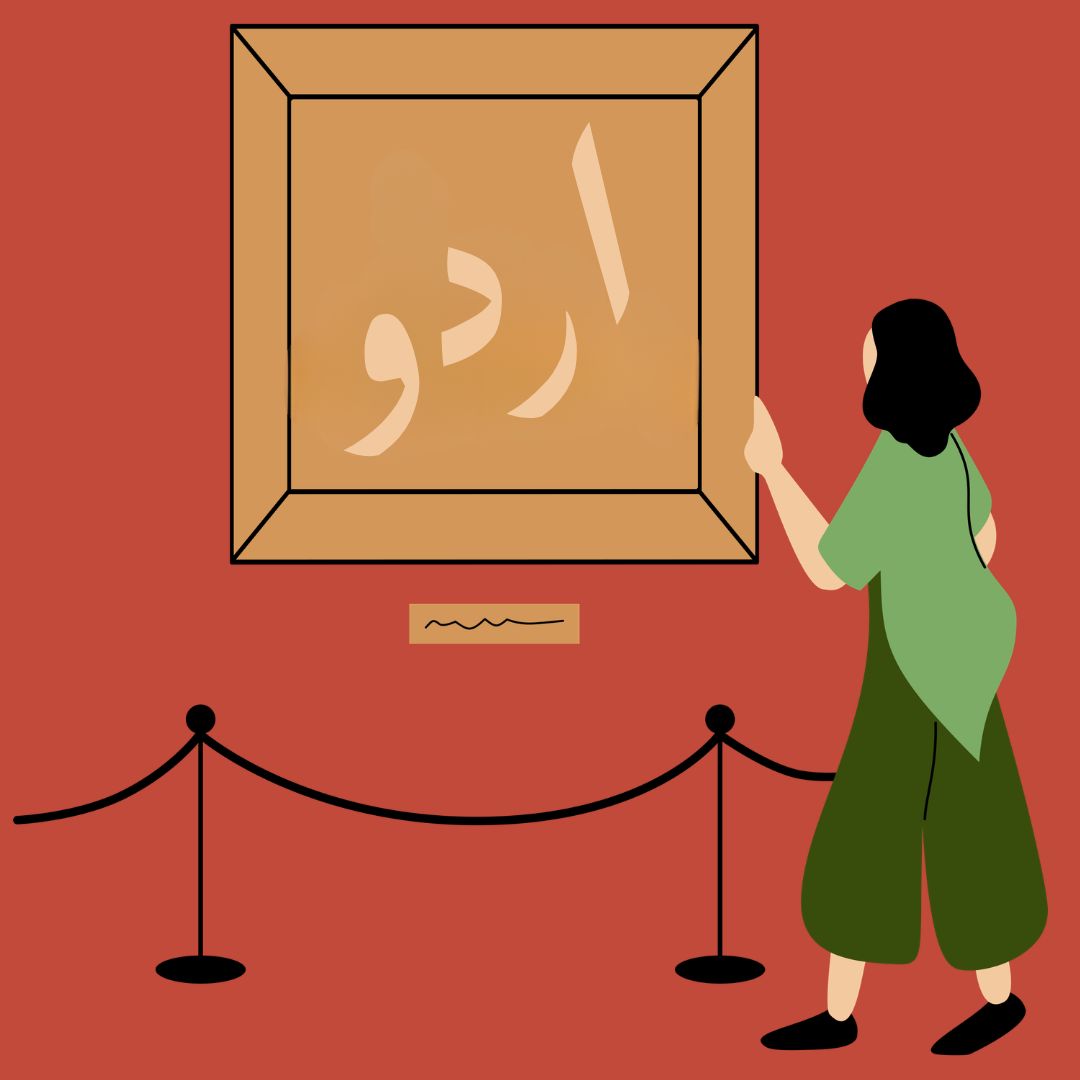
In the May/June 2026 CIE ‘Easy Urdu’ exam, students were reportedly stumped by a seemingly simple translation: ‘ajaib ghar’. Most students, despite ostensibly being native speakers of the language, did not know the answer to this. Within hours of this linguistic debacle, memes appeared online, with students poking fun at their own ineptitude. But beneath the humour lies a more unsettling story: have we really strayed so far from our own language that even familiar words have become foreign to us?
Ajaib ghar is not a word far removed from colloquial use. In fact, the irony is that it means “museum”. It is worth asking how a language we once fought for has itself become a relic to us: an artefact from the past, vaguely revered but no longer fully understood. “Even though it is the language of our history, our prose, poetry and fiction, students no longer feel that their identity is tethered to Urdu”, said an Urdu teacher I spoke to. In our conversation, I learned that the decision to enrol students for Easy Urdu/Urdu as a Second Language does not originate from the school board itself, but from the parent body. Stripped of its rich culture and literature, the language becomes simply “a vessel carrying students through their CIEs, another subject for them to suffer through”.
While she said that English-medium private schools certainly weaken students’ connection to Urdu, the deeper influence comes from the home. It is not so much an emotional disconnect from the language as it is a practical one. Parents aspire to send their children abroad and as such, feel that the verses of Ghalib or the Diwans of Iqbal are not necessary brain fodder for an already overstimulated student population. The students I spoke to agreed that this shift began at home, with parents encouraging them to read, speak and imagine themselves primarily through another language. “I love to read but I have never read a book in Urdu. No one ever encouraged me to, at home or in school,” said one of the students.
The teacher said she had noticed a disheartening shift over the course of her career where the value of education had been lost and it was now only seen as a means to an end. This utilitarian ideology raises uncomfortable questions: if there is no immediate “need” for Urdu in the global economy, why must it be studied? And ultimately, what is, then, the purpose of education? Are the expansion of our intelligence, the knowledge of our culture and history, and the growth of our intellect no longer worthy goals?
This separation from our language extends beyond just the classroom. Consider the linguistic landscape of our cities. In Lahore, for example, signage around the city promotes a tilted sort of bilingualism. Although it is the supposed national language, Urdu takes a backseat to its co-official and more commercially palatable counterpart, English. Cultural institutions, public spaces, billboards, restaurants and brands often identify themselves in English.
When Urdu is used, it is favoured more as an aesthetic marker, an empty symbol of culture or history and less as an actual communicator of a brand or institution’s ethos or message. For example, the Lahore Museum clearly identifies itself as a ‘museum’ in block letters and an ‘ajaib ghar’ a few panels lower. Similarly, the Lahore Zoo features its English name in Hollywood style letters at the first entrance whereas the Urdu signage appears at the back entrance on a poorly designed flex, more afterthought than announcement. It is not that Urdu is entirely erased from the public eye – advertisements still heavily rely on Urdu taglines and catchphrases to retain viewers’ attention, but these are often rendered in Roman script. It is almost as if Urdu must be repackaged to be digestible to an imperialistically inclined audience who have become strangers to a creature of their own making.
The split between a language and its native script is an unusual fracture, perhaps an unforeseen by-product of living in an attention economy where readability supersedes authenticity. What began as a phonetic transliteration developed for ease of communication via text or social media is now scattered across the cityscape as yet another reminder of how deep the disconnect really is between Urdu and its people. According to linguist Hijaz Naqvi, this is part of a larger civilisational decline: “Intellectual slavery to the English has made our outlook utilitarian. If people’s communicative needs are being met with Roman Urdu, what need is there to learn the complex Nastaliq script?” When asked if he thinks this may reflect the death of Urdu he said, “The language is doing the job of keeping itself alive while we have reduced it to a mode of communication and not a tool of self-expression as it once was.” But perhaps the death of a language does not always look like silence, maybe it begins when the language can still be spoken, but no longer felt. The writing is on the wall, but it seems we have lost the ability to read it.
It remains unclear whether this is what our linguistic identity must look like in a globalised world, or whether it is a devolution of the self: a slow thinning of language until it can still communicate, but no longer carry memory, culture or feeling. The students I spoke to echoed Naqvi’s argument by telling me they “think” in English, which explains their inability to articulate efficiently in Urdu. It is hard to express yourself in a language that you are cognitively disassociated from. While they still consider it part of their identity, they bear no real lived relationship with the language.
This is not simply a consequence of being educated into a system that teaches our own mother tongue to us as a ‘second language’ but also a sustained lack of interaction with Urdu in private and public spaces. When confronted with ‘ajaib ghar’ in their exam, students felt embarrassed about not knowing what it meant. Of the ones that did get it right, one had recently done a practice essay with the word while the other recalled its meaning from an earlier school lesson – neither of them had engaged with the word in colloquial conversation. Many mistranslated the word to ‘haunted house’. While that may be factually incorrect, they may have stumbled onto a deeper truth: perhaps we are stuck in a haunted house, but instead of ghosts, it is our ancestors speaking to us in a language we no longer understand.

Misha Anwar is a writer and photographer whose work examines the intersections of identity, power and memory. She writes from Pakistan.