The China-Pakistan Economic Corridor, now a flagship project of Beijing’s Belt and Road Initiative, represents the latest chapter in what both countries describe as their ‘all-weather friendship’. Yet, the foundations of this strategic partnership were laid not in Beijing nor Islamabad, but in a humid conference hall in Bandung, Indonesia, in April 1955. There, amid the post-colonial fervour of the Afro-Asian Conference, Chinese Premier Zhou En-lai and Pakistani Prime Minister Mohammad Ali Bogra held two private meetings that would fundamentally alter the geopolitical landscape of South Asia. What emerged from those conversations was a mutual understanding between two countries with seemingly contradictory positions, one that would endure through Cold War vicissitudes and regional upheavals for decades to come.
The Conference That Changed Asia
The Bandung Conference emerged from a world in profound transition. The vast European empires that had dominated global politics for centuries were collapsing, and across Asia and Africa, newly independent countries were finding their feet. Most of these states were not communist (only North Korea, North Vietnam and China fell into that camp), but were instead governed by nationalists embracing various permutations of socialism, liberalism and anti-imperialism. Against this backdrop, five prime ministers — from India, Indonesia, Burma, Pakistan and Ceylon — met in April 1954 and decided to convene a conference of Asian and African countries in Bandung a year later. Neither the Soviet Union nor Western powers were invited, reflecting the emergence of what would become the Non-Aligned Movement.
The Bandung Conference convened against this backdrop of a rapidly decolonising world. Twenty-nine leaders gathered in Indonesia between April 18–25, 1955, representing what was then called the ‘emerging Afro-Asian world’. For newly independent Pakistan, co-sponsoring this conference represented an opportunity to establish itself as an important voice in Asian affairs. Mohammad Ali Bogra arrived with what he termed an ‘open mind’, accompanied by diplomats Nawabzada A.M. Raza and Agha Shahi, both known for their sympathetic views towards China.
For China, Bandung represented something more urgent: a chance to break out of diplomatic isolation. By 1954, the People’s Republic had few international contacts beyond the socialist camp. The United States had constructed an elaborate containment architecture around China’s periphery: SEATO in Southeast Asia, various bilateral treaties and a string of military bases. Pakistan sat squarely within this American alliance system, having signed defence agreements with Washington. On paper, Pakistan and China were on opposite sides of the Cold War’s defining divide.
The Bandung Conference emerged from a world in profound transition. The vast European empires that had dominated global politics for centuries were collapsing, and across Asia and Africa, newly independent countries were finding their feet.
Chinese Premier Zhou En-lai came to Bandung with instructions from a Politburo meeting personally presided over by Mao Zedong: seek unity, avoid polemics and present a moderate, reasonable face to the world. According to Huang Hua, who served as press secretary for the Chinese delegation, Bandung was conceived as ‘a major counterattack’ against American policies of hostility and isolation.
The Private Meetings
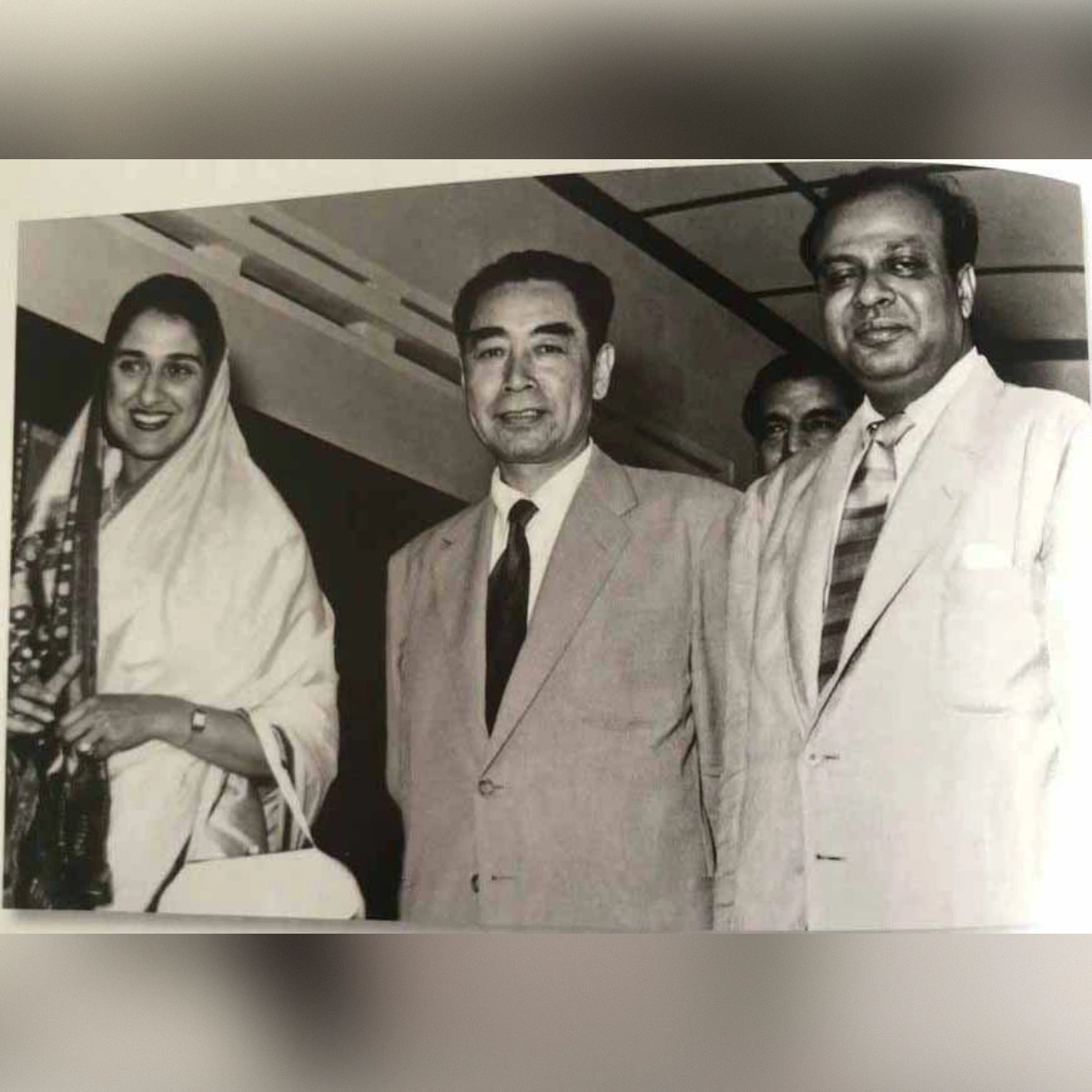
Raza arranged at least two meetings between Bogra and Zhou during the conference. These were the first encounters between the top leadership of both countries since diplomatic relations had been established in 1950. What transpired in those conversations would prove remarkable for its candour.
Bogra explained to Zhou that Pakistan’s entry into Western military alliances was driven entirely by the security threat it faced from India: the raison d’être was Kashmir, not communism. Pakistan harboured no hostility towards China, Bogra assured Zhou. More reassuringly for China, he promised that if the United States launched aggressive action under the military treaties or initiated a global war, Pakistan would not participate, just as it had stayed out of the Korean War.
Zhou appeared satisfied. He took the unusual step of reporting Bogra’s private assurances to the Political Committee of the conference itself, effectively testing the Pakistani leader’s sincerity by making the commitments public. “He told me that although Pakistan was a party to a military treaty, Pakistan was not against China,” Zhou told the assembled delegates. “Through these explanations we achieved a mutual understanding. This creates agreement and harmony among us in understanding each other on collective peace and cooperation.”
Bogra passed the test. He rose and publicly confirmed his private assurances to Zhou. Upon returning home, Bogra told reporters, “I am anti-Communist but I do realise that China has its own problems, some of which may have been solved by Communism.”
The Bandung Conference became the starting point of the Sino-Pakistan entente cordiale.

Building on Bandung
The months following Bandung witnessed an acceleration of bilateral engagement. A series of visits by politicians, parliamentarians, lawyers, industrialists, writers, artists, public officials and religious scholars took place between the two countries. Among the most important was the ten-day visit by Madame Soong Ching Ling, Vice-Chairman of the PRC, to Karachi, Lahore and Dhaka. The reception she received was extraordinary. Pakistan’s prime minister, foreign minister and other dignitaries personally met and saw off the delegation at the airport. British declassified documents noted that the treatment accorded to Madame Soong was warmer and more lavish than that given to American dignitaries, despite Pakistan’s far more cordial official relations with Washington.
The British High Commission in Karachi reported back to London: “It seems from the tone of Madame Soong’s public statements that Chinese policy at present is to try to woo Pakistan with words of sweet reasonableness. In this she was pursuing the path set down by Chou En-lai at the Bandung Conference.”
Bogra explained to Zhou that Pakistan’s entry into Western military alliances was driven entirely by the security threat it faced from India: the raison d’être was Kashmir, not communism. Pakistan harboured no hostility towards China, Bogra assured Zhou.
Economic ties began to deepen as well. Trade between the two countries had averaged $30 million since 1950, with China purchasing 200,000 metric tonnes of Pakistani cotton worth $181.19 million. Chinese companies established contacts with over 400 Pakistani industrialists. At a time when the unscrupulous dumping of American cotton in world markets had damaged Pakistan’s cotton exports, which along with jute constituted nearly 80 percent of the country’s total exports, China’s purchases helped Pakistan achieve its export targets. Under various contracts, China supplied 425,000 tons of coal and 60,000 tons of rice to Pakistan, and gifted an additional 4,000 tons of rice to overcome food shortages in East Pakistan.
In October 1956, Pakistan’s new Prime Minister Huseyn Shaheed Suhrawardy visited China for talks with Zhou En-lai and Mao Zedong that covered a wide range of subjects. Mao attended a banquet in Suhrawardy’s honour, a rare gesture. British declassified papers noted that the degree of frankness in Suhrawardy’s discussions was quite new compared to other Asian leaders who had visited China.
Yet, Suhrawardy spent considerable time defending American policy to Chinese leaders, claiming China’s perception of the United States was “mistaken” and even defending colonialism by arguing that although Pakistan had suffered under British rule, it had also “conferred” certain benefits. When discussing the Western treaties Pakistan had joined, Mao told Suhrawardy bluntly: “The only area of disagreement between us was on the Western treaties and pacts.” Mao added pointedly: “If because the USA is afraid of us, they must control the Philippines, Thailand, Japan then we can say we are afraid of the USA. We must control Mexico, Nicaragua and even Pakistan.”
at Bandung itself, cracks in the facade of India-China brotherhood began to appear. While Zhou En-lai impressed delegates with his apparent humility, reasonableness and willingness to listen to opposing arguments, Nehru left a very different impression. According to Carlos Romulo, the distinguished Philippine diplomat who headed his country’s delegation, many participants were “jolted by his pedantry”.
Despite these sharp exchanges, both sides issued a joint statement pledging to enhance commercial and cultural contacts. Suhrawardy later told Parliament: “I feel perfectly certain that when the crucial time comes China will come to our assistance.”
Zhou reciprocated Suhrawardy’s visit in December 1956. The joint statement announced that “there is no real conflict of interest” between the two countries and that different political systems should not hamper cooperation. Beijing assigned former PLA Major General Geng Biao to serve as ambassador to Pakistan from 1956 to 1960, clear evidence of the strategic importance Beijing attached to the relationship.
The Indian Dimension
The warmth developing between China and Pakistan stood in sharp contrast to the trajectory of Sino-Indian relations. Jawaharlal Nehru had courted Chinese friendship since the Korean War, acting as China’s advocate in various international forums. India opposed American efforts to condemn Chinese actions in Korea and voted for the PRC on the question of Chinese representation in the UN. In April 1954, Nehru signed an agreement recognising Chinese sovereignty over Tibet without demanding any quid pro quo on border issues, a decision that would generate considerable criticism in India for decades to come.
Yet, at Bandung itself, cracks in the facade of India-China brotherhood began to appear. While Zhou En-lai impressed delegates with his apparent humility, reasonableness and willingness to listen to opposing arguments, Nehru left a very different impression. According to Carlos Romulo, the distinguished Philippine diplomat who headed his country’s delegation, many participants were “jolted by his pedantry”. Nehru’s “pronounced propensity to be dogmatic, impatient, irascible and unyielding, especially in the face of opposition, alienated the good will of many delegates”. His attitude seemed to embody, Romulo observed, “The affectation of cultural superiority induced by a conscious identification with an ancient civilisation.”
Most delegates had expected Nehru to dominate the proceedings. Instead, it was Zhou En-lai who stole the show. When Ceylon’s prime minister John Kotelawala proposed in a press conference that Taiwan should be placed under international trusteeship and Soviet ‘colonialism’ over Eastern Europe should be condemned, Zhou met with him privately and, through what Huang Hua described as “fact, reasonable argument and mild attitude plus an appeal to unity”, convinced Kotelawala to relax his position.
This contrast in diplomatic styles mattered. While Nehru imagined himself as the natural leader of the Non-Aligned Movement and expected China to follow India’s lead in building a new Asia, Zhou demonstrated superior diplomatic skill in navigating the emerging politics of the Afro-Asian world. The seeds of future rivalry were being sown even as both countries publicly proclaimed their friendship.
It would take the complete deterioration of Sino-Indian relations in 1959, followed by the border war of 1962 and the Sino-Pakistan border agreement of March 1963, for the strategic partnership to fully crystallise. Yet, the essential understanding that would underpin this alignment — the mutual recognition of shared interests despite ideological differences — was achieved in those private meetings in Bandung, in April 1955. Seven decades later, as Chinese and Pakistani officials continue to describe their relationship with those same florid metaphors coined in the 1950s, the Bandung breakthrough remains the foundation upon which the entire edifice rests.

Aima Khosa is a journalist and researcher with a career spanning more than a decade. Her current research focuses on the history of China-Pakistan relations and discourses of solidarity between states and people.