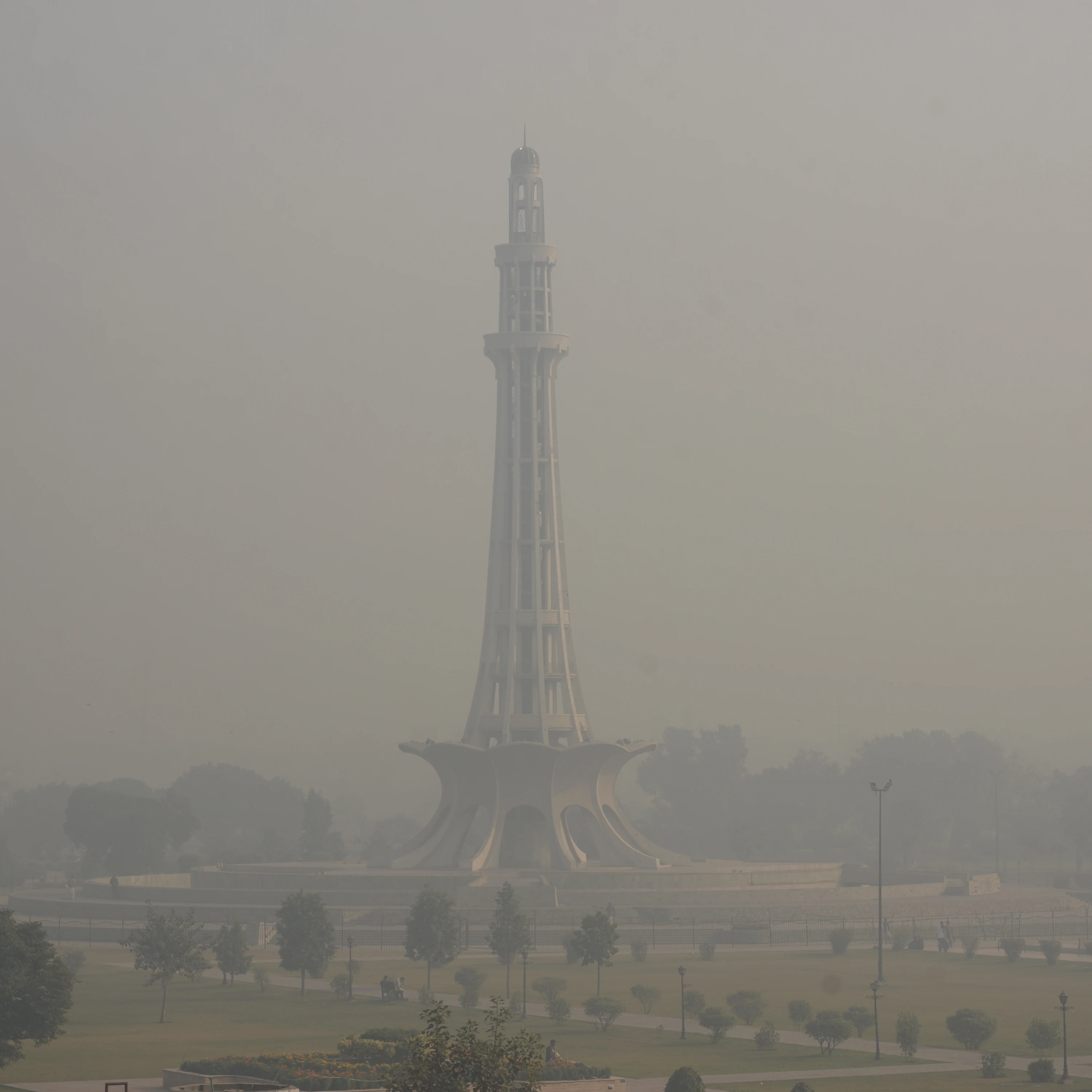
After embarrassing themselves with the installation of a predictably ineffective ‘smog tower’ last year, the Government of Punjab recently launched an even more expensive and high-visibility folly with its fleet of ‘smog guns’. Why implement tried-and-tested — but time-consuming — measures to address the root cause when you can experiment with flashy gimmicks at taxpayers’ expense?
There is perhaps no better illustration of the dire impact of years of brain drain on the calibre of governance than the fact that Punjab’s elite administrators genuinely believe a giant air purifier and some mist guns will be able to materially combat a 500-metre-thick blanket of atmospheric pollution spread across the entire Indo-Gangetic Plain. Indeed, it is quite sobering to realise that the Punjab Environmental Protection Agency’s best plan to address a national health crisis — that by World Health Organization estimates causes 128,000 premature deaths annually — resembles something Wyle E. Coyote might come up with.
Air pollution comes from several different sources, but by far the greatest contribution is from the combustion of low-quality fuel — in transport, power generation and industry.
Somewhere in the Punjab Secretariat is a committee of self-satisfied boomers being rewarded by the Chief Minister for thinking outside the box. Unfortunately, this was not even an example of coherent thinking, let alone innovative thinking. Water mist can reduce airborne dust, but its impact on air quality is short-lived and spatially limited. It cannot justify wasting so much freshwater when Punjab’s water tables are already beginning to run low. Moreover, the diesel emissions from the tankers on which these guns are mounted end up adding more harmful, micro-sized PM2.5 particles to the air than the larger dust particles that the water helps to settle.
Thinking outside the box tends to be framed as being inherently better than conventional thinking, because it exemplifies creativity, ingenuity and innovation. But innovation should also deliver some tangible improvement in the form of greater effectiveness, increased efficiency or lowered costs. Smog towers and canons do not deliver on any of these fronts.
Effective problem-solving requires utilising both conventional approaches as well as lateral thinking. Where a well-charted pathway exists, it makes little sense to consume resources experimenting and reinventing the wheel. Not unless there are compelling reasons to do so, such as opportunities for dramatically improved outcomes or reducing complexity or managing within financial and other resource constraints.
To address smog in the country, topical treatments that try to address the symptoms — like smog guns and cloud seeding — will not work. Nor will reactive measures, such as closing schools, make a difference to the long term persistence of smog. Here, conventional thinking and established approaches are needed: address the primary root cause, namely unclean, low-quality fuel.
Air pollution comes from several different sources, but by far the greatest contribution is from the combustion of low-quality fuel — in transport, power generation and industry. Other emission sources, such as rice stubble burning every autumn also contribute a significant share of pollutants. But the area under rice cultivation has not grown as fast as the transportation and power sectors. In the 30-year period from 1992 to 2022, the area under rice cultivation roughly doubled. During that same time, the number of cars on the road more than tripled and coal consumption increased seven-fold. Fuel quality needs to be addressed.
Unfortunately, the Government of Punjab cannot resolve this issue entirely on their own. The federal government and the national oil regulator need to step in and proactively drive a nationwide transition to cleaner fuels. This requires Pakistan’s refineries to upgrade their production stack — something they are keen to do, but for which they need substantial government incentives and support due to the size of financial investment involved. Regrettably, government support has not really been forthcoming the way it should, given the urgency. The Pakistan Refinery Policy 2023, which laid out incentives for refineries to undertake the investment needed to upgrade, took more than four years to develop. Even after the roll-out of the policy, the government has not provided a stable environment conducive to long-term investment planning. Policy inconsistencies and tax disputes have led to delays in refineries signing upgrade agreements and stalling investment plans. This means clean, domestically produced fuel is at least seven to ten years away.
In the meantime, Punjab’s Environmental Protection Agency can mandate fuel quality standards at petrol stations within the province and enforce these. Notifications to this effect are already in force and the EPA has a fleet of mobile labs that conduct fuel quality checks. However, the EPA tests for compliance against fuel quality specifications approved by the Oil and Gas Regulatory Authority, which, at Euro-2 standards, are woefully inadequate. It is practically pointless enforcing these standards.
There is perhaps no better illustration of the dire impact of years of brain drain on the calibre of governance than the fact that Punjab’s elite administrators genuinely believe a giant air purifier and some mist guns will be able to materially combat a 500-metre-thick blanket of atmospheric pollution spread across the entire Indo-Gangetic Plain.
This is an opportunity for real out-of-the-box thinking. In principle, Punjab’s EPA could set more stringent standards than the federal government. Pakistan imports about 70% of the motor gasoline that is consumed in the country; this fuel is all at Euro-5 standards. Punjab could demand that petrol stations in the province sell only imported motor gasoline, at least during the autumn and winter months. Such a move would potentially result in some resistance from domestic refineries, but nothing insurmountable. Almost a third of all registered vehicles in the country are in Karachi, enabling the port city to take a bullet for its northern brethren and absorb the entirety of domestically produced motor gasoline.
The challenge is that diesel, the worse of the two fuels in terms of particulate matter emissions, is mostly locally produced — about 65% of domestic consumption is from local refineries, which in many cases do not even meet the Euro-2 fuel standards. To enforce usage of imported, higher quality diesel in Punjab without leaving domestic refiners with an unsold surplus, some more creative, out-of-the-box thinking is needed.
One solution could be creatively managing the timing of when imported diesel is sold. The provincial government can potentially maintain stores of both imported and domestic diesel in a way to allow sale only of imported diesel during winter months — roughly a third of the year, corresponding to the 35% import volume — and sell the domestically produced diesel stocks during the rest of the year.
Pakistan imports about 70% of the motor gasoline that is consumed in the country; this fuel is all at Euro-5 standards. Punjab could demand that petrol stations in the province sell only imported motor gasoline, at least during the autumn and winter months.
Even with Euro-5 quality fuel, the full environmental benefits will be curtailed, because local diesel vehicles lack the necessary after-treatment systems. However, it is a necessary first step in pushing for a transition to higher vehicle emission standards.
These initiatives will require substantial effort, including intensive coordination between provincial and federal governments, as well as between the government and the private sector. These measures will not be cheap either. The oil storage and reserve management system will entail a heavy infrastructural outlay, not to mention massive financing costs of maintaining such huge inventories of diesel. But there is far more certainty in the outcomes and benefits of these measures than smog cannons, smog towers, AI surveillance systems and other flashy gimmicks. This kind of unconventional thinking may actually be a good use of public money.

Haroon Sethi advises on public-sector reform and economic governance in Pakistan. He has built and led ventures in manufacturing, automation and software technology.