When food stylist and writer Shayma Saadat began sharing recipes on her website, Spice Spoon, back in 2009, she often featured Pakistani dishes alongside Afghan and Persian ones. “I grew up in a Pakistani-Afghan household with Persian lineage, so these cuisines were never separate for me—they existed side by side in the kitchen.”
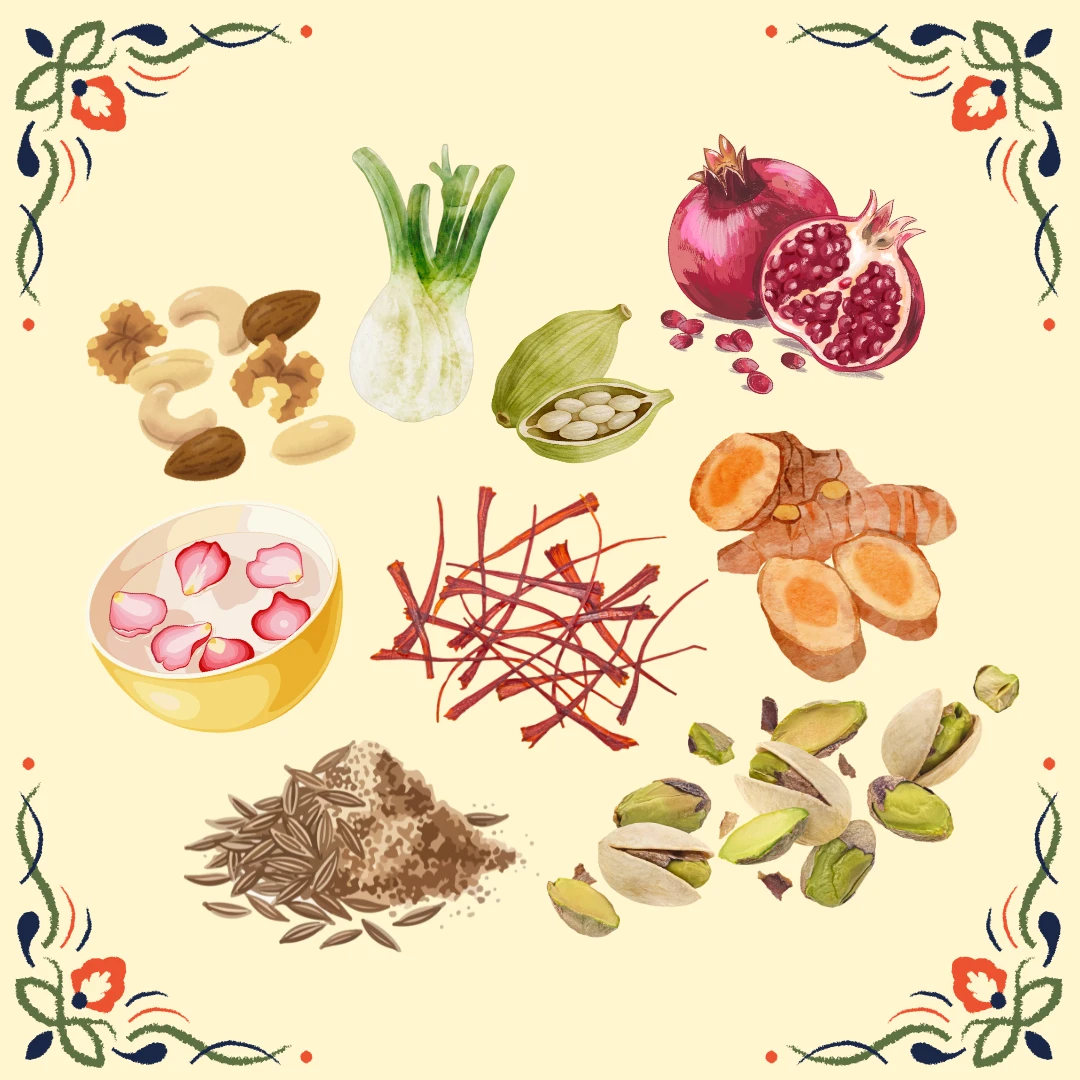
Seventeen years later, Saadat’s work—whether developing recipes or hosting workshops and supper clubs—seamlessly blends Persian ingredients and techniques with Pakistani ones. This fluidity exists because there are many shared ingredients across Afghan, Pakistani and Iranian kitchens: saffron, cardamom, rosewater, cumin, turmeric, to name just a few.
Author and broadcaster Yasmin Khan, who has mixed Iranian and Pakistani heritage—her mother is Iranian and her father Pakistani—also highlights the cuisines’ shared techniques and traditions. For instance: “Haleem during Ramadan, zulbia or jalebi during Eid, halwa prepared during times of mourning and the love of kebabs for family gatherings and weddings. These similarities speak to the shared cultural heritage between these two regions,” Khan tells me over email.
It’s no surprise, then, that when the U.S. and Israel launched airstrikes on Iran on 28 February, the attacks felt personal. Pakistan and Iran not only share a 900+ kilometre border, but also deep and expansive historical ties that touch upon every aspect of Pakistani culture, including, of course, food.
Shayma Saadat’s work—whether developing recipes or hosting workshops and supper clubs—seamlessly blends Persian ingredients and techniques with Pakistani ones. This fluidity exists because there are many shared ingredients across Afghan, Pakistani and Iranian kitchens: saffron, cardamom, rosewater, cumin, turmeric, to name just a few.
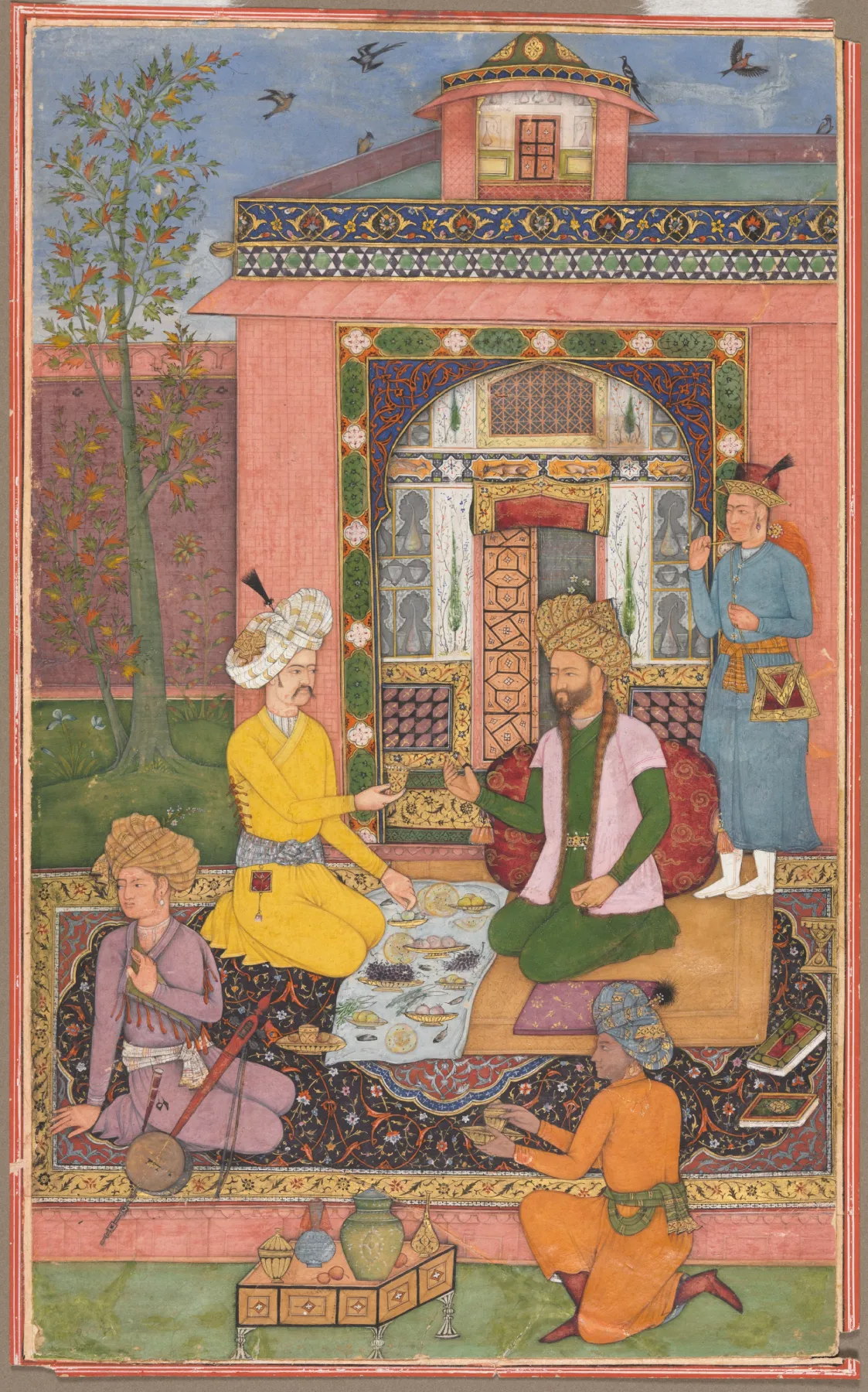
We most often discuss Persian influence on South Asian food through Mughlai cuisine. It’s easy to see why, given its syncretic nature and how it has come to define South Asian cuisine globally. While Babur strengthened the subcontinent’s ties with Central Asia when he established the Mughal Empire in 1526, it was his successor, Humayun, who—following his 15-year exile in Persia—developed a strong affinity for Persian culture and cuisine. Then Akbar brought Central Asian, Persian and Hindustani influences together to create Mughlai culture, giving rise to a rich and opulent cuisine that birthed some of South Asia’s most iconic dishes, biryani being just one.
The influence of Persia on the subcontinent, however, long predates Mughal rule. The broader Indus region, which includes present-day Pakistan, was under direct Persian rule in the 6th century BCE, a period some historians believe introduced key ingredients, such as saffron, pomegranates, almonds, pistachios and rosewater to the region. Sindh also came under brief Persian rule in the 16th century before being replaced by Mughal rulers.
This long history facilitated the integration of Persian ingredients and techniques into South Asian cuisine, evident not only in Mughlai traditions but also in more localised ones such as Sindhi cuisine. Many Sindhi rice and sweet dishes have close parallels with Iranian ones. For instance, the sweet rice dish tairi, flavoured with cardamom, saffron and fennel, and topped with pistachios and cashews, is often compared to the Iranian shirin polo, which similarly incorporates saffron and pistachios.
My friend Aqsa Gharshin, a Quetta-based civil servant and linguist, however, also reminds me that Iranian culinary influence, whether its ingredients, flavours, techniques and traditions, is not necessarily ‘foreign’ across Pakistan.
“It’s a shared experience, a shared life across the border,” she tells me in a voice note. “The British drew borders without taking into account that these people share culture, cuisine, language—almost every aspect of their society—because they are essentially the same people.”
Yet this shared regionality between Iranian and Pakistani cuisine rarely enters public discourse. That’s why it was a welcome surprise to see a collaboration focused on the Makran region—a sparsely populated coastal strip shared by Iran and Pakistan along the Arabian Sea and the Gulf of Oman—between two New York-based chefs, Pakistan-born Zainab Saeed and Anaïs DerSimonian, who has mixed Iranian and Lebanese heritage.
Saeed and DerSimonian had long wanted to collaborate on an Iranian-Pakistani supper club and ultimately chose to focus on Makran, because the food of southern Iran closely mirrors South Asian cuisine and Baloch food remains underrepresented in Pakistan. Saeed, who started her supper club series The Gathering Table two years ago, has always aimed to spotlight the fusion of non-Western cuisines.
Many Sindhi rice and sweet dishes have close parallels with Iranian ones. For instance, the sweet rice dish tairi, flavoured with cardamom, saffron and fennel, and topped with pistachios and cashews, is often compared to the Iranian shirin polo, which similarly incorporates saffron and pistachios.
“For a long time, we assumed fusion food meant the global South merging with the West. That doesn’t have to be the case. The way migration patterns have worked, there has been movement of flavours and techniques (between the global South) for a long time,” she says.
Their pop-up menu featured Makran-inspired dishes, with an emphasis on seafood—ghalieh mahi and fried shrimp biryani—as well as shared ingredients such as saffron, rosewater, cardamom, dates and almonds. When testing each other’s dishes, both chefs found them distinct from the food they grew up eating, yet also familiar.
Pakistan’s successful bid to mediate high-stakes negotiations between Iran and the United States was a reminder of our deep historical connection with the former, and a welcome departure from our India-centric focus. Looking westward, we might begin to see our culture—including our food—as what Saadat calls a ‘continuum’, rather than two separate parts, and reclaim a cultural exchange that has long transformed the way we eat.

Maryam Jillani Maryam Jillani is a Pakistan-born educator, food writer, and recipe developer. She is the author of the cookbook 𝘗𝘢𝘬𝘪𝘴𝘵𝘢𝘯, which was selected as one of the best cookbooks of the year by 𝘛𝘩𝘦 𝘓𝘰𝘴 𝘈𝘯𝘨𝘦𝘭𝘦𝘴 𝘛𝘪𝘮𝘦𝘴, 𝘛𝘩𝘦 𝘞𝘢𝘴𝘩𝘪𝘯𝘨𝘵𝘰𝘯 𝘗𝘰𝘴𝘵, 𝘉𝘰𝘯 𝘈𝘱𝘱é𝘵𝘪𝘵/𝘌𝘱𝘪𝘤𝘶𝘳𝘪𝘰𝘶𝘴, and 𝘕𝘗𝘙, among others. She also runs the award-winning website 𝘗𝘢𝘬𝘪𝘴𝘵𝘢𝘯 𝘌𝘢𝘵𝘴, which was archived by the Library of Congress in 2021.