The Mismatch of Matchmaking: Families Fit, Feelings Don’t
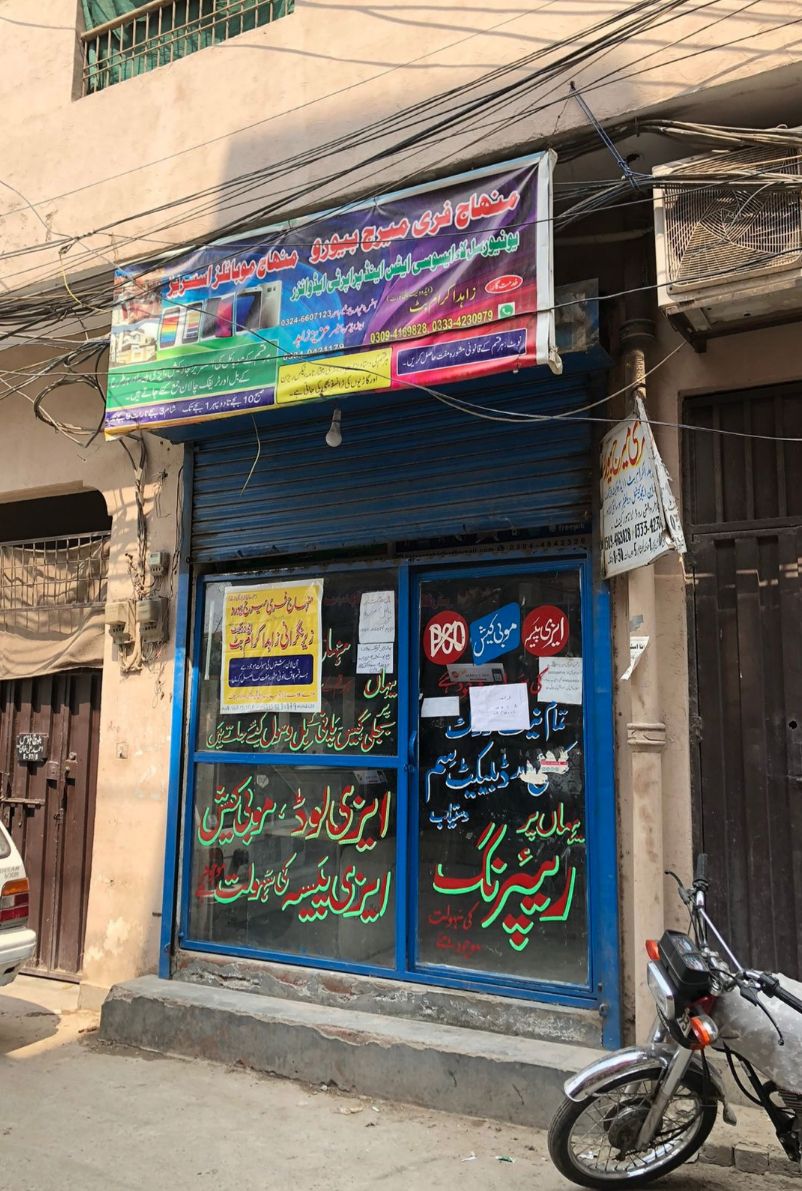
In one of the busiest parts of Lahore, in an alleyway emerging from the vast sprawl of Walton Road and nestled between two separate apartment entrances, is an office painted blue with a bright yellow poster pasted onto its glass window, calling passersby into Minhaj Marriage Bureau. The sounds of the city penetrate through the glass doors: honking cars, conversations between neighboring shopkeepers, and the call to prayer interrupt Mr. Zahid, an elderly man and retired lawyer, as he sits in his office from morning till evening, entering people’s data into his thick registers.
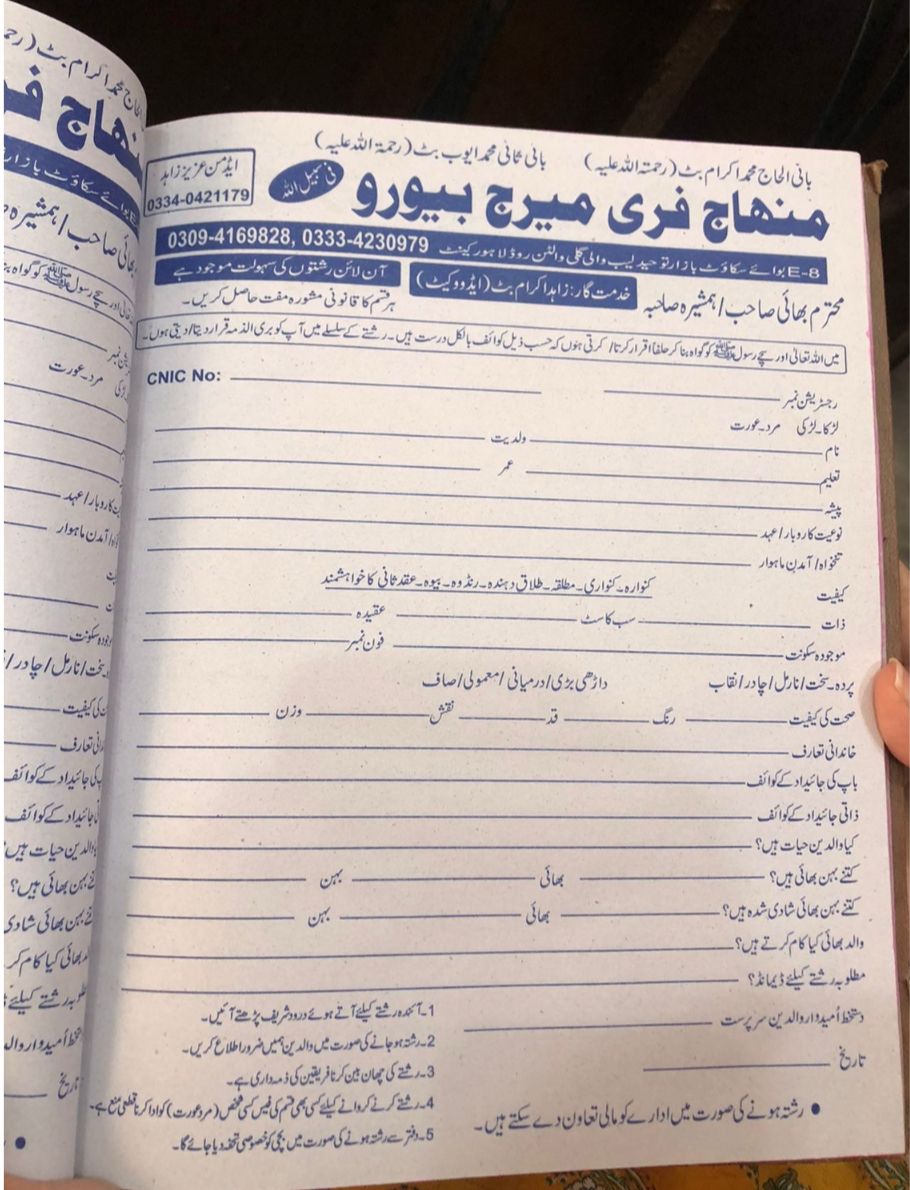
On a regular Wednesday afternoon, he sits across from me, wearing a simple beige shalwar kameez, narrates how he became a self-described “rishtay walay baba”. Mr. Zahid speaks about his mission to earn spiritual reward by spreading durood-e-pak, a practice he ensures everyone follows by making them recite durood thrice before submitting their “biodata”. He lifts a register from his old desk to show me the form he asks his clients to fill out.
Mr. Zahid, whose business card identifies him as a “khidmatgaar”, finds matches for his clients by scouring through his thick registers that classify people along demographic bases (such as financial status, age, education, and religious orientation), and uses a specific system to gauge compatibility between families. He appraises prospective male clients by “gauging if he respects everyone, can balance parental and spousal relationships, can take financial responsibility of his wife, is wise, modest and capable of controlling his emotions” before accepting them as clients. Yet, other than this initial vetting of brides and grooms, most of the remainder of Mr. Zahid’s dealings are with parents. For him, the real task is recommending families, not individuals, because in arranged marriages, decisions still often rest with parents, and in his estimation, the measure of success is whether the two households “fit” together.
However, the role of traditional matchmakers has fallen into disrepute among young people in Pakistan. For many young people, the rishta market feels transactional, money-driven, and detached from the idea of helping two people genuinely connect — a far cry from the glory days of traditional matchmaking, when matchmakers were seen as performing the respected relational labour of connecting families and fostering community. Among Pakistan’s burgeoning urban youth today though, the figure of the matchmaker is seen as “too much”: too money-oriented, too backward, too rigid, too classist. Across drawing rooms, late-night chai chats, and Instagram memes, the complaints tend to echo each other: matchmakers are out of touch, overpriced, and push proposals that ignore the priorities of young men and women, to whom compatibility often means far more than family status and fit.
Bisma (names of interviewees accessing matchmaking services and/or apps have been changed for privacy), a final-year student at a private university in Lahore, had just been introduced to the world of matchmaking by her parents when a rishta aunty arrived at her home. “She said she’d charge Rs. 50,000 per consultation and wanted her travel expenses covered plus a good ‘chai ehtemam’ when she visited,” Bisma recalled. “She even had tiers of rishtas, labelled ‘elite’ and ‘middle-class’. It felt like she was a broker running a proper business.”
For Bisma, the business model was clear: keep families dependent. Profiles shared by matchmakers and marriage bureaus often left out crucial details, such as phone numbers and addresses, forcing families to go through the matchmaker to connect.
Shehzad, a LUMS PhD student who had grown frustrated with proposals recommended to him by matchmakers, explained: “A lot of the proposals matchmakers send aren’t compatible because they’re only thinking of growing their business. They don’t care about your preferences. They often lie about a lot of things to sell rishtas and present something other than the reality which becomes apparent when one meets the other family.” Others share this view, pointing to a deeper issue: many matchmakers aren’t really listening.
Dawar, a sales professional and IBA graduate, shared a similar disappointment while finding proposals for his sister through traditional matchmakers, “These traditional matchmakers and marriage bureaus have become extremely commercialized and are only in it for the money. In the few months we tried to find proposals for my sister in the traditional way, our experience was disastrous, we had matchmakers literally force rishtas down our throats”. For Dawar and his sister, everything depends on whether the “vibes” align, an idea that seems to sail right over the heads of their parents, fixated on family background and status, and by matchmaking agents who can’t see beyond their files and forms.
For young men and women, the dream is to find someone they actually click with, someone whose values, humour, and ambitions line up with their own. For matchmakers, “compatibility” still mostly means the families tick the same boxes on class, background, and social standing. Somewhere between those two definitions, the search for love gets lost.
Scroll, Select, Shaadi?
In the gap between what young people dream of finding in the rishta market and what traditional matchmaking offers, a different space has begun to draw them in: the digital realm of online matchmaking websites, apps, and sprawling Facebook groups, where introductions unfold through profile pictures, typed-out bios, and the hope that algorithms might succeed where rishta aunties have not.
These online spaces are born out of a desire to escape the suffocating rituals of the old system, the long hours with rishta aunties, the prying eyes of families, and the exhausting routine of putting oneself on display for one proposal after another. Here, the entire matchmaking experience is reimagined. Gone are the tea trolleys and awkward, stilted drawing-room conversations that have become synonymous with the traditional process. On digital matchmaking platforms, individuals drive an autonomous, self-selecting search.
For many, the rishta market feels transactional, money-driven, and detached from the idea of helping two people genuinely connect — a far cry from the glory days of traditional matchmaking, when matchmakers were seen as performing the respected relational labour of connecting families and fostering community.
One such platform is the Alumni/Luminites Rishta Group, a restricted-access Facebook community for LUMS students and alumni searching for partners. Hamna, a LUMS graduate, founded the group in her senior year after watching a family member struggle to find “a compatible person” through traditional matchmaking. The experience pushed her to create a platform where people could share profiles and connect with like-minded individuals, to self-arrange their marriages and avoid what she calls “any conventional rishta finding.” Her goal, she explained, was to provide a “safe space where people can potentially find their match”, a place where compatibility is more likely because members have a shared educational background, and often, similar outlooks on life.
Instead of the bare-bones “biodatas” handed out by professional matchmakers, platforms such as Alumni/Luminites Rishta Group display detailed, personalized profiles. Each post blends text and image to construct an identity, one that performs for its viewers. In these profiles, the individual comes alive: their life story, motivations, aspirations, beliefs, hopes, and dreams all woven into a curated digital self. With each click, comment, and private message, these individuals come closer to their hope of finding their partner. In the process, they are sidestepping long-standing traditions and embracing a new courtship cycle — scroll, select, and start again — until compatibility, or something like it, finally appears.
Her Match, Her Rules
For many young women, digital matchmaking platforms offer a way to reclaim agency in the search for a partner. Online matchmaking avenues allow them to decide who to meet and when, often without the watchful eye of family members.
Aliya, an IBA graduate, said she joined matrimonial apps and sites to “obviously” exercise her choice. Part of that choice meant keeping it private from her parents. “I wanted to gatekeep this part of my matchmaking journey because parents would nag too much and constantly ask who I’m meeting and whether I’m ready to commit,” she explained.
Similarly, Anum, a LUMS graduate and education practitioner, turned to two closed Facebook groups, Alumni/Luminites Rishta Group and People of IBA and LUMS - Rishta Edition, for the same reason. “It was something my over-protective parents couldn’t control,” she said. “For me, it was a conscious choice of exercising my right to choose my own partner.”
But reclaiming agency doesn’t always mean excluding family from the process. For religiously observant women, autonomy can mean choosing a partner within the boundaries of faith and with parents still involved.
Asiya, a self-identified practicing Muslim, signed up for a three-month subscription to the matchmaking app Muzz. It was, for her, an Islamically acceptable way to meet her future husband. “It’s Islamically acceptable to look for your own person,” she said. Her use of the app was self-regulated and “within the limits and boundaries established by Islam.” Unlike Aliya and Anum, Asiya kept her parents informed from the start. “If I ever went to meet someone, they knew about it. I told them the location and assured them they could reach me at any point.” she said.
The independence young people hoped to gain by “self-arranging” their marriages through digital matchmaking platforms has, for some, curdled into disillusionment, with happy-hour soulmate searching reduced to the endless doomscroll of proposal shopping.
Together, their stories show that young women are engaging with the digital matchmaking market on their own terms: some using it to assert independence, others to claim a God-given right to choose, some looping their families in from the very first swipe, others involving them only when a serious prospect emerges.
Doomscrolling for ‘The One’

While digital matchmaking spaces have broadened the options for choosing a partner and particularly helped women seek partners for themselves, it is far from the utopia that digital matchmaking sites seem to advertise. Beneath the flashy UI, there’s an unease simmering that is often brushed under the rug, as individuals continue swiping left and right across digital matchmaking platforms.
On a humid Lahori evening, Sarim, a young software engineer, sits hunched over his phone, thumb flicking through a parade of faces on different matchmaking apps. “It became part of my daily routine,” he admits, “but after a while I thought, what am I really doing? Just swiping people away like I’m shopping.” The profiles blur together: cropped selfies, neatly listed degrees, a line about being “family-oriented.” In his view, the constant scrolling and swiping is a “daunting and draining process. You’re reducing someone to a photo and three bullet points,” he says. “It’s objectifying. You forget there’s a person on the other end.”
This unease isn’t his alone. Mariam, a graduate from Multan, deleted her account on a matchmaking platform after three months of swiping. “You only see a curated image,” she says. “Then you talk for a bit, and one of you moves on to the next person. It’s distracting having so many options, it feels like you’re always keeping the door open for someone ‘better’.” For her, the abundance of profiles created a kind of choice paralysis. “You can’t commit because you’re thinking, what if the next swipe is the one?”
Even when the apps promise safety and verification, individuals often feel the opposite. These platforms, Sarim and Mariam echo each other, have adopted the logic of the marketplace. Profiles are optimised for visibility, designed to catch the eye much like products on an e-commerce site. Users learn to “sell” themselves, highlighting the right job title, the right photo, the right blend of modesty and ambition. “It’s marketing,” Mariam shrugs. “You’re branding yourself for marriage.”
But unlike buying a car or a phone, there’s often no clear end point. Swiping becomes a habit, a way to fill an idle moment. Sarim scrolls while waiting for his coffee; Mariam did it before bed. The act itself becomes detached from its goal. “At some point,” Sarim says, “you realise you’re not really looking for a spouse, you’re just… scrolling.”
The independence young people hoped to gain by “self-arranging” their marriages through digital matchmaking platforms has, for some, curdled into disillusionment, with happy-hour soulmate searching reduced to the endless doomscroll of proposal shopping. Despite their desire to escape the exhibitionist culture that traditional matchmaking has devolved into, many find that these new digital spaces are slipping into the very same pitfalls.
Even as matchmakers like Mr. Zahid, leafing through biodata registers, are increasingly vilified as profit-driven agents, the alternatives to traditional matchmaking have not offered young individuals a perfect solution either. Between the formal visits to marriage bureaus, the ritual of family meetings, and the curated profiles, clicks, swipes, and late-night messages of online matrimonial spaces, young people are finding it harder to remain fully human in their search for love. Yet even as they are pulled between family expectations, ticking timelines, and the blur of faces, profiles, and almost-connections, they continue to show up, propelled less by certainty than by the stubborn hope that somewhere, someone might still be theirs.
Photographs are courtesy of the author.
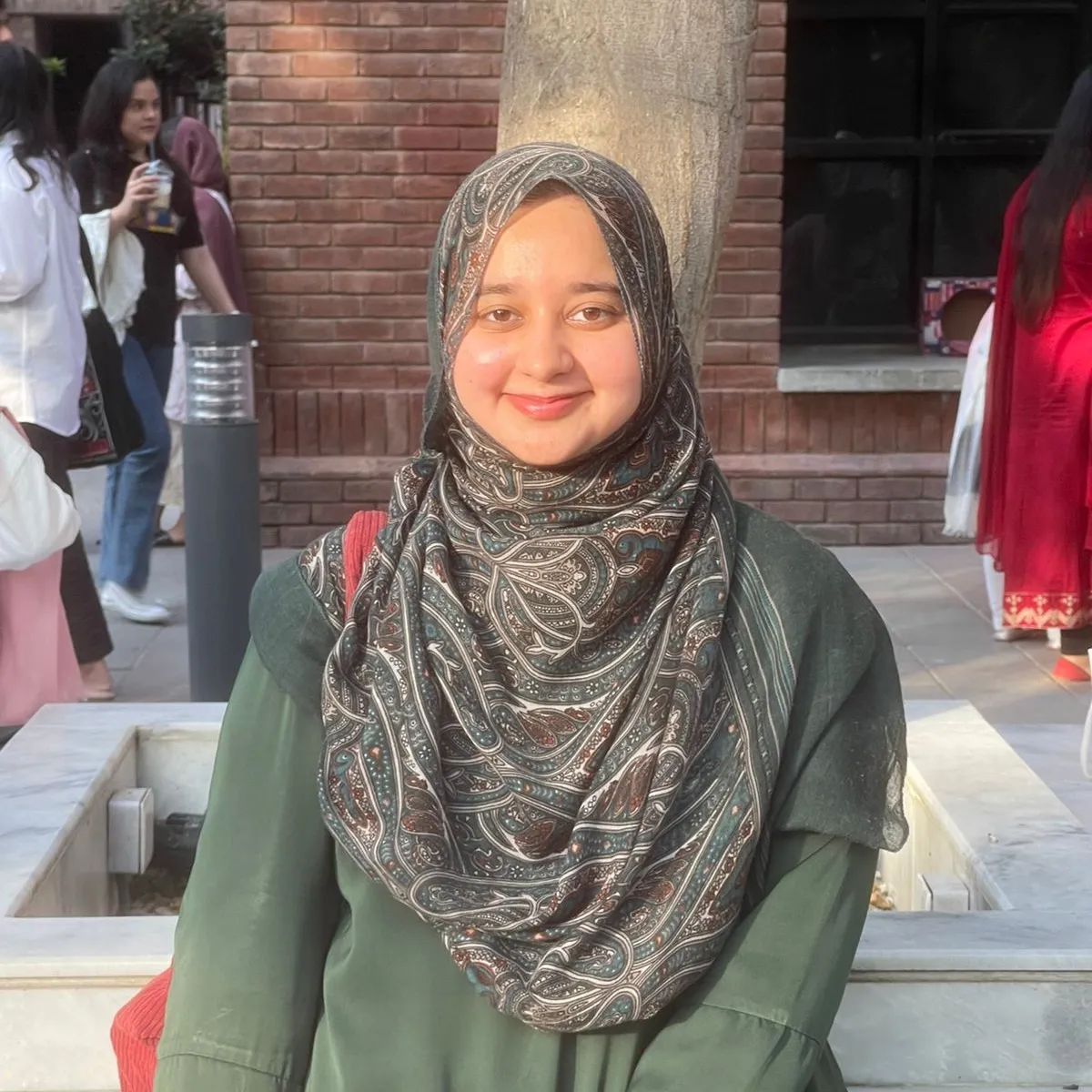
Mahrukh Murad , trained as an anthropologist, works across research and international development on cross-cutting issues of gender, social protection, education and sustainability.