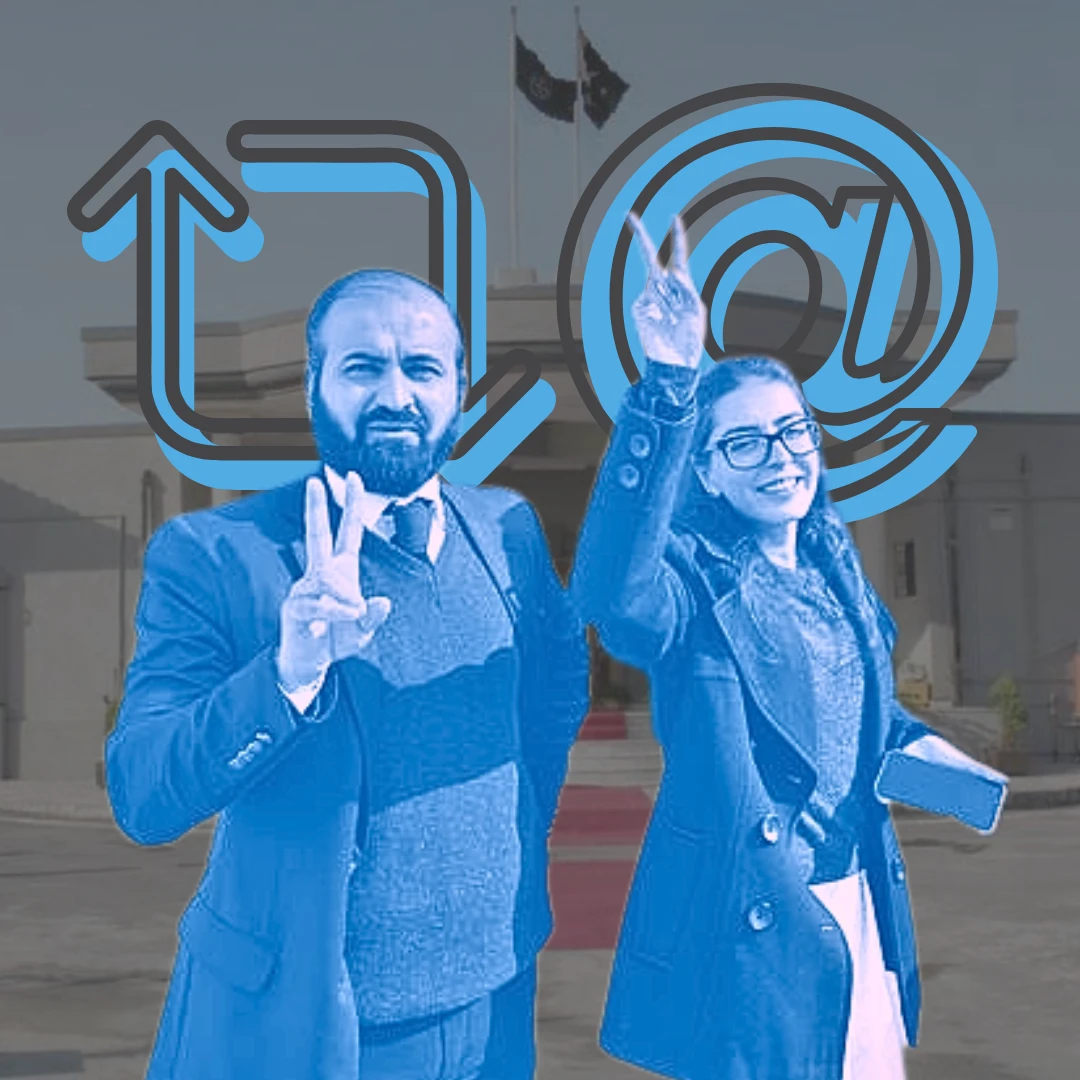
Two of Pakistan’s most prominent human rights activists are serving a seventeen-year jail sentence for the crime of tweets. Last month, Judge Muhammad Afzal Majoka had held that lawyers (and spouses) Imaan Mazari and Hadi Ali Chattha were guilty of spreading an “anti-state narrative”. His judgment painted a picture of a vast online conspiracy, aimed to strike at the nation’s foundations and cripple it from within.
In doing so, this judgement unravelled a grave threat to our country and its people. Just not the one intended.
See, there’s something more dangerous at play here than words on the internet. For years now, these two lawyers have been at the forefront of the kind of activism that shouldn’t take bravery, but in this country, does. You could disagree with them all you like (on several issues, I’m sure I would too), but you could also rest assured that if you found yourself in a situation where ruthless injustice was raining down on you, theirs would be the rare voice willing to speak out. They carried on with their work even when it was certain to irritate some very powerful people. So, it came as no surprise that a decision was made to spite them for the cardinal sin of dissent. If the thunderbolt hadn’t struck from this cloud, it would have struck from another.
In its relentless pursuit of this end, the detailed reasoning of the judgment threw the interests and identity of Pakistan under the bus. It portrayed our country as so fragile as to have its existence threatened by the picture of a woman holding up a peace sign. And it jeopardized Pakistan’s foreign relations by parroting decades-old Western classifications of countries as “terrorist states”, before the obvious mistake had to be hastily (and unlawfully) amended.
This is just an overview; I’d like to delve deeper into its text.
The judgment is unburdened by worldly desires such as grammatical correctness or logical coherence, so after laying down the facts, it gets straight to the point: “This court is not agree [sic] with arguments of learned defence counsel”. It quotes several tweets by Imaan Mazari, and after each one is the helpful observation that Mr Chattha retweeted it too.
Throughout the judgment that has condemned him to over a decade behind bars, there is not a single statement attributed directly to Hadi Chattha — he is held equally guilty on account of his retweets, and we are to assume that this has nothing to do with the fact that he is Ms. Mazari’s husband.
Where does this leave the thousands of other people who retweeted the same posts? Can the re-sharing of (allegedly) illegal content constitute a crime in itself when there is no proof of endorsement? If so, what do we do about the fact that the judgment itself quotes the statements in their entirety, and has thereby disseminated them to an even wider audience? What reasoning can the judgment use to convict Hadi that does not apply equally to its author? It has a great solution for this problem: it provides none.
The judgment relies on section 9 of the Prevention of Electronic Crimes Act to convict the two for “glorification” of proscribed persons. Crucially, however, the tweets quoted in the judgment are overwhelmingly comprised of statements against the alleged illegal detention and/or custodial torture of these persons. The judgment makes no attempts to explain what constituted their “glorification”. What we know for sure, though, is that advocating for their constitutional protections does not. It is a settled principle of domestic and international law that due process and fundamental rights attach to the individual, not to the nature of their accusation. Everyone is entitled to them, especially those accused of heinous crimes that incur the wrath of society and the state. It is no crime to demand constitutional rights for your fellow citizens.
Can the re-sharing of (allegedly) illegal content constitute a crime in itself when there is no proof of endorsement? If so, what do we do about the fact that the judgment itself quotes the statements in their entirety, and has thereby disseminated them to an even wider audience?
The judgment later moves on to Section 10 of PECA, which deals with the heavy charge of “cyber terrorism”. It asserts that the accused have “declared the Pakistan State as terrorist state in their tweets”, without stating where they did so. The original text asserted that, actually, there are only four terrorist states in the world: Cuba, North Korea, Iran, and Syria, and the accused, being lawyers, ought to have known this. Says who, you ask? The only body maintaining such a list is the US State Department. As per this judgement, we were expected to surrender our sovereignty and take the word of the Americans as gospel about what constitutes a terrorist state. Once the Foreign Office intervened, the Judge backtracked, passing an order that this had been “due to typing mistake”, and was therefore removed. This retraction is in direct violation of Section 369 of the Criminal Procedure Code, which states that no judgment can be altered after it has been signed, except to correct a “clerical error”. Was that really the case here? This wasn’t some throwaway line, or one of the several dozen typos that are still very much there in the judgment. It was an entire paragraph that not only relied on a falsehood (as is now accepted by the Judge himself), but was so confident in this falsehood that it scolded the people it was convicting for not being convinced by it too. If that can be accepted as being a “typing mistake”, then we can all be accepted as fools.
We are then told that the accused have “called the state as coward enemy”. An academic discussion follows in paragraph 42, stating that while criticism is perfectly fine, “an anti-state narrative is judicially understood as speech that crosses the permissible boundary of dissent”. Let’s interrogate this with a simple question: what is the state? Article 7 of the Constitution defines it as the Federal Government, Parliament, a Provincial Government, a Provincial Assembly, and local authorities empowered to impose taxes. No one else. Criticism of the government, even when it is harsh, is the right of the citizen, as was affirmed by Muhammad Ali Jinnah on April 18, 1948, in Peshawar: “Certainly criticize fearlessly when a wrong thing is done”, and on June 15, 1948 in Quetta: “We must subject our actions to perpetual scrutiny and test them with the touchstone, not of personal or sectional interest but of the good of the State”.
I would like to believe that my country is not built from a wood that burns so easily. That the rage of those who feel wronged by it is something to be soothed, not spited. That a few harsh tweets are not enough to terrorise it into locking up a young couple for over a decade each. And that we are logical enough to understand that attempting to suppress undesirable speech by force has only ever led to its further amplification.
I view patriotism as a quiet, secure kind of thing, rooted in love for a place and a people that mean something to you, despite maddening imperfections in both. I see it in stark contrast to its mutant cousin that we know as nationalism — loud, imposing, and dripping with insecurity.
I hold these opinions not in spite of my patriotism, but because of it. I believe James Baldwin when he writes that it would be a spiritual disaster to pretend that one doesn’t love their country. That you may disapprove of it, you may be forced to leave it, you may live your whole life as a battle, but you can’t escape it. So, I view patriotism as a quiet, secure kind of thing, rooted in love for a place and a people that mean something to you, despite maddening imperfections in both. I see it in stark contrast to its mutant cousin that we know as nationalism — loud, imposing, and dripping with insecurity.
What we are seeing now is a violent manifestation of the latter. Our subjection to laws like PECA and judgments such as this one are the real attack on our state; the actualisation of an idea long held by our aspiring authoritarian boomer demographic — that this loud and irritating youth of ours needs to shut up or get locked up.
As this Gen Z writer can attest, most of us have no particular desire to pick fights or vie for martyrdom. But we value our freedom. In the words of Woody Allen: “I do not want to live on in the hearts of my countrymen. I want to live on in my apartment”. To that end, the bravest among us are indispensable in their willingness to sacrifice their comfort to disturb the comfortable. Dissent like theirs is the bedrock upon which the rest of our freedoms are built. In their absence, none of us are truly free.
The writer is a lawyer and columnist from Okara, based in Lahore.
X: @hkwattoo1
Hassan Kamal Wattoo is a lawyer and columnist from Okara, based in Lahore. Twitter: @hkwattoo1