It was nighttime in the boys' hostel at the National College of Arts. A single bulb flickered somewhere outside the room, casting enough light through the doorway to make out the corridor. The hostel was famously haunted. Most residents knew this.
Inside one of its small rooms, an eleven-inch laptop screen glowed with images of a Pashto horror film. Beside it sat Shahrukh Khan, an architecture student from Peshawar who spoke Pashto. There were no English subtitles, and the small screen made the darker scenes almost impossible to see, so he translated, scene by scene, laughing often. The film was funny in places that were difficult to grasp without knowing the language, while its images offered another kind of spectacle altogether.
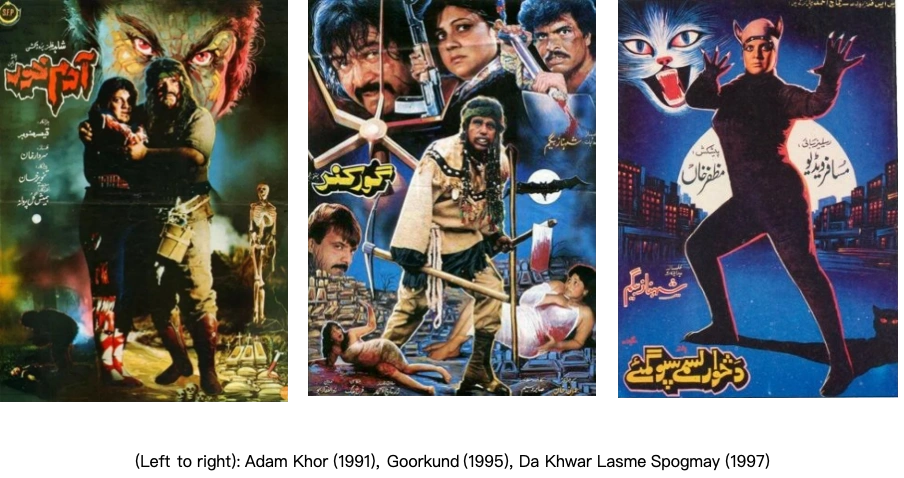
Pashto horror felt easier to write about than to get a hold of. Adam Khor, Goorkund, Da Khwar Lasme Spogmay – they all existed in scholarship, in Milan Hulsing's essay Pashto Horror Films in Pakistan, before they could be found on a screen. The hunt for them eventually led to the Internet Archive, where all three sat together under the title Pashto Trash Triple Feature. "Delightfully bizarre, off the wall and sleazy," the uploader had written. "No English subs, but who needs 'em." Two of the three, Goorkund and Da Khwar Lasme Spogmay, were directed by the same woman, Shahnaz Begum, who also acted in the third.
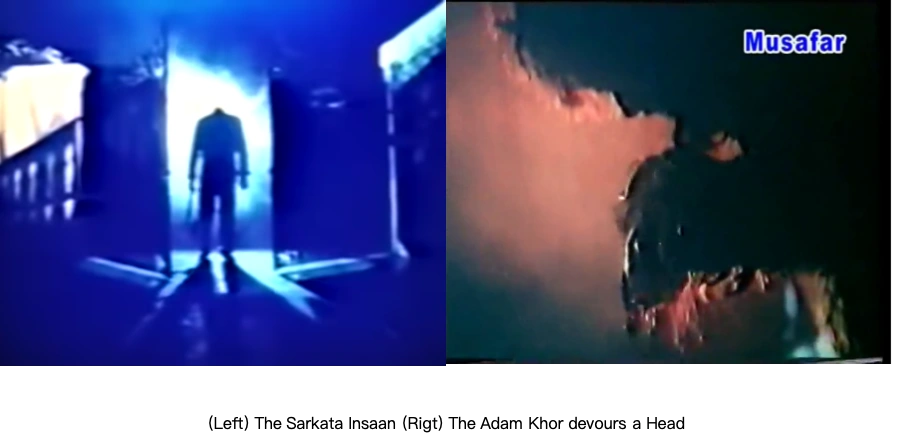
Pashto horror films are immediately recognisable due to a permanent watermark. Sometimes at the bottom of the image in Adam Khor, sometimes as a banner in the centre, sometimes as a logo in the top-left, appears a stamp for ‘Musafar’, alongside Pashto and Urdu script and a phone number. Fifteen years after the film's release, a Musafar CD store was doing business out of Nishtarabad, Peshawar's wholesale market for CDs and DVDs, home to more than a hundred and eighty shops. In 2010, its owner, a man named Muzaffar, told a Tribune reporter that he was moving five to six hundred discs a day, most of it "minifilms" – films shot in six or seven days for under four hundred thousand rupees and sold for the same price as bus fare – the same cheap, fast, sell-it-or-starve logic Hulsing describes for the genre's original 1990s boom, just running on a newer format. Nishtarabad had been bombed three years earlier. The shop owners chose not to close. They were back at work the next morning. Whether that Musafar and the one stamped across Adam Khor are the same operation isn't something a watermark alone can confirm, but the name is still active online today, running a channel with hundreds of thousands of subscribers, three formats and three decades deep into the same business of getting Pashto film in front of people.
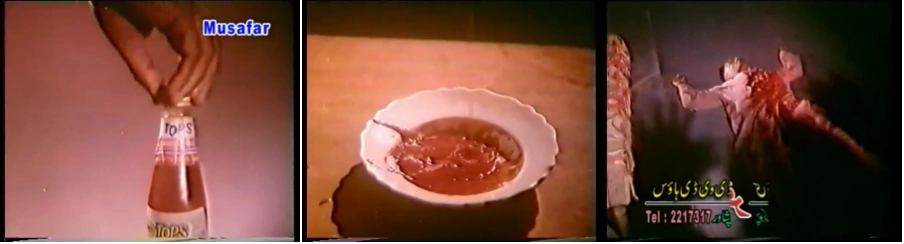
he's tearing at the chicken in a frenzy that has stopped being about hunger. The scene jump-cuts. The host is on the floor, disembowelled. His body reacts to ketchup exactly the way it reacts to blood. It's a stupid scene, and yet it's the smartest thing in the film.
Hulsing describes the world these films came from as a genuine renaissance: low-budget productions released in only a few prints, touring endlessly along the theatres of what was then the North-West Frontier Province and across the border into Afghanistan, moving on the same smuggler's roads as everything else. A concoction of horror, action, melodrama, music and comedy could sit in the same scene without needing justification.
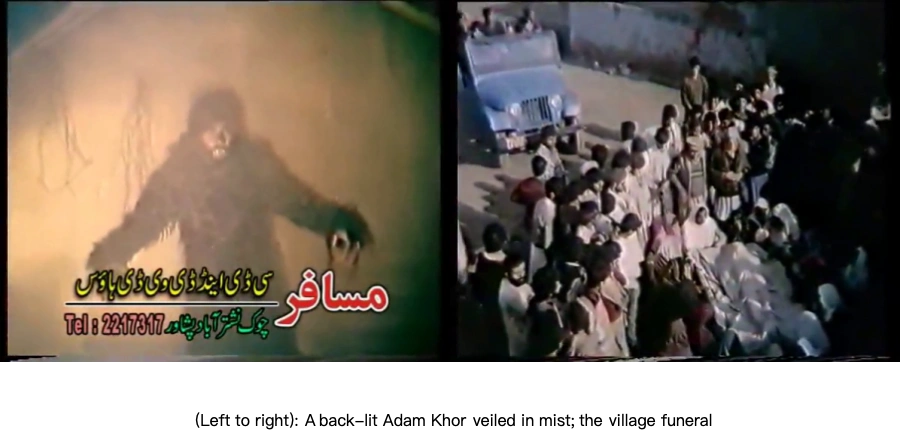
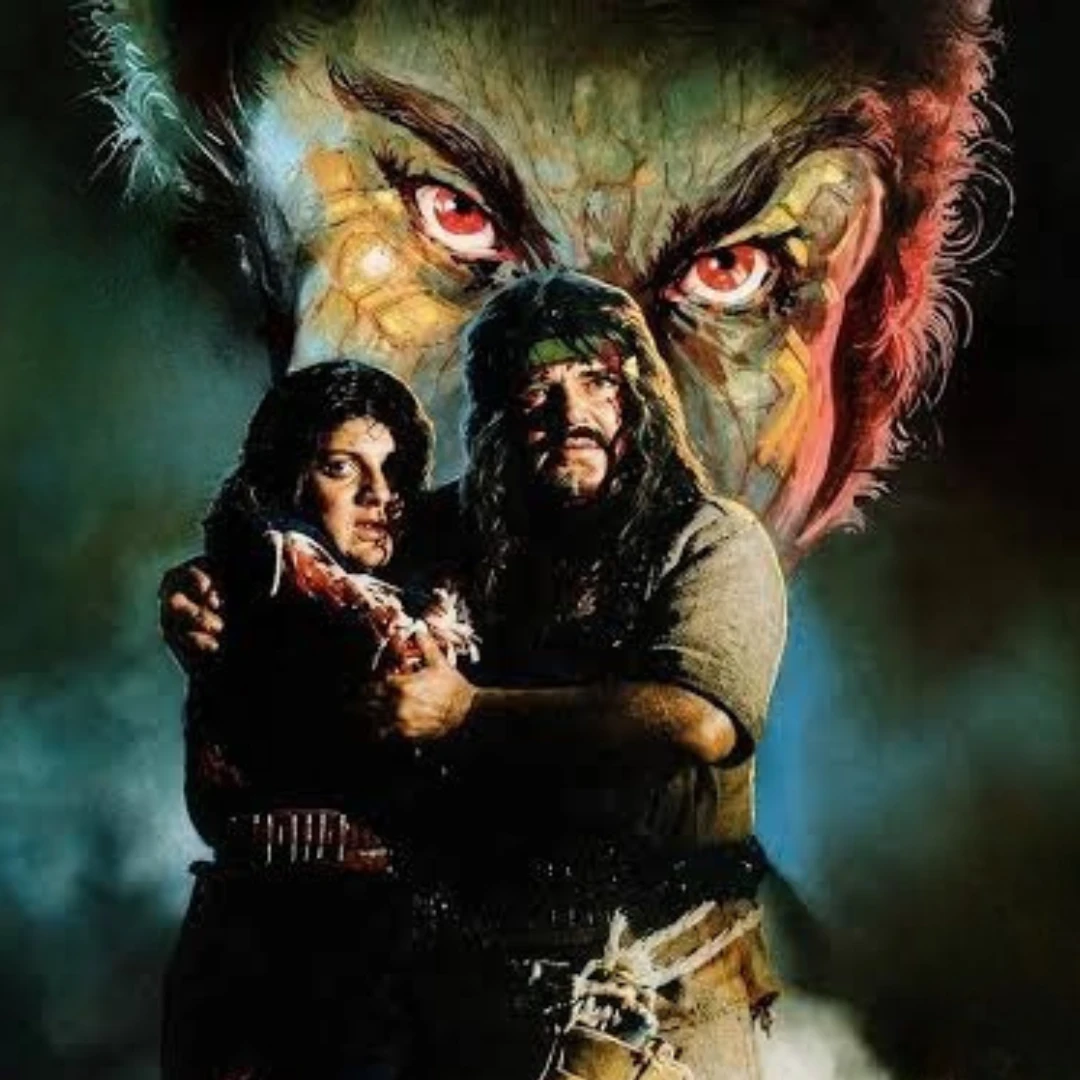
Adam Khor, released in 1991 and directed by Qaiser Sanober, starts that cycle. A village is being hunted by a cannibal and abandoned by the state. A monster is pursued. A familiar premise. The film opens with the Adam Khor itself, unidentified, running down and devouring its prey, and cuts from there to the victim's funeral. Haibat Khan enters the story separately, as the leader of a devil-worshipping cult; for most of the film's first half, his rank and his cannibalism are kept apart.
Inspector Sam is sent to stop him and fails within the first act, publicly, in front of the whole village. His own subplot gets a full song sequence and a marriage proposal he insists on deferring until the case is closed, a love that would never blossom because Haibat's men would soon ambush him, torture him and shoot him dead. When his lover reaches him, she is killed in the same attack. The film buries them together, in each other's arms, the first and gentlest instance of a pattern it would go on to repeat several times, though with far less tenderness: two bodies bound by the same violence, laid down as one. His sister Shahnaz empties her gun into the retreating gang and vows revenge over his body. A new inspector, Asif Khan, takes the case; his sister is taken hostage almost immediately, which is how a woman ends up in a graveyard for Badar to save.
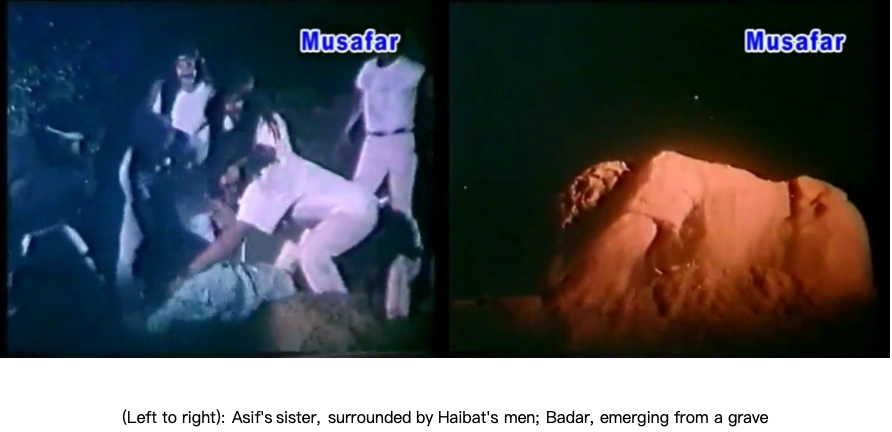
The scene leading into that rescue is cold. Asif's sister, surrounded by Haibat's men, is lit in the same flat, blue-toned night that shrouds most of the film's violence. Then the earth gives way, and the whole frame turns orange, the only warmth in a scene that had none a moment before, as Badar rises out of a grave to fight them off. He saves her. The film later establishes that he lives among the graves. It never explains why his introduction should require him to come out of one, or why the ground itself seems to have been keeping a light source in reserve for exactly this moment.
Every account of a cinema's golden age tends to blame the audience or the genre that supposedly ruined it, rather than the plainer fact that halls have always followed whichever audience could still afford a ticket.
The police arrest him anyway. They take him for the Adam Khor, cage him on the back of a tractor and parade him through the village. The crowd is chaotic on screen, bodies overlapping with no clear centre, a jeep, a dozen onlookers, someone climbing a wall to see better, no single point holding the frame together. His monkey bombs the police convoy. His horse carries him out. One moment, the film stages a grotesque slaughter, and minutes later, it's cheerfully cartoonish about a grenade-throwing monkey.
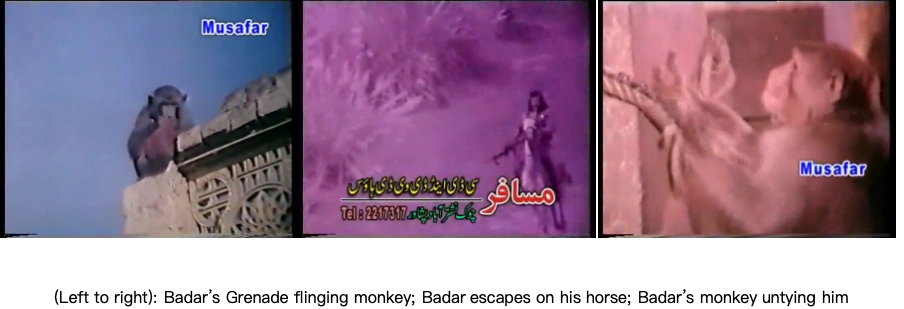
It is only afterwards, cornered in a shootout by Shahnaz, that the film breaks open Badar's memory and explains the arrest. He had been present when the real Adam Khor murdered a woman. Her family found him standing over the body and decided he had done it. They beat him, tied him up in front of his own house and made him watch while his family was killed and his house burned down. The monkey pried a horse loose from the stables, and the horse carried him out. He went to the graveyard and stayed in a place where the dead were at least openly dead, and the name stayed with him.

Later, when Badar and Shahnaz chase a wounded member of Haibat's gang back to the stronghold, the film finally closes the gap it opened at the start, between the cult leader upstairs and the monster nobody has yet been allowed to name. In the stronghold, a snake moves across the floor of the lair. Beside it, painted onto the wall, is another snake, this one with a human face, the features unmistakably the Adam Khor's. The camera holds long enough for an arm to emerge from the painted serpent's mouth. A painted tiger roars. A jinn steps forward from a painting of the devil. A skeleton with red eyes flares over the terrified gang member who is seeing all of it. "A man who is less than a man is not worthy of being called a man," Haibat tells him, before dragging him into the lair. The monstrous, as he says it, is a grade of manhood he can fall to. The sequence is lit in colour, red and blue washes cut across it, with patches of warm spotlight breaking through wherever a face or a fang needs to stay readable. A body can stand in red for one shot and blue for the next with no source in the room to explain the change. Skull sockets go fully black under it, faces reduce to the suggestion of a face, and at this resolution, colour bleeds past its own edges anyway, the compression and the fake blood indistinguishable, red spilling slightly into whatever it touches. None of this is explained. It doesn't need to be. The wall has already done the work that the transformation itself is about to do, more slowly. By the time Haibat actually changes shape, the room has already taught you not to trust the difference between an image of a monster and the monster itself.
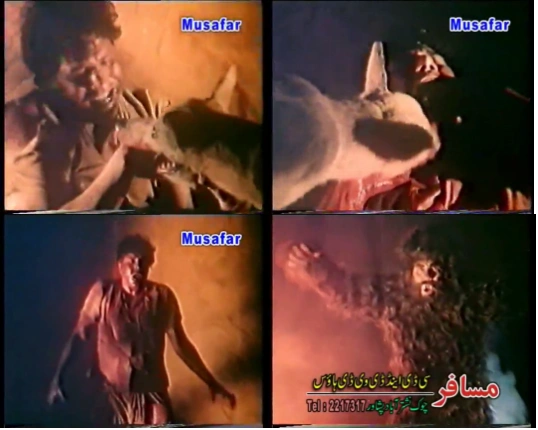
Haibat's own history surfaces eventually. His father-in-law had handed him a suitcase of money, then called the police and accused him of stealing it. Cornered with his brother, torn open by wild dogs, Haibat transforms for the first time and eats his brother. Later, as the Adam Khor, he kills a woman without knowing she is his own daughter. Badar is found standing over her body and taken for her killer. Her family, the same family whose betrayal made Haibat what he is, ties Badar up and burns his house down with his family inside it. He escapes, still framed as the Adam Khor.
The strangest scene in the film sits inside that memory. Haibat, dishevelled, flags down a car on a desolate road. The driver takes pity on him, brings him home, and sets a table. Fried chicken, French fries, and one more plate, empty at first. The room is lit warm, reddish at the edges, about as close as this film comes to comfortable domestic light. The host lifts a bottle of Tops tomato ketchup, and empties it onto the plate. The camera doesn't cut away. It moves in, clinical, almost bored, just the plate, the red pooling against white china. At this resolution, in this print, the ketchup doesn't read as a different red from the blood in the rest of the film. It's the same crushed, oversaturated red the compression gives everything, which means the joke and the horror are, materially, the same substance. Haibat stares at it the way you'd stare at something familiar. Then he's tearing at the chicken in a frenzy that has stopped being about hunger. The scene jump-cuts. The host is on the floor, disembowelled. His body reacts to ketchup exactly the way it reacts to blood. It's a stupid scene, and it's the smartest thing in the film.
Haibat becomes the Adam Khor without ceasing to be Haibat. Badar never becomes it at all, and the village makes him one anyway. Both men, it turns out, are tied to the same ground. Haibat's basement is a hidden room with bones stacked along the walls, skulls facing outward, jaws slack, lit warm and reddish, with spots of red bleeding across the ceiling itself. Everywhere else, the film goes cold and blue at night. The one room built to house a cannibal is lit like it's on fire, which might be the point. This is hell, or the closest thing the film's imagination has to it, and it makes sense that it would burn. Badar's underground is a grave he already lives in, in the open, in a graveyard anyone could walk into. One man buries the fact of what he is. The other lives on top of his, visibly, and gets punished for the visibility. Neither of them is exonerated by his history, and neither of them is separable from it.
This is not a problem Adam Khor invented. Twenty-four years earlier, Khwaja Sarfraz's Zinda Laash had built an entire film around a body that would not resolve into one state. Professor Tabani drinks the immortality elixir he has spent the film perfecting, clutches his chest and drops dead with blood running from his nose. His assistant lays him in a coffin in the castle basement. The camera pushes in on the open coffin, and Tabani's body begins to convulse in exactly the way it convulsed as he died, the same contortions, the same blood at the nose.
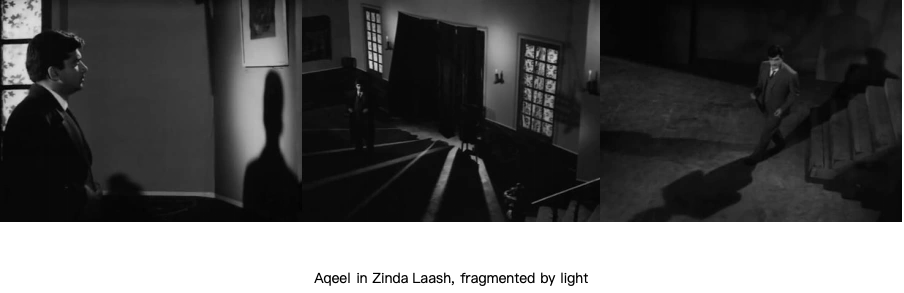
Sarfraz keeps saying it with light. Dr Aqeel, arriving at the castle, is cut into sections by the shadows of curtains and bannisters before anything has happened to him; once bitten, standing in that same basement, his body throws several shadows at once. This gives the in-between body a specific look, hard shadow and duplication, which Adam Khor reuses and coarsens a quarter-century later.
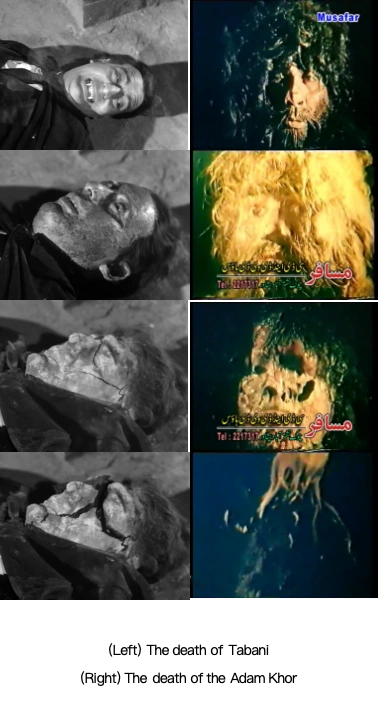
It also has an ending Adam Khor takes as its own almost entirely. Cornered by Tabani in the basement, Aqeel's brother prays aloud to be delivered from the evil spirit, and a divine light falls; Tabani rots in time-lapse, years compressed into seconds, until he is dust. In 1991, cornered by the man-beast in the graveyard, Badar prays; a beam of light puts a sword in his hands, and he drives it into the Adam Khor until the creature decays and withers away. The scene is tinted green throughout, the only stretch of the film shot in that colour, as though the palette itself needed something outside its usual blue-and-orange vocabulary to mark an ending. A working solution to the problem of how a Pakistani horror film ends, passed down and reused because it worked. Two films, twenty-four years apart, arrive at the same conclusion that some fights only end when the story hands the hero something older and stronger than a gun.
Three years after Adam Khor, Saeed Rizvi's Sar Katta Insaan took the same knot and made it anatomical. Adam Khor had already been treating the face as something that could come loose from bodily identity, a man staying legible as himself right up until the moment he wasn't; Rizvi just gives that idea a scalpel. Inspector Anwar's severed head is grafted onto the body of a dacoit named Nadir, on the assumption that a life can be dismantled into parts and reassembled into something obedient. A smart head on a violent body, the perfect hitman, a dead man who cannot snitch. It does not work, and it does not work in a specific way. By day, head attached, the hybrid walks the city, attracting the interest of a crime reporter. By night, he takes the head off and goes hunting. Policeman and criminal in one body, both individualities maintained by the repeated act of severance, until the severance becomes the identity.
What Adam Khor distributes across two men, Sar Katta Insaan stacks into one. Badar and Haibat are bound together by a single killing, each of them ruined by the same night from opposite ends. The film keeps their bodies apart, but they remain connected, through violence, through imminent burials, both physical and that of the self. Rizvi simply sews the victim and the perpetrator together at the neck and lets them share a torso. The history attached to the head stays in the head, while the body refuses to give up its own.
Three films, three different mechanisms, and the same finding each time: the past is not simply backstory, but it is the genre's actual machinery. A flashback alters a body you thought you understood. A photograph reveals an identity the man carrying it never had access to. A grave becomes a house. Horror works here by making history physically inescapable, which is a strange thing for a cinema whose own history is narrated almost entirely through the language of the unprecedented. Read enough about Pakistani cinema, and you'll notice the same word doing all the work: "first." The first horror film, the first zombie film, the first attempt at some new technology or genre. It's useful, and it's also a little insulting, because it turns a film into a checkpoint on someone else's map rather than a thing that happened on its own terms. Nobody making Adam Khor in 1991 was trying to be first at anything. And yet genres persist because people remember what worked, reuse what is available, alter what they inherit, and make something out of the conditions immediately around them.
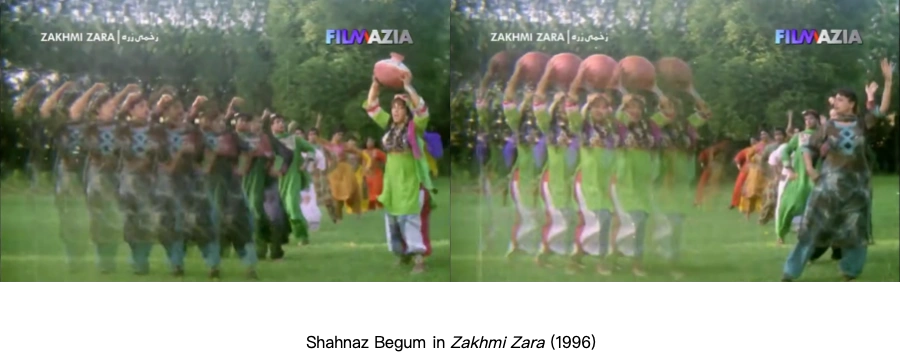
Begum's own account of getting there is not gentle. In an interview with Qarar TV, she talks about how coming into the industry brought her a great deal of difficulty. While she was supported by her husband, Pashtun families, she says, generally do not accept a woman venturing into the entertainment industry, and hers was no exception. People from her own family and community acted against her, threatening her with weapons and, she says, with acid. She kept working. Goorkund came first, then Zakhmi Zara, then Da Khwar Lasme Spogmay, which Hulsing considers the only masterpiece the genre produced. In a separate, Urdu-language interview, she has put her own filmography at something close to six hundred films, a number large enough to explain why, when asked what makes a film work, she answers in the vocabulary of someone who has done the actual labour of it: "story first, then a script strong enough to hold a story, then music, then the cast," in that order.
Syed Noor received a Sitara-i-Imtiaz for his contribution to Pakistani cinema. Begum directed two of the three films sitting in a folder marked ‘trash’. Draw your own conclusions about which kind of filmmaking this country decides to honour.
The industry she describes has since become difficult to locate. Peshawar, which once had something like two dozen screens, is now down to three or four; the rest have become shopping plazas, medical centres, parking plazas. Cinema-going in Khyber Pakhtunkhwa has now contracted to Eid, and even that is unreliable. Three Pashto films opened for Eid ul-Fitr in 2025, one for Eid ul-Adha that June, two in 2026 after a gap long enough that their arrival was reported as a comeback. Both were family-feud dramas, pitched around peace, brotherhood and traditional values.
Begum measures the same decline in terms of work rather than screens. In Badar Munir's time, she says, there was no shortage of films, and no shortage of employment either. People had steady work, day and night, because he was there to make it. A single film could run for a year. Now, a hit is rare enough that anything that succeeds gets called a "super-duper" film, a description that used to be unremarkable.
In a 2026 Tribune piece, the veteran director Shahid Khan, asked to account for the same decline, points partly at the genre this article has spent its length admiring. The horror and action productions of the 1990s, he argues, drove family audiences out of the halls in the first place. Militancy did the rest, hitting the buildings directly, bombing Shama Cinema, and closing the theatres in Swat, Mardan, and Kohat for good. This is a reminder that the people who lived inside this industry are not obliged to share our fascination with the 90s, and that films which look, from a laptop in Lahore, like a lost treasure can look from Peshawar like part of what went wrong.
There's a familiar shape to that kind of remembering, though. Every account of a cinema's golden age tends to blame the audience or the genre that supposedly ruined it, rather than the plainer fact that halls have always followed whichever audience could still afford a ticket. Urban, English-speaking Pakistan tells the same story about its own 1960s, a supposedly refined moment before regional-language cinema coarsened everything, skipping the part where the urban gentry left for television first, and the halls simply kept selling to whoever remained. Khan's own account could just as easily describe a hall following a working-class audience as one losing a genteel one. Which leaves the films themselves in an odd position. They are not lost. They are in Hulsing, in Khan and Ahmad, on the Internet Archive, on YouTube, in a back catalogue that still has a business built around it, in the memory of the people who made them and in the arguments of the people still making films in Peshawar. What has gone is not the film. It is everything that used to surround it – the halls, the touring prints, the audience that turned up for the reel because there was somewhere to turn up to.
The hostel room at the National College of Arts is presumably still standing, still famously haunted, and someone is presumably still watching something on a laptop inside it. Adam Khor is easier to reach from there now than it was that night. A better internet connection, the same watermark, and still no subtitles. What is not reachable from there is the hall in Peshawar where it once played to an audience that did not need Shahrukh to explain the jokes.
Asked whether any of it could come back, Begum doesn't hesitate in her answer. “No,” she says. “Once that time has passed, it doesn't return. It's difficult now. If those same actors, those same technicians, those same people were still here,” she allows, “then maybe.” They aren't.
Zeerak Suhail is a Doha-based writer, filmmaker and visual designer. Formerly Arts Coordinator for the third Lahore Biennale, they co-edit Tasveer, a photography publication shown at Lumenvisum in Hong Kong and Printed Matter in New York. They are completing an MA in Digital Humanities at Hamad Bin Khalifa University.