Qaum, Mulk, Sultanat, Paendaatabindabaad" sounds as nonsensical as 'supercalifragilisticexpialidocious' at times. For over sixty-two years of Pakistan's history, these words have been a morning rite for schoolchildren across the country, repeated so often that they're settled more in the muscles than the mind. The words of Qaumi Tarana, written by poet Hafeez Jalandhari, may be etched forever in our collective consciousness, but their meaning is still left for the Urdu literarians to parse.
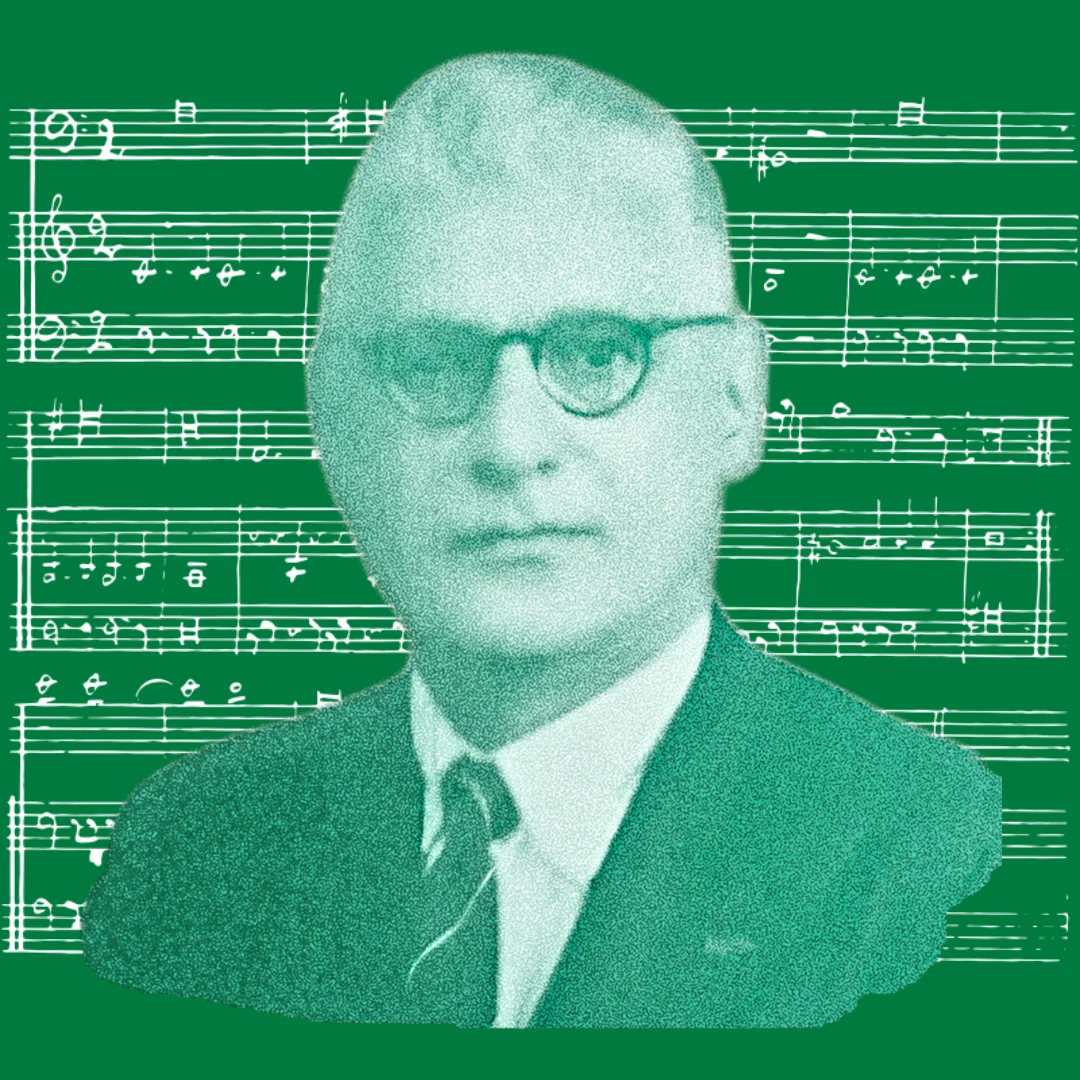
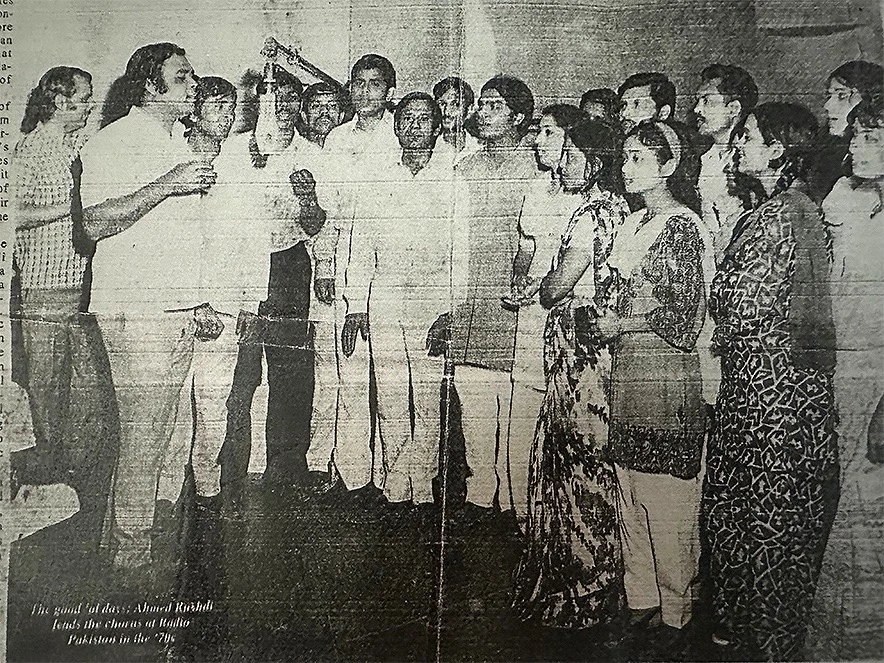
A little before the lyrical contributions of Jalandhari, a melody had already been reverberating across the Dominion of Pakistan in 1949, composed by Ahmad Ghulam Ali Chagla. On 16 August 1954, Jalandhari's lyrics and Chagla's composition finally received the imprimatur of the state. The subsequent recognition, although, was significantly biased in favour of the former: Jalandhari was garlanded with Pride of Performance in 1958. Chagla, the principal architect of the score, died shortly before the anthem's official adoption, and waited decades – until 1996 – to be recognised for it at all. This lukewarm acknowledgment is also a familiar one: Chagla joins the league of accomplished Pakistanis, Dr. Abdus Salam among them, whom the state has never found convenient to market for its cause.
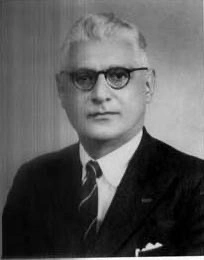
[G]enerations of youth are introduced to Jalandhari as the creator of the Qaumi Tarana, while Chagla's name, if it appears at all, arrives as a footnote.
From a more generous and nationalist perspective, it could be argued that poets, by virtue of their engagement with language, are more legible and bankable than composers. A poem can be printed in a textbook, quoted in a speech, and taught alongside a translation; a melody resists such paraphrasing. In this case, Jalandhari also arrived with a pre-existing body of work, including Shahnama-e-Islam, and a religious background far more pronounced than Chagla's — a composer whose own persona read as secular, suited, and reflective of cosmopolitan artistry. Quite expectedly then, generations of youth are introduced to Jalandhari as the creator of the Qaumi Tarana, while Chagla's name, if it appears at all, arrives as a footnote.
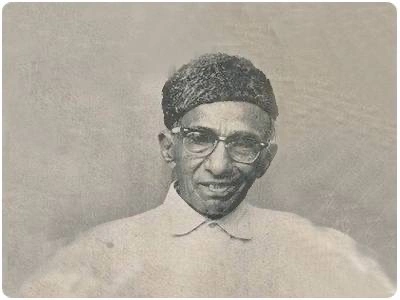
The relationship between the state of Pakistan and music is one filled with unwritten rules and half-hearted recognitions. While poetry earns a notable place in the school curriculum, music is virtually non-existent aside from the typical sing-song ‘music classes’. However, the notion that words outdo music in general legibility is the very notion that Chagla upends with his work. Nevertheless, his legacy must not be reduced to a mere war between poetry and music — it is, in fact, the opposite: an acknowledgment and celebration of just how poetically he composed. So poetically, in fact, that his work is one of the most notable cultural shorthands for patriotism across Pakistan.
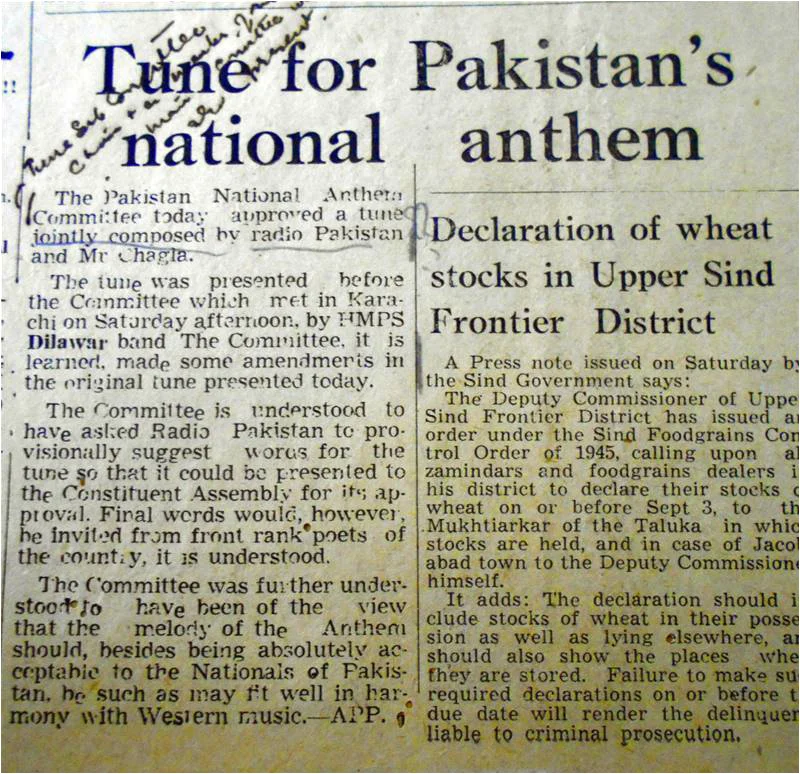
While poetry earns a notable place in the school curriculum, music is virtually non-existent aside from the typical sing-song ‘music classes’. However, the notion that words outdo music in general legibility is the very notion that Chagla upends with his work.
Chagla's musical journey started at Sindh Madrasatul Islam where he studied under Maharaj Swami Das, a renowned musician of Karachi. He later enrolled at Trinity College of Music in England to study musicology, and before the creation of Pakistan, worked as a musician at Ajanta, a film company in Bombay. After independence, the government of Pakistan appointed him to the national anthem committee. He prepared the composition and subsequently played before the then-prime minister and committee members, earning their approval on 21 August 1949. While the committee saw Chagla’s composition as a compelling work of music to represent the country, the composer himself aimed for much more. While most national anthems settle for simple, singable tunes, Chagla conceptualised a deeper character, ideological goals, musical meaning, and worldbuilding. Clearly, he was thinking of the schoolchildren who'd have to sing it.
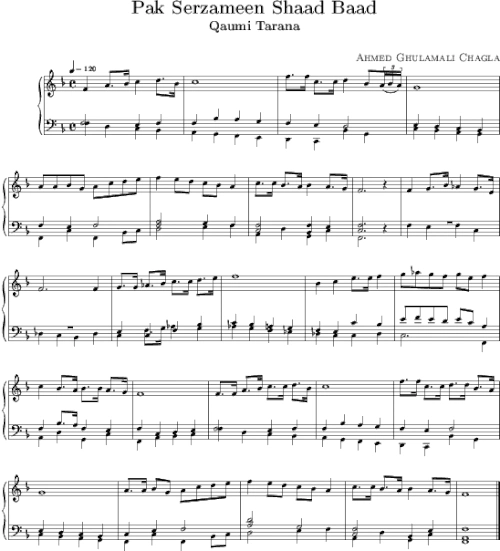
The national anthem of Pakistan is divided into three segments. Two segments, the first and last, are in the major key, with the middle segment shifting to minor. Chagla composes in B-flat, a key that comfortably suits a wide range of voices, a deliberate choice toward making the anthem singable. Whatever modes and scales the composition wanders through, each phrase eventually resolves back to the tonal centre of B-flat. Sometimes this resolution arrives through a standard, more resolving major cadence; at other times, via spicier chromaticism: the musical technique of using uneasy intervals outside of the key. At the very end of the first segment, he writes a similar chromatic phrase for the underlying horns section. The phrase is specifically designed to be part of the harmonization of the choir, to bring colour and anticipation, reminiscent of Wagner's leitmotivic chromaticism or even Debussy's colouristic wandering, quite atypical of an anthem. As this chromatic phrasing brings tension, it also serves as an effective foreshadow of an upcoming sinister segment. Since every decision, including the chromatic runs, orbits the tonal center, performers need only grasp that one note as their reference point, making the rest of it relatively convenient to sing.
The second segment introduces a rather grim character into the melody. Beginning with “Pak sarzameen ka nizam,” this segment opens on a minor-key phrase, a scale commonly associated with tension. Any composer has two major ways to approach a major-minor key change: relative minor and parallel minor. Relative minor is built from reversing the notes of the initial major scale but changes the tonal center, while parallel minor is built using the tonal center but uses different notes. Chagla chooses parallel minor, and harmonic parallel minor specifically. The harmonic minor scale is distinct from a standard minor scale, roughly corresponding to Raga Kirwani in Hindustani classical music. A midnight raga, it's known for its characteristic darkness and Middle Eastern and Islamic flavour. The melody, therefore, hits a similar cultural register while retaining the sonic anchor of B-flat. This is precisely why an otherwise jarring key change passes here smoothly. Even non-musicians are able to sing over the key change, as their mind is anchored to B-flat, letting them remember the changing scales once they've heard the melody.
While most national anthems settle for simple, singable tunes, Chagla conceptualised a deeper character, ideological goals, musical meaning, and worldbuilding. Clearly, he was thinking of the schoolchildren who'd have to sing it.
The anchoring through the tonal center isn't just a compositional trick; it's a practical solution to the problem of writing for a crowd. In an assembly of schoolchildren, just a handful of strong voices can pull the rest back toward the tune. Chagla’s thought process is quite similar to musicologist Christopher Small's idea of ‘musicking’. Small argues that music is not a fixed object to be admired from a distance but a verb, an activity that only exists in the relationships enacted through performing and listening. The anthem, similarly, exists in the act of a crowd of imperfect voices singing it together, and Chagla appears to have composed with exactly that understanding. He was not writing a piece of music so much as scoring a relationship between a country and its citizens, one that has to be re-enacted on a routine basis. Every ambitious harmonic choice is built to survive contact with millions of untrained voices. This is exactly what Small's framework predicts for music designed to be ‘musicked’ rather than merely heard.
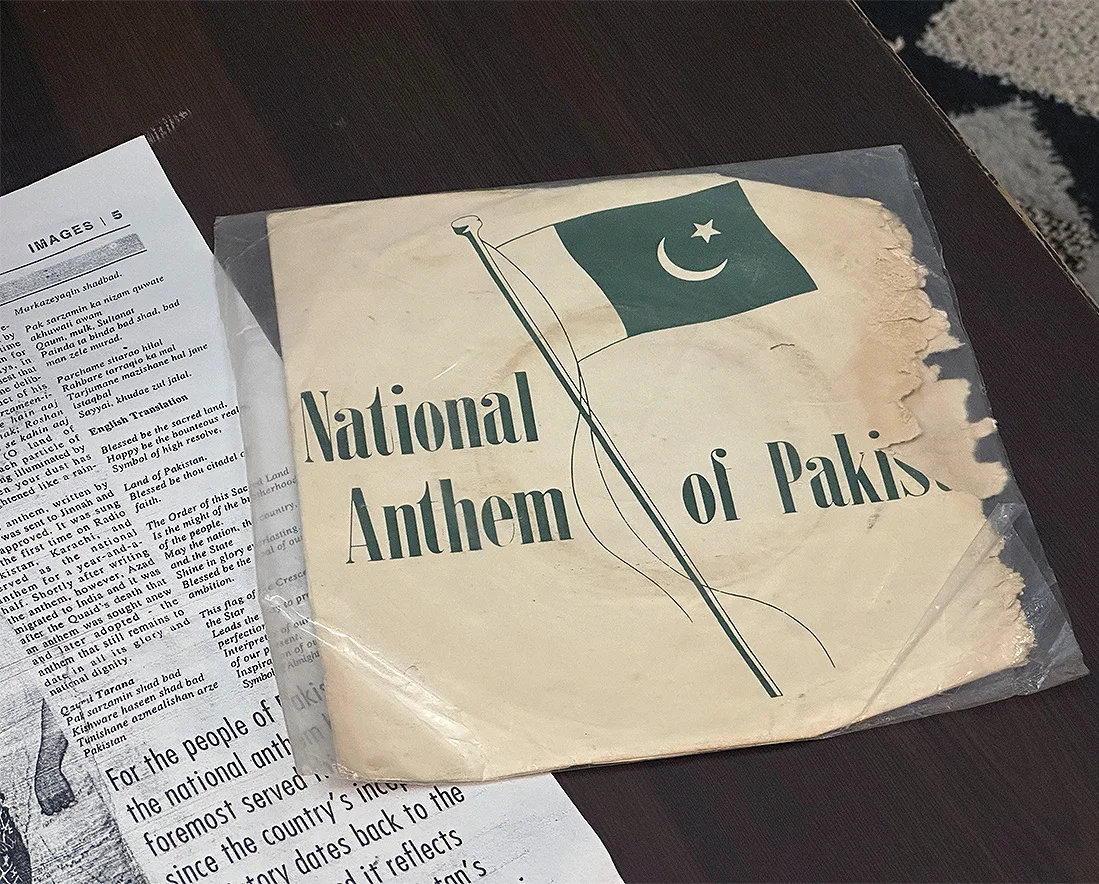
While much of the Qaumi Tarana's emotional core rests on the duality of major and harmonic minor, that alone doesn't fully explain its instant recall. The melody follows a very poetic A-B-A structure: the major section opens with “Pak sarzameen shaad baad,” gives way to a minor section at “Pak sarzameen ka nizam,” and returns to major for “Parcham-e-sitara-o-hilal.” Jalandhari, likewise, reserves his verses on progress and flag for the major sections; his invocation of the people's power for the minor-key segment. This interplay of music and poetry owes a lot to Chagla's musical framework. The three segments contain four musical phrases each, with the third phrase of each segment being the most melodically adventurous. This creates a memorable rhythmic pattern, and creates a strong recall meant for the heads of millions.
Chagla understood more than just composition; he was a musicologist and a sound intellectual. Notably, Chagla worked as an independent journalist during his time at Trinity College, where he studied musicology, a crossdisciplinary study of music and culture. He was also an active member of the Theosophical Society, authored a book on Shah Abdul Latif Bhittai, and worked in European opera houses.
Nothing in the musical world of Chagla is co-incidental. The Wagnerian chromaticism, harmonic minor melodies, and the general architecture are not accidents, or music theory embellishments. In fact, Chagla understood more than just composition; he was also a musicologist and a sound intellectual. Notably, Chagla worked as an independent journalist during his time at Trinity College, where he studied musicology, a crossdisciplinary study of music and culture. He was also an active member of the Theosophical Society, authored a book on Shah Abdul Latif Bhittai, and worked in European opera houses. This unusual range of experience gave him a singular vantage point. He does think simply in terms of aesthetics, but instead engages with a myriad of perspectives in music, culture, and national identity. Chagla’s musical practice carries a vision similar to composers like Ludwig van Beethoven. Just as Beethoven translated the ideals of the Enlightenment into music through Ode to Joy, Chagla transformed the struggle for homeland into one of the most recognisable musical works of 20th-century South Asia.
Every passing government of Pakistan will continue to redefine what the country stands for, but the Qaumi Tarana takes a definitive stance. It engages with the fundamental question: Who is a Pakistani? According to Chagla, a Pakistani is a little major, a little minor, a little happy, a little sad, tense at times, and, most importantly, relatable and memorable.
Jalaluddin Hyder is an independent filmmaker, cinematographer, and critic based in Karachi. His films have screened at Hudson Valley Museum of Contemporary Arts, Egyptian American Film Festival, Alliance for Media Arts and Culture, and more. He can be reached at @hyder_films on Instagram.