Pakistani creative industries – particularly those built around image and performance– have always shared a complicated relationship with religion. Long before Instagram apologies and carefully managed comebacks, some of the country's biggest stars publicly wrestled with the contradictions of fame, often describing an inner reckoning that eventually reshaped their careers. Junaid Jamshed remains the most famous example. Najam Sheraz walked a similar road. Ali Haider spoke more candidly than most about the tragedies that altered his relationship with music and belief.
But this isn't an essay about spiritual transformation. It is about something much newer: the way public religiosity has become woven into the choreography of celebrity rehabilitation in Pakistan's digital age. It is with an entertainment ecosystem that has learned to deploy visible piety as a shortcut around public accountability.
The system, as it always has, remains complicit, favouring whoever already holds power. And the participatory promise of the internet – the hope that a more accountable, more democratic public conversation might finally take root – keeps finding its antidote in the same recurring sequence: a performer accused of questionable conduct disappears from public life, only to resurface at a majlis, a dars, alongside a prominent religious scholar, or at a holy sanctuary.
May God be with them, and may the light they seek bring the introspection it promises. But my sermon today isn't for them. It's for the fans who pay – with attention, with money, with devotion – to have these same stars say their name, like their comment, or notice them for a second. My dears, you carry a bigger responsibility than you think.
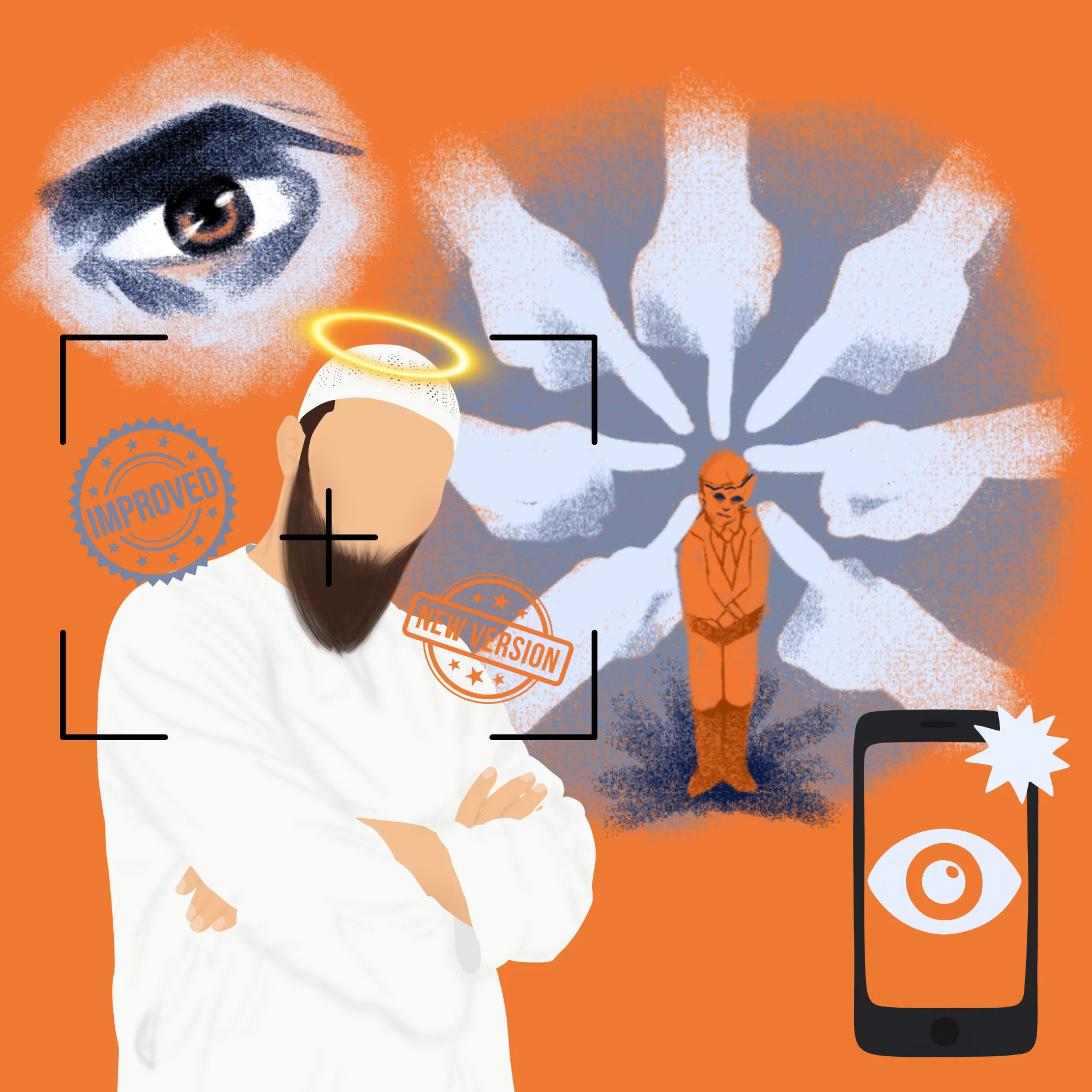
The pattern is difficult to ignore once you've seen it. Every time a Pakistani performer – overwhelmingly a male one – is implicated in morally questionable conduct, he disappears from public view. Before long, a photograph emerges: at a majlis, beside a respected scholar, inside a shrine, or at a mosque. The image quietly becomes the centrepiece of the conversation surrounding his return.
I am not questioning anyone's faith. I am interested in the choreography.
Somewhere along the way, public displays of religiosity have become part of celebrity rehabilitation in Pakistan – as predictable as the tearful Instagram apology, or the carefully worded statement about "taking time away to focus on myself."
Ducky Bhai, Sham Idrees and Shahmeer Abbas – all three of them – declared their forgiveness by writing in the comments section from their official YouTube channels. A private reckoning, if that's what it ever was, immediately became a comments-section pageant of humility, each YouTuber racing to be seen receiving the sermon rather than simply receiving it.
The reveal follows the same logic that drives every successful social-media campaign: curiosity first, confirmation later. Platforms reward anticipation long before they reward certainty. For an average Pakistani celebrity page, going viral isn't left to chance – it can be commissioned for as little as twenty thousand rupees, and the real craft lies in making it look like it wasn't. What follows is a genuinely well-engineered arc. Take Ashura, or any other religiously significant observance: early in the day, a handful of incomplete images start to surface, such as a hand mid-gesture, a face caught at an angle, a frame that looks spontaneous rather than staged. As the evening unfolds and the actual community observing the day gets pulled further into the rhythm of the ritual itself – the preparations, the mourning, the remembrance – the fragments online begin resolving into something whole: a complete video, a finished photograph, arriving exactly when the appetite for it has already taken root.
Does that look like so-and-so at a majlis? Does that look like so-and-so beside a leading religious scholar? While the community actually observing the day is occupied with the real business of grief or celebration, the digital version of the story is quietly assembling itself on a separate track – a sequence engineered to unfold in sync with the sanctity of the occasion, releasing itself in shorts till it completes into a clean, believable narrative of return.
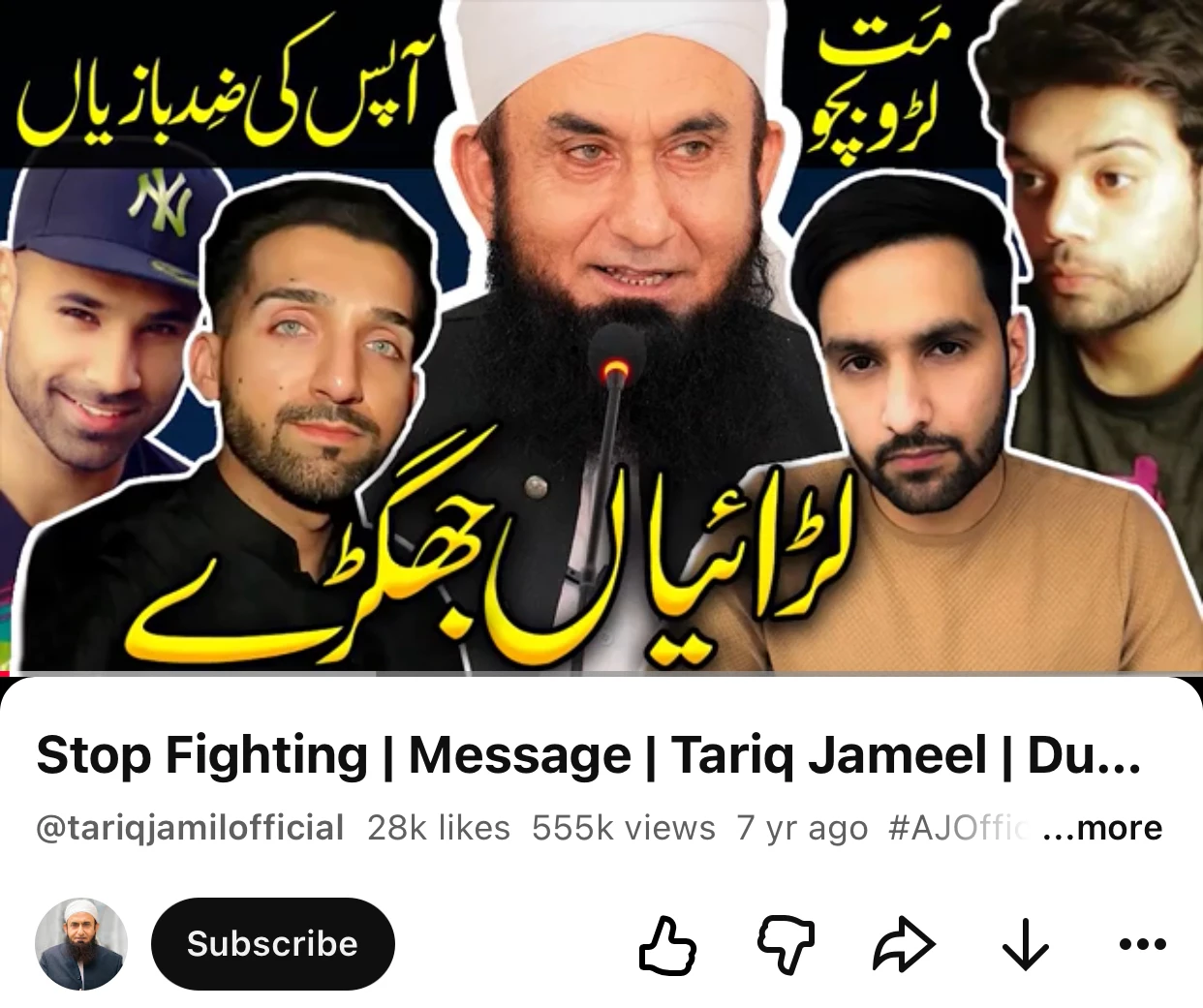
I will admit, though, that not every instance of this script disgusts me. Now that I have seen certain moments almost miraculously emerge on social media at the exact right timing, I have more respect for Sham Idrees and Ducky Bhai, who after a very public falling-out found their way, at least by name, into the orbit of the well-known and well-regarded scholar Maulana Tariq Jameel, who took it upon himself to broker peace. The symbolism mattered more than the logistics. Although only Zaid Ali T appears beside Maulana Tariq Jameel, the message was addressed to all five creators involved in the feud. It was an almost old-fashioned instinct applied to a thoroughly digital conflict: when you can’t resolve it yourselves, you turn to someone whose moral authority still carries weight.
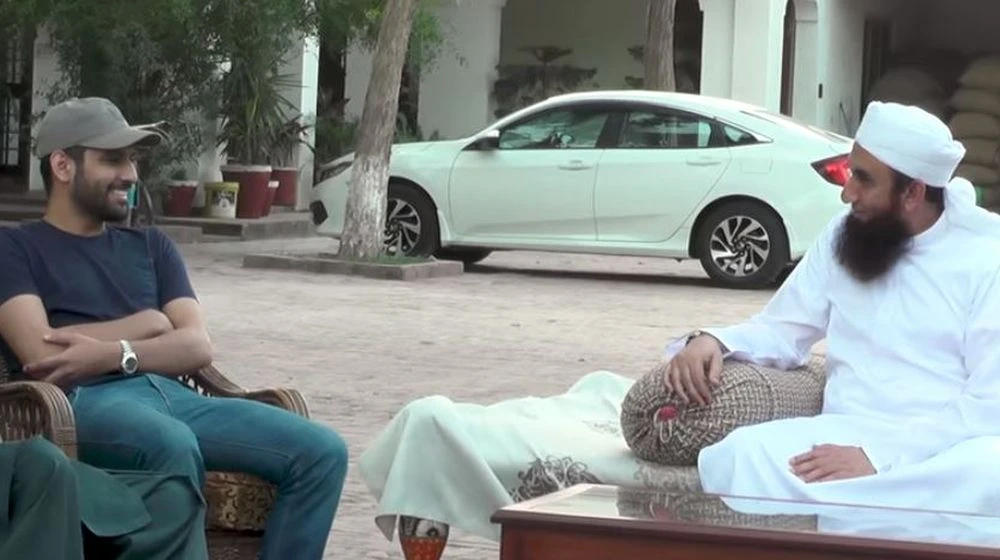
What happened next is the part that really gives the game away. The feuding YouTubers didn't quietly absorb the message and moved on; instead, they showed up in the comments section, one after another, to publicly perform their gratitude. Ducky Bhai, Sham Idrees and Shahmeer Abbas – all three of them – declared their forgiveness by writing in the comments section from their official YouTube channels. A private reckoning, if that's what it ever was, immediately became a comments-section pageant of humility, each YouTuber racing to be seen receiving the sermon rather than simply receiving it. The apology, in other words, needed an audience as badly as the feud once did.
For what it's worth: the video uploaded on the Moulana’s channel has sat at 555,687 views since May 17, 2019. Call it a modest reconciliation if you will, quietly kept, or proof that even piety-as-PR has a shelf life once the algorithm moves on to the next feud.
Digital creators, though, are a different case – because they live a life that is already fully digitised, people like Ducky Bhai and Zaid Ali T understand the mechanics of the platform, and the ecosystem built around it, better than anyone else in this equation. They rarely need an external page, a leaked photograph, or a well-timed majlis appearance to buy back the audience's goodwill, because they are both the performer and the publisher – they can simply orchestrate the moment of restraint themselves, calculate its financial and social return in real time, and post it directly, often only to slide right back into the very behaviour they just publicly repented for.
But this choreography of disappearance and return is a script almost exclusively available to men. A woman accused of comparable "questionable conduct" is rarely afforded the same arc back into public grace. Instead, she is more likely to be slut-shamed, her body, clothing and personal choices subjected to an endless cycle of public judgement with no equivalent sequence of images capable of restoring the benefit of the doubt. The contrasting trajectories of Alizeh Shah and Rabi Peerzada illustrate this uneven terrain: despite taking markedly different paths after deeply public moments of scrutiny and shame, neither was granted the kind of culturally legible redemption so often available to men.
In her book Empowered: Popular Feminism and Popular Misogyny, Sarah Banet-Weiser argues that visibility itself is gendered. Patriarchal culture does not simply produce different reactions to men's and women's scandals; it distributes public attention unequally. Women's bodies, reputations and choices remain under continuous scrutiny, while men are more readily permitted to disappear until the next carefully timed image signals their return. In that sense, the majlis photograph functions less as a source of redemptive capital than as a culturally legible exit from a spotlight that patriarchy rarely keeps trained on men for long.
However, none of this would work without us. Every performance requires an audience, and redemption campaigns are no different. They succeed because we are hungry for moral closure. Religion offers precisely that: a culturally familiar language of forgiveness that feels emotionally complete even when accountability remains unfinished. We don't simply consume these narratives; we help stage them, rewarding the choreography with attention long before we ask whether anything has actually changed.
The contrasting trajectories of Alizeh Shah and Rabi Peerzada illustrate this uneven terrain: despite taking markedly different paths after deeply public moments of scrutiny and shame, neither was granted the kind of culturally legible redemption so often available to men.
The ones who actually suffer for lack of that control are film and television stars – showbiz in the older sense of the word – because their livelihood remains tied to an industry rather than an audience they own: producers, brands, endorsements and the next phone call that may never come. That dependency is precisely why it is these actors, not YouTubers, who are more likely to hire entire PR teams to engineer their return – not simply from scandal, but back into likeability itself.
So, the next time you see a performer leveraging a sacred occasion to return from controversy, remember that somewhere behind the apparent spontaneity there may also be a strategy meeting, a communications plan and a publicist whose job is to make the performance disappear into authenticity. The more convincing the choreography, the less visible the choreography becomes.
What interests me is what happens the day the script stops working. What happens when audiences begin to recognise the choreography for what it is, when the sacred occasion no longer offers cover but becomes evidence of calculation instead? I suspect the advice from the PR team will remain unchanged: your intentions were sincere; your heart was in the right place; God knows the truth. Perhaps He does. The rest of us, however, should ask a different question: when did redemption become something that could be storyboarded, scheduled and released like any other publicity campaign?
Rafay Mahmood is Assistant Professor of Practice at Habib University and writes on pop culture, digital rituals, and contemporary media culture in South Asia. 𝘏𝘦 𝘵𝘸𝘦𝘦𝘵𝘴 @𝘳𝘢𝘧𝘢𝘺_𝘮𝘢𝘩𝘮𝘰𝘰𝘥 𝘐𝘯𝘴𝘵𝘢𝘨𝘳𝘢𝘮 @𝘳𝘢𝘧𝘢𝘺_𝘮𝘢𝘩𝘥𝘰𝘰𝘥