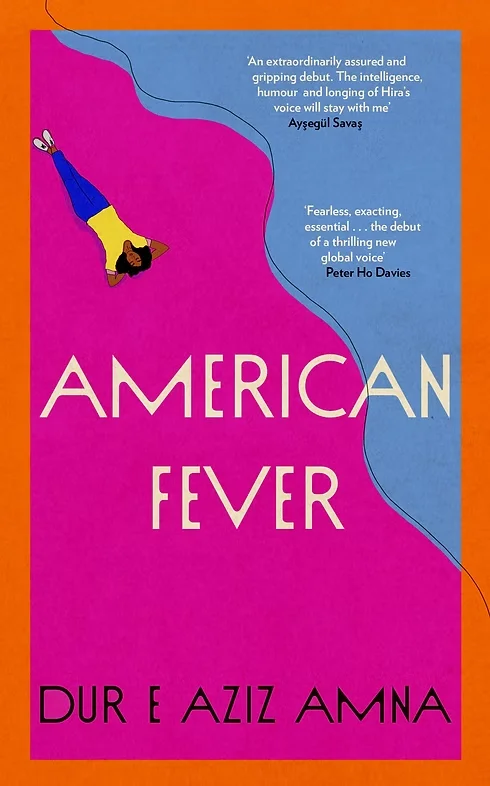
The novelist Dur e Aziz Amna’s first real mark in Pakistani literature came through a short story. Within it, her female narrator is a devotee of a shrine in Multan, a ‘lieutenant’ to a female saint. But though her life is comfortable, fuelled by donations of the crowds who revere her Bibo Mai, a complication risks unravelling everything Amna’s narrator has built up. This unusual, speculative piece — entitled ‘You Get What Is Yours’ — won Amna the Salam Award for Imaginative Fiction in 2021. A year later, American Fever followed, and Hira and her fraught time as an exchange student in the United States established Amna as part of a newer generation of Pakistani writers in English. Both in the novel and in an acclaimed essay from 2019, Amna delivers blistering attacks on the US and the strange effects of its world for immigrant populations, leaning on her own experiences with migration to inform her clear-sighted takedowns of culture and home.
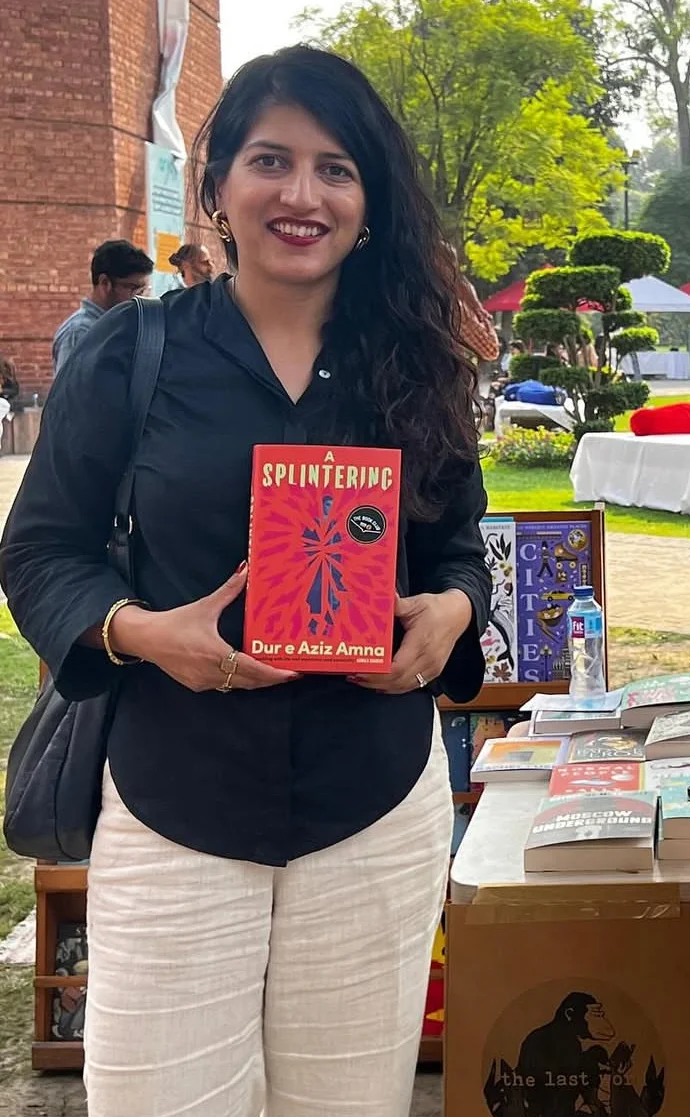
In her latest, A Splintering, Amna drifts away from North America; instead, her reader is placed exclusively in central Pakistan, tracking an ambitious young woman striving to raise herself from fictional ‘Mazinagar’ to the upper echelons of Rawalpindi society. And while Amna does not call it an Islamabad novel, its weaving of moments pivotal to the capital’s history into its narration — like the Ojhri disaster, the earthquake — maximises the novel’s impact as bearing testimony to a very particular, underwritten Pakistani urbanity.
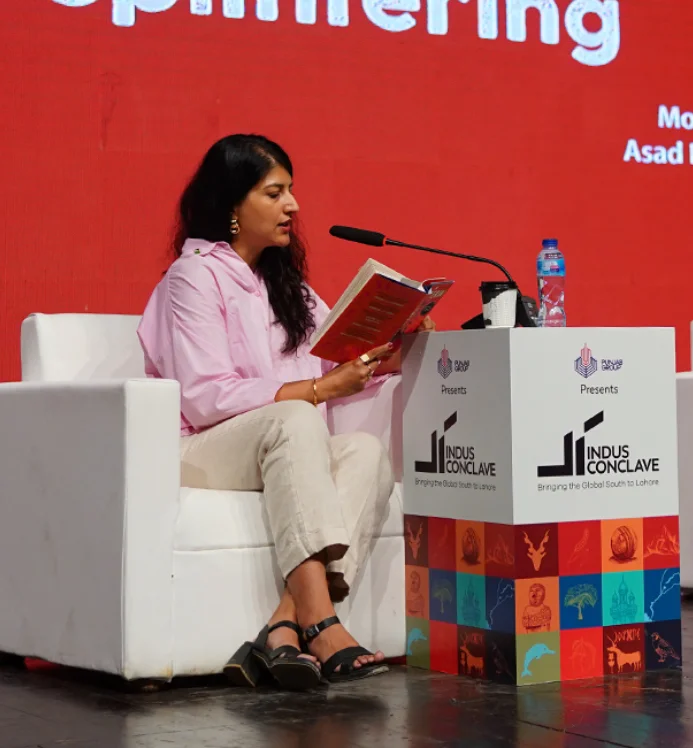
This interview took place in Lahore, during Amna’s visit as a delegate of ThinkFest 2026.
Rana Saadullah Khan (RSK): The setting for A Splintering was unusual to me, as your precedents for work set in Pakistan have typically centred around Lahore or Karachi. What made Islamabad the space for your novel?
Dur e Aziz Amna (DAA): It’s interesting that you say Islamabad, though only a few scenes are set there. But I think that speaks to the porousness of Rawalpindi and Islamabad — when you’re living there, so much is shared between the two cities; you might be based in Pindi, but your kid might be going to school in Islamabad, or you might work in Islamabad and live in Pindi. But the biggest reason I chose Pindi is the fact that I grew up there, and while it’s not what my parents call home — because their home is the ‘village’, as Tara puts it in A Splintering, those villages that are not really ‘villages’ now, because they’ve grown into towns or cities of their own — my whole life was spent in Rawalpindi. It’s the place I feel most comfortable with; I have no desire to write a Lahore or Karachi novel.
RSK: Thinking of transforming villages, Mazinagar also evolves within the span of the novel. Have you encountered other fictionalisations of the towns and villages in Kallar Kahar that inspired Mazinagar? What would you say that particular rural landscape evokes for you?
DAA: One of the writers that I really love is Ahmad Nadeem Qasmi. He’s from the town called Anga, which is very near Sakesar, in the Kallar Kahar region, so it shares a lot of similarities in landscape — but also in ethos — with Talagang, where my parents are from. It is what Mazinagar is sort of based on. It’s a very different landscape from the Punjab of Lahore or southern Punjab. You must have noticed it upon descending the Kallar Kahar mountains: you come down the mountains and suddenly things get much greener, much flatter — the ‘bread-basket’. But that’s not what the Potohar is. There’s not a lot of irrigation there, and it’s nowhere near as fertile as this Punjab.
RSK: Something I find interesting about the interactions Tara and her mother have with shopkeepers in Rawalpindi-slash-Islamabad is how they sometimes switch into ‘dialect’ to make sure they aren’t understood by the people around them. I believe there’s a more revitalised interest in Potohari as a language too, as opposed to it being understood as a dialect of Punjabi. Have you personally experienced that kind of code-switching?
DAA: The code-switching for me really is between Urdu and English, since I live in the United States. I did grow up in a household where my parents spoke to each other only in Punjabi, but as soon as they talked to us, they firmly switched to Urdu. We were not allowed to speak in Punjabi to them, because there was this idea that it would soil our Urdu and that the Punjabi accent would seep in. There are two reasons I used the word ‘dialect’ in the novel. It is true that Shahpuri, which is what Tara would have spoken, is a specific dialect that is different enough from Lahori Punjabi for it to be pretty noticeable; the grammar might be the same, but the vocabulary is very different. One of my cousins is an undergraduate at Habib University (Karachi), and I believe that there’s some requirement there to take a local language course, so he took Punjabi. Whenever he would speak in that class, he spoke in our dialect; it was different enough for the professor to say that what he was speaking wasn’t Punjabi. That isn’t to say it was a bigoted response, but that it sounded so different that the professor felt it wasn’t Punjabi.
The second reason I chose the word ‘dialect’ and used words like ‘provinces’ is because I didn’t want to be tied down to specifics in a way that distracted. Especially when we write about ‘our’ worlds, any time you get too specific, it becomes anthropology. I don’t know if the solution is to remove all proper nouns — that probably isn’t the solution — but I was exhausted with that feeling of, okay, now that I have written ‘Punjabi’, I have to explain the differences between this Punjabi and that Punjabi. Even if you were to say, for example, ‘I began to read the Fatiha’ as opposed to ‘I began to say a prayer’, the reader — and I would argue even the local reader — might start thinking about the particularities of the Fatiha, about my choice to use ‘Fatiha’. So these choices ultimately were also a way for me to zoom out. The problem of speckling other languages into the English text seems to be that you run the risk of making the other language a tamasha. But is the solution to only write in English, and lose access to all the other meanings we have at our disposal? Certainly not, but in A Splintering, at least, I was toying with that particular solution.
RSK: There’s also something about your diction itself — especially within A Splintering, but also to some extent in American Fever — where there’s a deployment of the English language in an orthodox way. It isn’t ‘channa daal’, but ‘chickpeas and lentils’. I admire how this interacts with Tara’s ambitions in the story and as a narrator. I wonder if your inspirations in South Asian literature in English are in Anita Desai, rather than, say, Salman Rushdie or Arundhati Roy. Of course, I use ‘orthodox’ here with a pinch of salt.
DAA: With Rushdie, I don’t remember who the critic was, but I can remember the use of the term ‘chutnified English’. What is interesting about it is that it comes from the mouth of certain characters and not others who speak in proper English. I’ve always grated against putting on a sing-songness; the typical victims of this style are, of course, servants, who will always speak in broken English. But then, if you think about it, they’re not speaking in English at all, so the way you then translate it — there’s something very strange going on there. With A Splintering, I was exhausted with the language question entirely, partly because I had been banging my head against it for a while; I even published an essay about it. The essay was well-received, but it also showed me just how many people were grappling with this question, reaching the same conclusions, and I was tired of it.
American Fever was quite autobiographical, and it took me a long time to realise just how wild that had been for me, to go from an upper-middle class school in Pindi to what both Hira and I imagined as the best and most prosperous country in the world.
But, of course it still comes up in Tara’s head: when she moves to the city, she really wants to speak better English, and she can tell that the touches of Punjabi are coming into her Urdu, she can tell her husband speaks differently from her. The other thing I wanted to do was to stay true to the character of Tara. She is not the kind of person who cares about language at all. She’s not invested in making sure her kids carry on the language and is deeply practical. Tara is focussed on other things in life.
RSK: Both of your novels are also given to very dramatic turns, especially in the sense of how unpredictable their plotting can be. Do you think that’s intuitive for you as a writer, or is it rooted in particular narrative structures?
DAA: With both the novels, I knew where they would start. But with A Splintering, I didn’t really know where it would end. The character of Tara was very clear to me, her motivations and goals. But I didn’t know what she would do to achieve them. Even when I saw what she would do, I still didn’t know how far she would take it. And then of course that ending — it took me a long time to get there, and I got there during the process of writing the novel. With American Fever it was different: I knew from the start what would happen. Still, the way it would get from point A to point B was a mystery to me.
RSK: Would you say that you wrote the opening to A Splintering at the end of the writing process?
DAA: Yes! The very opening of A Splintering — which is her breaking the fourth wall and addressing the reader — comes from a strange story. Initially, the book started with Tara in her childhood home. There’s a scene with her and her brother, where he is yelling at her and we get a direct view of this character who’s going to be one of the main secondary characters, her tormentor throughout the novel. When we were out submitting the novel, my agent was worried that the archetype of the very domineering brother wouldn’t be very relatable for an American audience, that it would be a hard sell. I got very frustrated with that. However, we needed to do what we needed to do, and I began considering what we could have as an introduction instead.
What we get at the very beginning is this woman who’s struggling with class disparity and a desire for endless wealth; she feels like she’ll never have enough, because she’s always comparing herself to other people. That felt, in some way, to be a more relatable thing to start with. Especially now with wealth inequality the way it is globally, this did feel like something everyone could gather around before I divulged the specifics of the story. Which is also why — consciously or subconsciously — there’s this passive aggression to how Tara is like: Listen, I know I’m not a relatable character, but can you hear me out?
RSK: You’ve mentioned Elena Ferrante in your other interviews as an influence, and this conversation is reminding me of the violent, controlling brothers in the Naples she creates. I wouldn’t necessarily agree with your agent that those mores are very different from the violences at play in A Splintering. As a writer, have you found curious resonances emerge for you in literatures unusual to your experience?
DAA: There’s Ferrante, but then there are also Annie Ernaux and Jenny Erpenbeck. I’m not exactly able to pinpoint what it is that I like about them. If we are to assume that in some ways — and I know it’s a very limited view of history, a very flat way of thinking — the Europe of a few decades ago is the Pakistan of today, particularly with respect to women’s place in society, there might be some truth to it. There’s something there in that older generation of female writers coming out of Europe that I feel a lot of affinity for, and I think it is because they’re writing about this sudden propulsion of women into the public space in a way that I saw in my early childhood here.
RSK: When you started American Fever, did you know that it was also going to be about the disparities of urban Pakistan and the United States?
DAA: The template was very clear: I knew that the novel was going to be set during an exchange programme, so there was a discrete start and end. It’s not just the disparity of becoming an ‘immigrant’ — which Hira isn’t, since she’s just an exchange student — but also about going from this chaotic, urban landscape to the middle of nowhere. American Fever was quite autobiographical, and it took me a long time to realise just how wild that had been for me, to go from an upper-middle class school in Pindi to what both Hira and I imagined as the best and most prosperous country in the world. Except you end up in a highway town on the West Coast, and there’s nothing to do. There are very limited resources, and there’s actually a lot of poverty around you, tons of people without health insurance. Imagine just how jarring that was because of all that you’d been told about this place. I went back to Oregon last year, and now I know the US more, and I was able to better place the markers of extreme poverty that exist there — such a strange place! There was this one time my husband and I were driving on this road, and he stopped driving and said, “Who the [expletive] thought it was a good idea to send you here?” It was oddly redemptive to have an adult say that. But yeah, it was a very strange experience, but also, strange in a way that took me a long time to understand.
In fact, if you can accuse Pakistani literature in English of anything, it’s that it’s very political: it’s very aware of geopolitics, of who is the prime minister, of who’s getting killed…
RSK: Hira’s experiences definitely gave me a new way of seeing, especially thinking about the amount of physical activity and sport the average American girl is expected to partake in. Hira realising how rare it is for schooling systems or communities to think too much about sports for girls in Rawalpindi has stayed with me. In the process of creating characters like Hira and Tara, what was the Urdu or South Asian literature in English you encountered growing up which influenced your storytelling?
DAA: When I was in school, we were made to read Dastak Na Do by Altaf Fatima; like many of the Urdu novels that I’ve read, it’s set around Partition. Another in the same vein of works is Khadija Mastur’s Aangan, but I didn’t particularly enjoy reading it; to me, it was quite stifling and frustrating. I remember talking to a male friend of mine for whom it was eye-opening to hear from the other side, from inside the courtyard. But I remember thinking: I know the flipping courtyard! It was too close to home in some ways — not that I’ve spent my life in a courtyard, it’s just that I’ve been in those spaces where women are entirely enclosed, and their concerns are supposed to revolve only around that space. In Aangan, the story never leaves the courtyard, you’re stuck inside for the entire novel — it’s claustrophobic. Something of that might have filtered into A Splintering, in the sense of the novel being a history of Pakistan told from within a courtyard.
I guess the very first Pakistani English-language author that I encountered was Bapsi Sidhwa, and that is because my mother read her; she pressed The American Brat into my hands. Then there was Mohsin Hamid’s Moth Smoke and Kamila Shamsie’s Kartography. In some ways, we are lucky: we did have some prototypes, and I didn’t feel like I walked into a blank space. Not that we ever did, we always had writers writing in other languages, with English fiction only taking off in the ‘90s and early 2000s. But it was comforting to know that there were other writers writing in English and excelling at it.
There’s something there in that older generation of female writers coming out of Europe (Ernaux, Erpenbeck, Ferrante) that I feel a lot of affinity for, and I think it is because they’re writing about this sudden propulsion of women into the public space in a way that I saw in my early childhood here.
RSK: Your response to Aangan reminds me of criticisms I’ve heard of Banu Mushtaq’s Heart Lamp. Some readers found that the parameters of its short stories stick very close to the metaphysics and themes explored in Pakistani soap operas and television plays, and thought it was underwhelming to encounter that again in prose fiction.
DAA: I sometimes do think about how our soap operas’ logic is so different from the logic of our literature. That’s probably true for soap operas elsewhere, since they are by definition escapist. But no politics exists, you don’t really know what year you’re in, you don’t know who’s prime minister — there are no markers of anything external. That is what makes Pakistani English fiction so singular, because that’s not the case there at all. In fact, if you can accuse Pakistani literature in English of anything, it’s that it’s very political: it’s very aware of geopolitics, of who is the prime minister, of who’s getting killed…
RSK: And given how literary conversations are conducted in Pakistan, spaces like the Indus Conclave, the Lahore Literary Fest and ThinkFest do appear to be invested in how politics affects ordinary people. Do you think that schism is really pronounced between how you encounter literary conversations within, for instance, conferences like the AWP in the United States, compared to how this kind of programming is done in Pakistan?
DAA: Yes, absolutely! It’s such a shock to me whenever I come here and I’m reminded of how easy it is for people here — mostly for the better, but sometimes for the worse — because occasionally the people talking about certain subjects are not an expert on that subject at all. I do think there’s something so freeing in giving yourself a broader mandate. And also just this acknowledgement that literature is firmly tied to all these other things that we care about and think about, whereas in the US, it is very siloed. For instance, on a literature panel in the US, most writers would talk exclusively about craft, whatever that means.Things are more segmented there.
RSK: That said, you’ve done tours for your books in Pakistan, the UK and the US. Do you think there’s a distinction between these places in terms of how people generally pose questions about literature?
DAA: I always say my best and worst readers are Pakistanis; some of the most outrageous questions I’ve gotten have been in Lahore, but some of the most in-depth conversations I’ve had have also been in Pakistan. There is just so much to be talked about when the context is shared.
RSK: I’ve noticed that there is sometimes a response to your characters in which some people wish they behaved better: Hira should have been nicer to her host-mother; Tara should have been a more feminist figure. What do you think about these responses?
DAA: I don’t. That sounds glib, but I truly don’t. Once I’ve written it and it’s out there, it’s between the reader and the book. But particularly with Tara, I’ve noticed that there’s always, always this question of permission. A lot of readers will say: Well, I was with her when she was trying to get an education, but then she did this thing and that’s where I lost her. The thing is, she didn’t ask you — she didn’t ask you what she was going to do. In this hypothetical tussle with this character, why are you assuming she was asking you for permission? I think that’s just how we approach women: every moral question around women is based on permission, which is not the case for men.
I always bring up this example of male anti-heroes: Tony Soprano is a famous one, a guy who’s doing blatantly bad things. But it’s made up for by the fact that he’s generous and he loves his family; in fact, I would say he’s admired because he’s flawed, not despite his flaws. That logic doesn’t apply to women. Honestly, and it’s so funny that Tara has been framed as an ‘unlikeable’ character, but I actually think that between Hira and Tara, I like her far more than Hira. If I read back passages from American Fever, I have this feeling of being grated by her teenage-ness, which we lose some patience with as we grow older. With Tara, though, I feel like some of the responses go back to that question of permission.
Particularly with Tara, I’ve noticed that there’s always, always this question of permission. In this hypothetical tussle with this character, why are you assuming she was asking you for permission? I think that’s just how we approach women: every moral question around women is based on permission, which is not the case for men.
RSK: Something I especially want to ask you: as someone who is involved with literary networks like Tin House, in book launches with other new and older Pakistani writers like Farah Ali and Mohammed Hanif, how have these communities helped you remain embedded within Pakistani literary writing?
DAA: I think there are two different things. Community is essential — it’s important to have friends, but do the friends need to be writers? I don’t know. Most of the time when I’m writing, it’s very solitary. I’m not showing anyone my work.
I don’t know exactly what people say when they mean a ‘literary community’. It can be nice to have that, but I don’t think it has anything to do with writing. Even when I was at the MFA, it was great to be around other people who wanted to be writers, but if there’s one thing I learned it is that we couldn’t help each other write. When you had to write, you still had to recede into that dark room or, at least what feels spiritually like a dark room, because you never know what’s coming next.

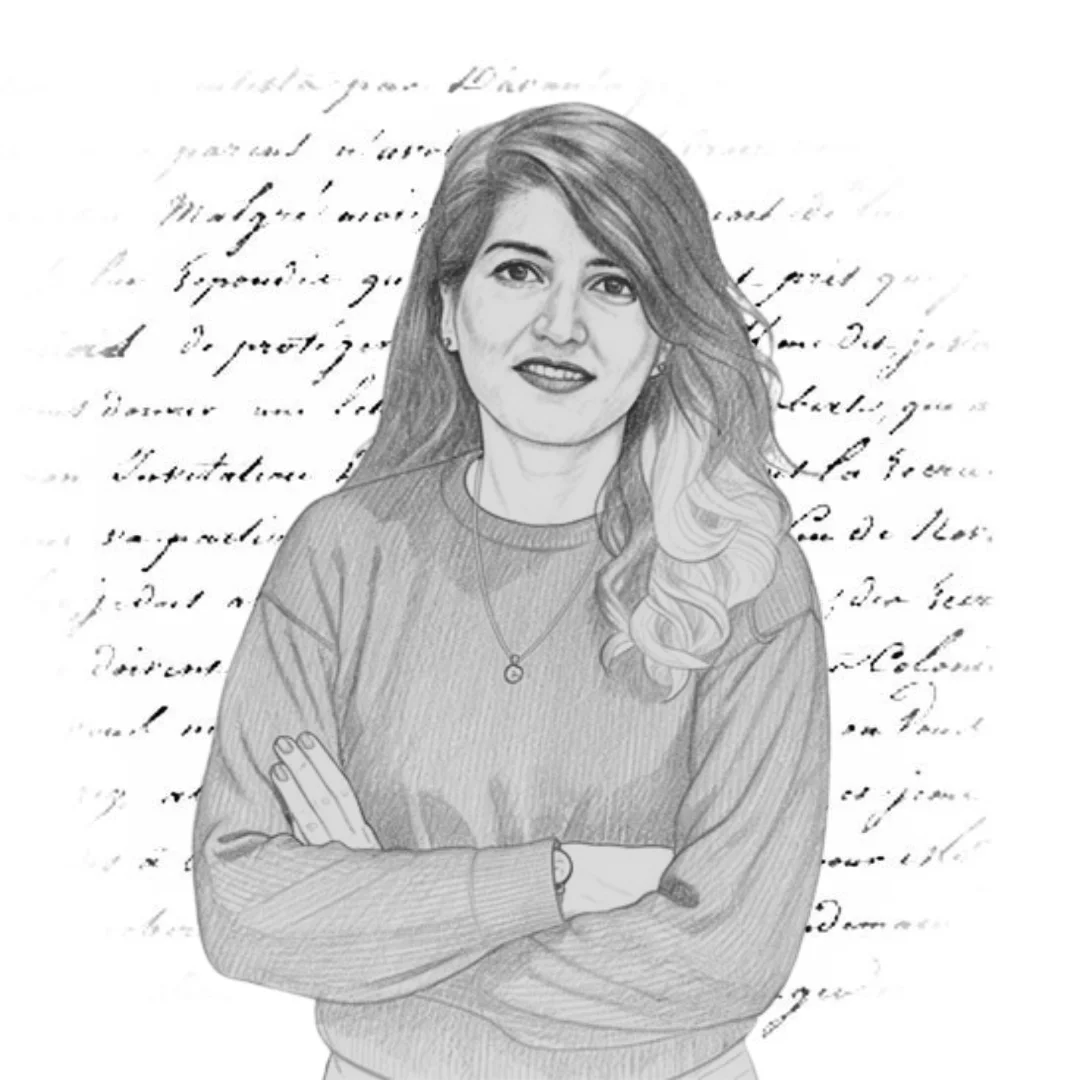
Rana Saadullah Khan is a writer from Lahore and Islamabad. His work has been published in Lakeer, Jamhoor, The Aleph Review, as well as through UNESCO Pakistan and by the history education platform, Hashiya.