It is a slightly less depressing time to be a Pakistani critic and lover of cinema. In the last three years alone, local cinema has stumbled into a relationship with speculative fiction. Though still concentrated around the two Eids, and populated by the same stars playing familiar archetypes in increasingly interchangeable stories, recent Eid releases have at least attempted some fun experiments with genre films, including fantasy, horror, and science fiction.
2024’s endearingly impaired offering was Umro Ayyar – A New Beginning, a fantasy drama that inspired some confidence in the otherwise bleak future of visual effects in Pakistan. The VFX and select performances delighted even when the world-building failed to cohere into something with its own internal logic. Despite its faults, it was considerably easier to cut Umro Ayyar some slack for at least trying to think outside the box. Of course, 2025’s Deemak also tried to break out of the box, in another much-appreciated yet deeply uneven attempt at horror. Flailing between comically bad CGI jinns and generational trauma, the film lurched from contrived exorcists to psychiatric breakdowns, revealing a palpable lack of confidence in itself.
As is often the case with Pakistani genre cinema, every new horror or fantasy film is treated as though it has emerged from a vacuum.
This year continues the grand Eid tradition as the first-of-its-kind Zombeid approaches its premiere. Directed by Nabeel Qureshi, the film stars Fahad Mustafa as a mixed martial artist and Mehwish Hayat as his romantic interest. When a virus outbreak erupts at one of Mustafa’s cage matches, he must pair with Hayat, alongside a number of hapless civilians, to survive. In one scene, a visibly irritated cop hears about the outbreak and scoffs, “Zumbees? Everyone’s up for a joke on Chand Raat.” A sweat-slicked Mustafa, all bandana and bulging arms, spends the trailer hurling punches at staggering white-eyed zombies.
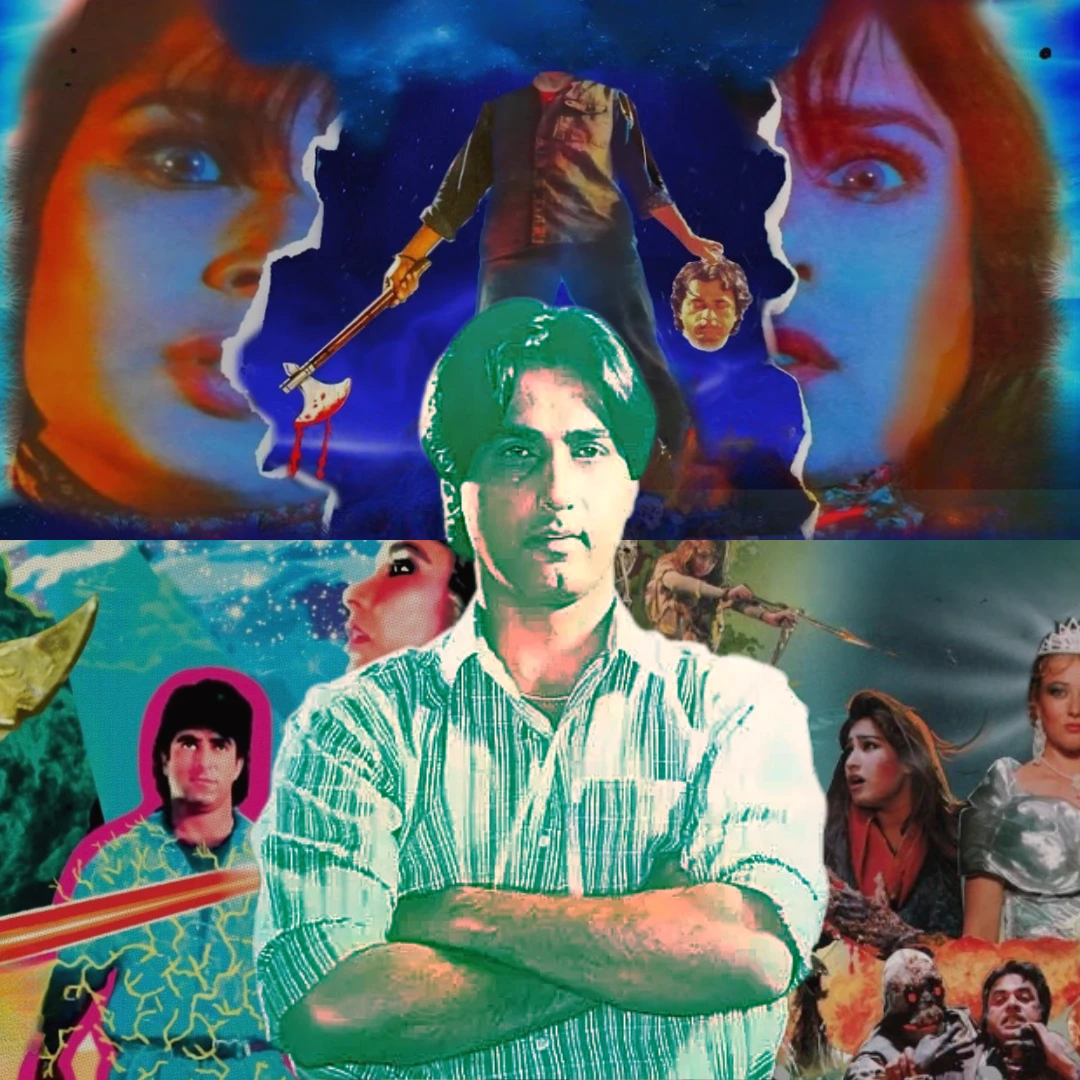
As is often the case with Pakistani genre cinema, every new horror or fantasy film is treated as though it has emerged from a vacuum. Omar Ali Khan’s Zibahkhana (2007), for instance, has a stronger claim to being the first Pakistani zombie film, arriving with the grime and self-awareness of post-Texas Chainsaw Massacre splatter cinema. However, long before it, Pakistani horror had already been experimenting with vampires, mad scientists, aliens, and severed heads through films like Khwaja Sarfraz’s Zinda Laash (1967) and the flourishing of Pashto horror cinema in the ’80s and ’90s. But it may have reached its most visually consistent form through the work of director and cinematographer Saeed Rizvi.
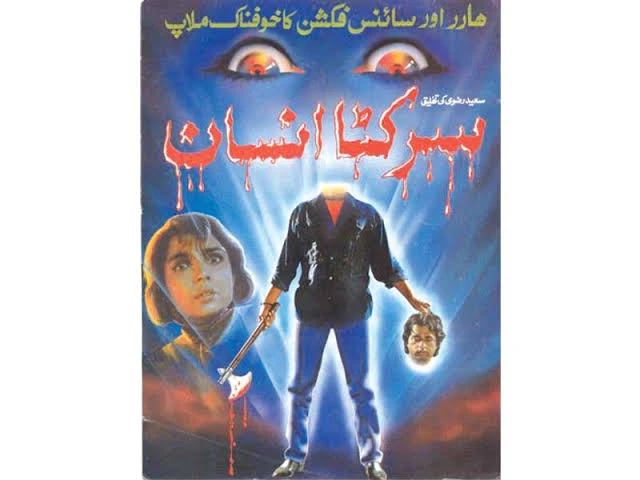
The son of filmmaker Rafiq Rizvi, Rizvi entered the scene with Shani (1989), an alien-UFO saga starring Babra Sharif and Sherry Malik in lead roles. Though Shani won a Nigar Award, Rizvi is better remembered for his next film, Sar Katta Insaan (1994). Starring Sharif opposite Ghulam Mohiuddin, the film follows the birth of a headless man after a science experiment goes wrong.
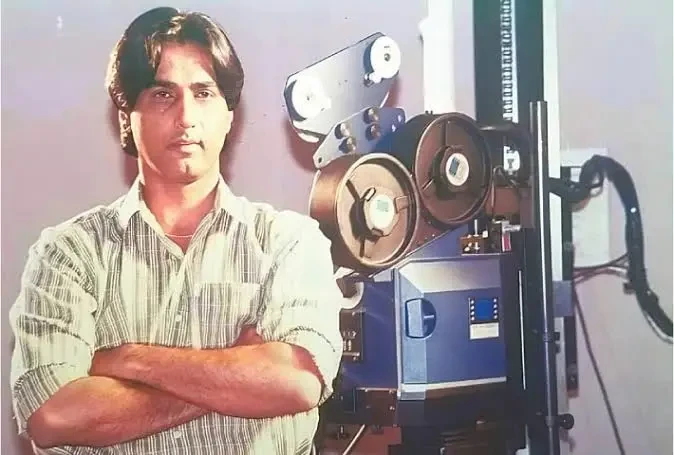
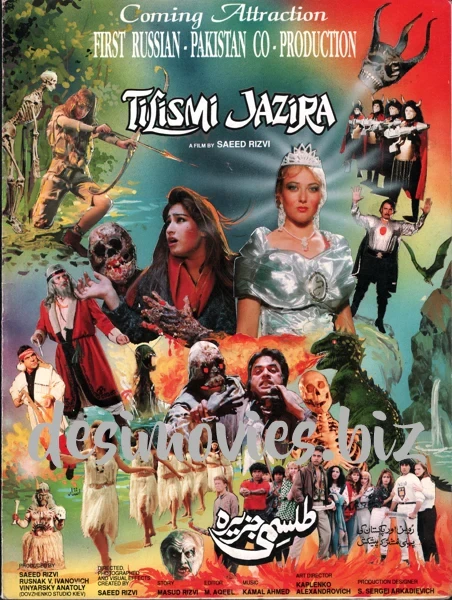
To describe Rizvi’s filmography to an unfamiliar audience: imagine if the Ramsay Brothers’ vernacular gore collided with Mario Bava’s nocturnal and lushly fatalistic imagination. This merger between Indian horror and the Italian master may not be as outlandish as it sounds since, despite auteurist interest in Bava, both traditions remain burdened by the label of “camp.” Rizvi’s reputation has remained similarly unstable, partly because Shani, Sar Katta Insaan, and 1996’s Tilismi Jazeera — completing Rizvi’s spooky trifecta — survive mostly through jittery pixelated bootlegs on YouTube, the informal archive of Pakistani cinema. In 2023, Sar Katta Insaan received an extensive restoration: the print was scanned in 6K and its bogged mono-track converted into separate 5.1 Dolby Digital channels shortly before a theatrical re-release.
Nowadays, cinephiles flock to Criterion Collection and MUBI to access precisely the sort of cinema Rizvi was making decades ago. With curated streaming off the table and no indie theatres and institutions like India’s Film Heritage Foundation (whose restoration of the 1986 Malayalam landmark Amma Ariyan just screened at Cannes), it makes sense that Sar Katta Insaan’s theatrical return went largely unnoticed. At the end of the day, the few cinephiles devoted to Pakistani cinema inevitably end up on YouTube.
It is a testament to Rizvi’s feverish command of the image that his films remain striking despite compression glitches and dropped frames. Revisiting Sar Katta Insaan, one is immediately struck by its atmospheric use of a teal-orange palette that has now come to dominate Pakistani film and television. Where contemporary uses of the palette often function as shorthand for prestige and production value, Rizvi deploys it as a genuine interplay of light and shadow. This is no small achievement given how few Pakistani films sustain a cohesive visual logic capable of contesting the limits of the merely “filmed.” Through tight close-ups and expressive inserts, Rizvi repeatedly attempts to rupture the static camera arrangements inherited from theatrical staging.
Per Rizvi, there are among us monsters not quite monstrous and aliens not quite alien. So difficult are they to identify, emotionally or empirically, that Shani sustains an otherwise conventional action-romance plot with an alien quietly seated in the front seat.
While nights recur throughout Pakistani film and television, Rizvi was easily among the first filmmakers to use darkness as an excuse to submerge entire frames in electric blue, flattening bodies into spectral silhouettes. Elsewhere, warm orange introduces an infernal heat, producing a chromatic clash that recalls the lurid theatricality of an Italian Giallo, especially the delirious colour logic of Black Sabbath.
The film follows Inspector Anwar, whose corpse has its head sawed off and stolen by a strange alliance of underground mafiosi and a mad scientist. Having invested millions into a “super mission,” the doctor and his goons want to attach a “smart” brain to the bloodthirsty body of a dacoit named Nadir in order to forge the perfect hitman: a dead man who cannot snitch. Chaos ensues when Nadir’s headless body escapes the laboratory with Anwar’s head in hand. By day, with the head attached, he roams the city and kindles a strange fascination in crime reporter Ambreen. By night, he removes the head and goes on a rampage. It is here that Rizvi gives us some of his most claustrophobic and dazzling silhouettes, images that recall equal parts of Hollywood noir and Ramsay brothers’ Purana Mandir (1984).
In one memorable shot, the headless man drives through the night. With the camera positioned in the passenger seat, we see him and the car’s interior drenched in blue, the city outside reduced to a passing smear of orange. He lives underground in the sewers, storing Anwar’s head in a rectangular crevice in the wall. If the night allows Rizvi to explore a largely underdeveloped nocturnal mood in Pakistani cinema, the daytime scenes are saturated in a clinical dull yellow and punctuated by fascinating visual effects. Consider the amusement park sequence where a revolving ride strikes the Anwar-Nadir hybrid and sends his head flying into the air. In one bizarre frame, it momentarily lands in the palm of a passenger on a ride. Then there is the hallucinatory song sequence “Dum Dama Dum,” featuring Sharif and Mohiuddin dancing alongside the Pink Panther and the Teenage Mutant Ninja Turtles, intercut with dark silhouettes against red and blue backdrops.
Much of this visual catalogue has its seeds in Shani. A recurring motif is the animal insert: hissing snakes, an owl swivelling its head, cats shrieking in the dark. More than Sar Katta Insaan, Shani plays with these images in ways that extend the film’s central politics. A UFO drops an alien into a village on a mission, where he takes on the shape of a dead man named Shanawar, nicknamed Shani. Upon seeing him, the villagers — including his family and fiancée, Hina — assume he has escaped the gangsters pursuing him. Any awkwardness in this closeted alien Shani is explained away as the aftereffects of torture in captivity.
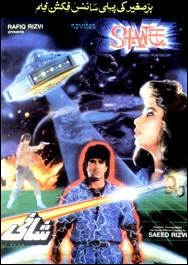
Compared to Sar Katta Insaan, Rizvi emerges in Shani as remarkably consistent in his preoccupation with the supernatural and the philosophy underlying its treatment. There is a simultaneous sense of wonder, fear, and ordinariness in the villagers’ discussions of a UFO landing nearby. “What’s so surprising about this? Flying saucers have always been landing on our soil,” says a village elder at a grand council. “Earlier, we had only heard about them — now we’ve finally seen them too.”
Indeed, there is a charming simplicity in the village’s failure to recognise Shani as an alien, one that echoes Ambreen’s fascination with Anwar-Nadir in Sar Katta Insaan. Clearly smitten, she sighs, “Daddy, there is something different about him — he is brave and serious.” Per Rizvi, there are among us monsters not quite monstrous and aliens not quite alien. So difficult are they to identify, emotionally or empirically, that Shani sustains an otherwise conventional action-romance plot with an alien quietly seated in the front seat.
This explains why, upon Shani’s “return,” the family decides to proceed with his marriage to Hina so that he may recover from his trauma. Much of the film’s runtime is devoted to the newlyweds on the run from the same gang, while Shani discreetly uses his powers to rescue them, usually interfering only as much as necessary. Minus the alien, the film could still sustain its melodramatic structure. Yet with the alien present, the familiarity of the drama shares a secret with the audience: an effective merger of the novel with the tried-and-tested.
Visual effects have always been central to Rizvi’s practice and sense of novelty, and Shani demonstrates this from its opening moments. The film begins with the image of the UFO descending into the woods. As a small crowd of villagers chases after it, the craft settles in a clearing, red lights beating along its rim while a soft pink-purple glow emanates from its underside, casting an eerie pallor across the forest. From the outset, Rizvi’s debut already contains the distinct elements of his style: tight expressive close-ups and nights lit in deep cobalt blue.
So brilliant is the colour that skin transforms into something lunar and otherworldly, leaving one to wonder what a fully restored print of the film might evoke. Maybe it would help us recognise an auteur in Rizvi. At the very least, it might make us more wary of what gets framed as unprecedented. Until then, it seems Pakistani cinema will continue to perpetually rediscover itself.

Manahil Tahira is a Karachi-based journalist and writer whose work moves between fiction and nonfiction, tracing the intersections of bodies, spaces, visuality and technology. Formerly desk head of Lifestyle at The Express Tribune, their creative writing has appeared in Arzu Anthology, Fahmidan Journal, Lakeer, and is forthcoming in The Aleph Review (2025). They are also a Non-Fiction Editor at South Asian Avant-Garde (SAAG) magazine.