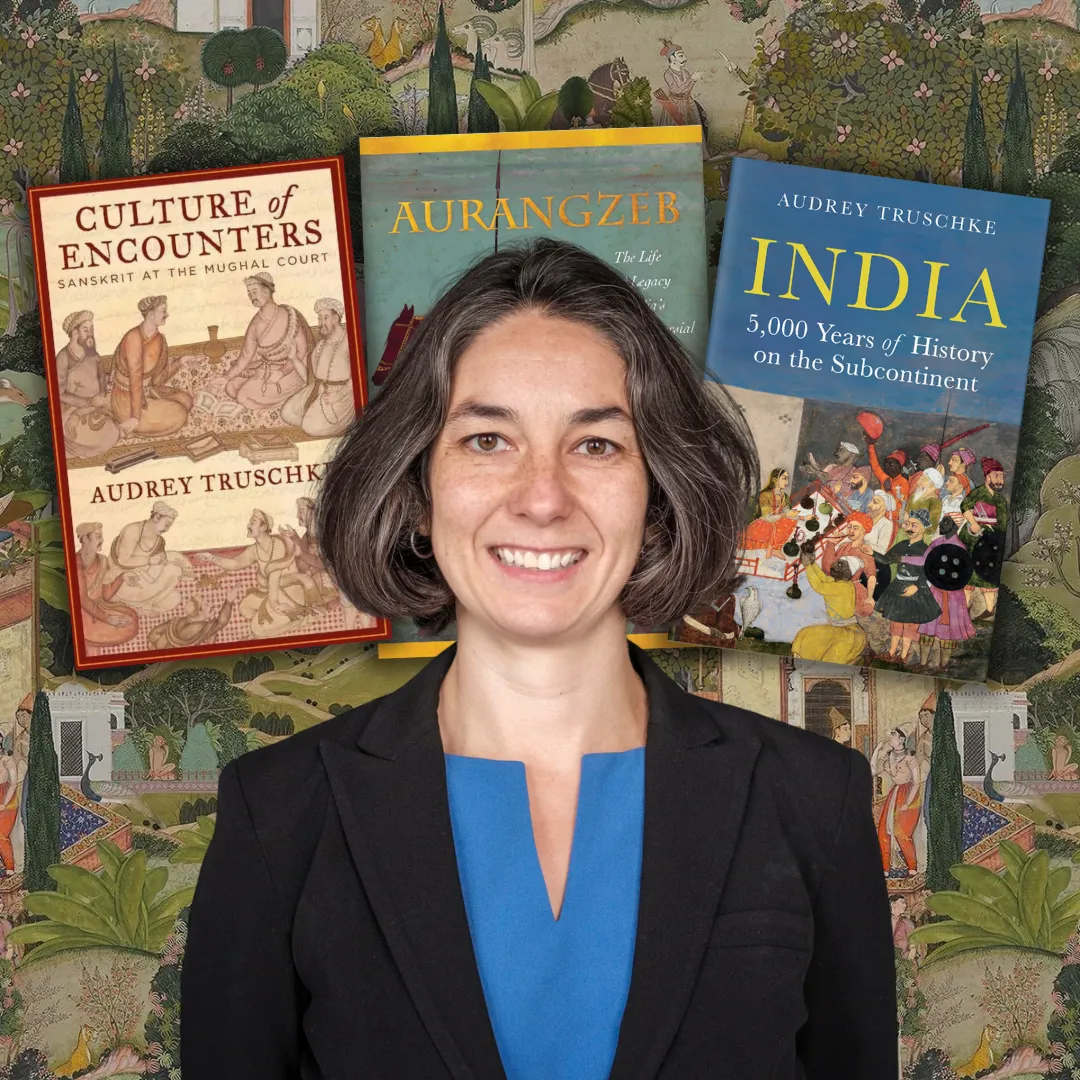
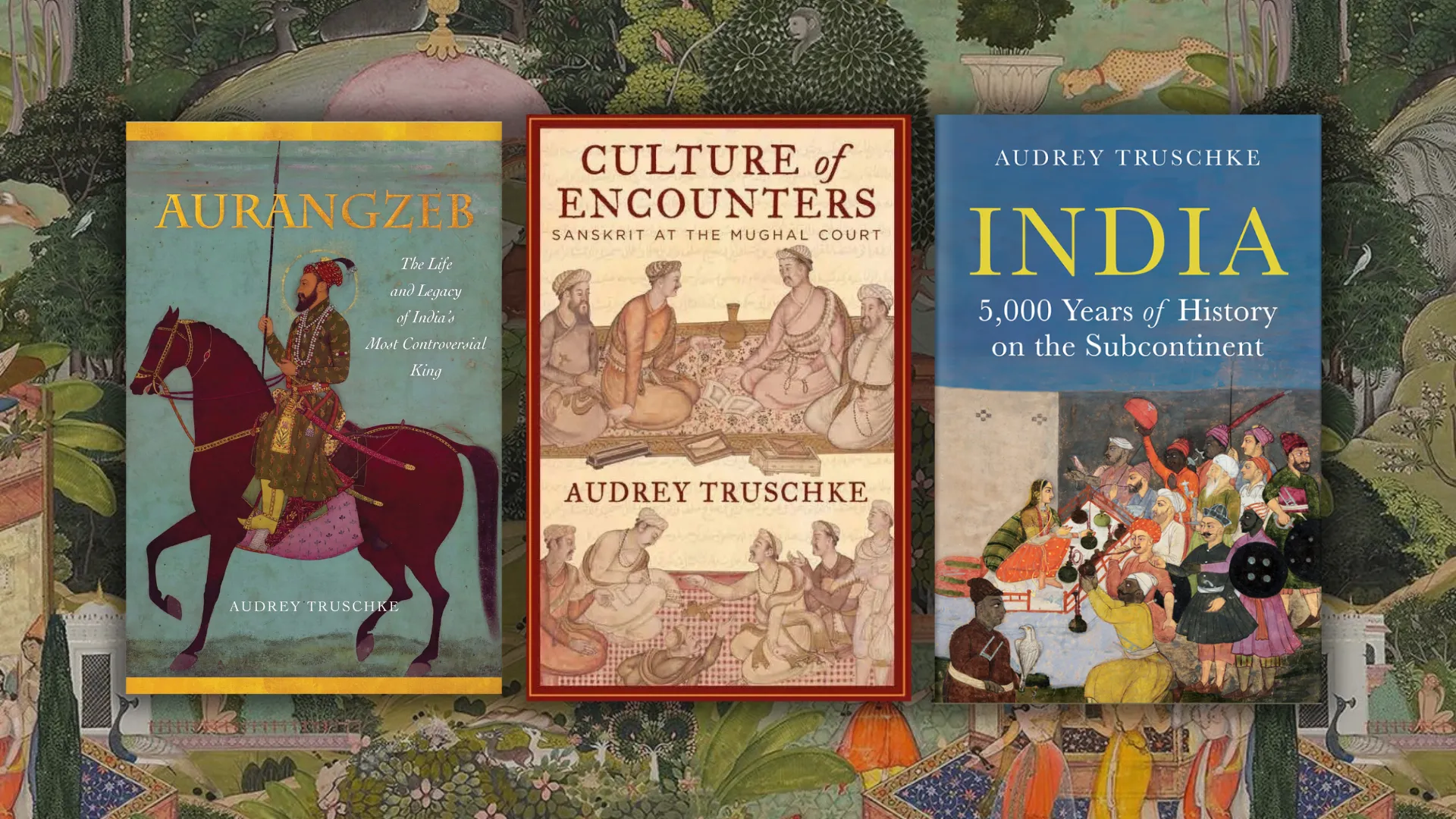
Audrey Truschke is an academic, rather than a popular historian, with a focus on South Asia. Her first book, Culture of Encounters: Sanskrit at the Mughal Court (Columbia University Press, 2016), centred an unusual history of literary interactions between the worlds of Persian and Sanskrit in the Mughal court; her second, Aurangzeb: The Life and Legacy of India’s Most Controversial King (Stanford University Press, 2017), was a scholarly monograph on the last of the more famous Mughal emperors. The former won Truschke the prestigious John F. Richards Prize, one of the highest commendations in South Asian history. However, though the latter’s publication was well-received within academia, it precipitated the beginning of an intense smear campaign against Truschke and her work, primarily originating from Hindu fundamentalist organisations in India and the United States. In 2021, a group of undergraduate Hindu students at Rutgers — where Truschke is a professor — called for her to be removed from teaching anything related to Hinduism, citing (among other things) how she had ‘conveniently decided to whitewash’ Aurangzeb’s legacy in her book. The Hindu American Foundation, an entity with links to the RSS, also named Truschke in a libel suit targeting her and several other individuals and organisations, including progressive Hindu groups.
The suit failed, and Truschke continues to be a teaching professor at Rutgers University in New Jersey. As a PhD from Columbia, trained under American Sanskritist Sheldon Pollock, Truschke persists as one of the most eminent scholars of Sanskrit and Indo-Persian literature to emerge from the United States. This interview was taken with her in Lahore, during a visit to promote her new book, India: 5000 Years of History on the Subcontinent (Princeton University Press, 2025).
The interview has been edited for length and clarity.
Rana Saadullah Khan (RSK): Did you ever imagine that the history you were working with would entail so much heat, back when you were a historian-in-training?
Audrey Truschke (AT): Not in my wildest dreams. Imagine: I’m in my mid to late 20s, in graduate school — I received my PhD at the age of 30 — and I’m spending most of my time in libraries, whether in the Indian subcontinent or somewhere in Europe or New York. My concern, if I had any about the reception of my eventual work, was that no one would care about it. I was somewhat aware of the ‘controversial issues’ in South Asian history, but I wasn’t looking to get there. From my perspective, the controversy came to me. I’m sure Hindu nationalists have a different viewpoint on that particular subject. For me, though, the labelling and treatment of my work as ‘controversial’ goes back to its earliest published forms, back to 2015.
RSK: That’s earlier than the publication of Aurangzeb…
AT: Yes, a bit earlier. I gave an interview to The Hindu about my first book, Culture of Encounters, on the eve of that book coming out — I was thrilled that anyone wanted to talk to me about it and wanted to drum up any level of interest in what I’d written. I made, what I thought were edgy, statements on Akbar that were pushing the envelope, thinking: I wonder if anyone will react.
Nobody has ever reacted to those ‘edgy’ comments, but in the same interview, I said two unobjectionable short sentences about Aurangzeb, and I felt like the world exploded at me after that. I essentially stated that Aurangzeb was a misunderstood figure: he was a pre-modern king. No historian would bat an eye at that, it is such a bland, obvious point. What this made me realise was that what is obvious in the academy is not necessarily obvious outside of it. I saw the opportunity to do public-facing scholarship for the first time and subsequently wrote Aurangzeb.
RSK: How did the intimidation against you in India and the United States intensify after Aurangzeb? Was it immediate?
AT: Not immediately. When I wrote Aurangzeb, I faced the decision of whether to publish it in India or not. I did what any scholar would do: sought the advice of my colleagues. They were divided nearly fifty-fifty at this point; the reason why people thought I should not publish in India was because they anticipated the backlash. I personally thought that the backlash would be about 18 months, and then it would calm down. That’s what happened initially — it was pretty hot and heavy for about a year and a half, and then things did calm down.
They intensified after India’s general elections in 2019, when the BJP won by a landslide. Now that victory has absolutely nothing to do with me, and I am one very small casualty in a bigger set of trends here. I honestly believe that the intensification of attacks on me is not a direct result of my scholarship; I had by then achieved a certain level of scholarship and notoriety, and when Hindu nationalists start to feel especially emboldened and fierce, they look around for academic targets. I was simply one of the names that rose to the top.
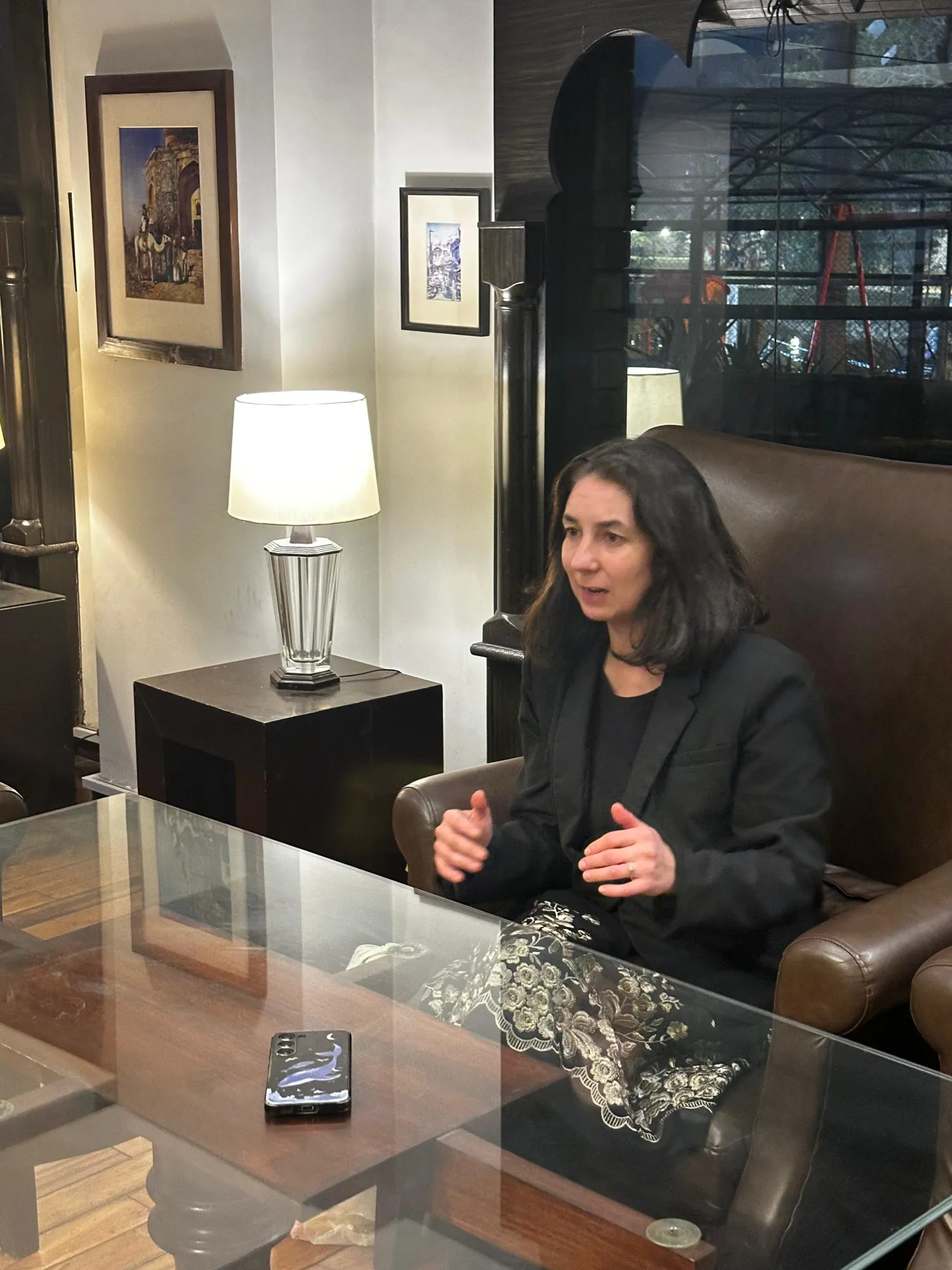
RSK: How does somebody from the American academic world even develop such a specialised interest within such a specific period of South Asian history?
AT: I went to college to study religion — religion is a very long-standing intellectual interest of mine — and took a class on Hinduism. I knew nothing about Hinduism at the time. I’m from the American Midwest and have no family associations with South Asia, so I was blind going in. Hinduism, naturally, was a bit confusing, but also delightful and fascinating. I had never read or encountered these myths and stories before and wanted to learn more. Eventually, I ended up taking Sanskrit. I was at the University of Chicago at the time, which is a nerdy academic space, so pursuing this was easy.
I essentially stated that Aurangzeb was a misunderstood figure: he was a pre-modern king. No historian would bat an eye at that, it is such a bland, obvious point. What this [the backlash] made me realise was that what is obvious in the academy is not necessarily obvious outside of it.
RSK: It is a pretty unique environment for South Asian studies in the United States, isn’t it?
AT: Absolutely! But that’s not why I went there. I was originally going to take Koine Greek — the Greek that the Bible is written in. However, after coming across Sanskrit, I realised that a lot of people read Koine Greek in the academy already and decided I wanted to pursue the former. Thus, I ended up focusing on Hinduism as an undergraduate. At a certain point, I became a little dismayed with how everything was so old; I was working with the epics, which are close to 2000 years old. I wanted to ‘modernise’ myself by learning Persian, which gets us into the second millennium of South Asian history.
I know this is going to shock everyone, but learning Sanskrit and Persian and studying Hinduism did not lead to excellent employment options upon the completion of my Bachelor’s degree! I worked for a year, but then decided the outside world wasn’t for me and ran back to the academy. The idea of connecting Sanskrit and Persian came with thinking about what I would do for my PhD work.
RSK: In Culture of Encounters, you spend a lot of time talking about how the Mughal empire is one of those world-empires that hasn’t received enough academic interest, that the attention it has gotten is not comparable to the Ottomans or other world-empires of its nature. Why do you think that’s so?
AT: Especially outside of South Asia, South Asian history continues to be understudied and under-taught, simply as a consequence of bias and bigotry. There’s nothing complicated about that. Most people don’t think it’s the most important part of the world to study, and this in turn leads to how South Asian specialists are represented.
I teach at a history department in New Jersey, arguably the most diverse state in the country. Still, our history department at Rutgers looks like almost every history department in the US, which is to say more than half of our professors focus on US history. We’re talking about 250 years of history, with very specific specialists.
For the rest of the world, we are the token representation. You’ve always got a group of people who work on Europe; for every other part of the world, you’ve got one person. For instance, we have one Africanist, and I’m the only South Asianist. I’m expected to teach all of South Asian history from the Indus Valley Civilisation to the present in two semesters! While I enjoy it, this is a completely insane way of teaching history. I am expected to teach 5000 years of history for a quarter of the world’s population, while 20 of my colleagues have divided 250 years of American history between them. That inequality is almost laughable. Except that it’s replicated in almost every history department in the US. European nations tend to do a little better on balance, but not as much as many people would think.
RSK: In terms of the texts that you explore, which stories do you feel have been underrepresented in the world literature canon?
AT: I think there have been attempts to include either one or both of the Sanskrit epics. The Ramayana is taught often, but with the Mahabharata, there are too many characters, and it’s a bit long to get into, so people get lost very easily in that work. The Ramayana is a clear story, and if you remember six names, you can navigate it easily.
Despite the attempts to include both these texts, it’s been difficult, partly because you need a fair amount of cultural understanding to appreciate either epic. The idea of a worldwide literary canon in a ‘Great Books’ approach is that we should be able to read literature on its own. There is South Asian literature that lends itself to that, the Therigatha is a great example, which is a collection of Buddhist women’s poetry from 3rd to 2nd century BCE. It’s originally from Pali, and is available in English; it reads very well. From a far later period and in a different genre, the Baburnama, originally in Turkish, translated into Persian — and mainly, partially survives that way — also reads very well. But the epics tend to be a little harder in my experience.
Especially outside of South Asia, South Asian history continues to be understudied and under-taught, simply as a consequence of bias and bigotry. There’s nothing complicated about that. Most people don’t think it’s the most important part of the world to study, and this in turn leads to how South Asian specialists are represented.
There’s also this tension in diversifying the canon. Should we diversify the canon with texts that were not necessarily the most read or most important, but happen to read well now? Or should we diversify the canon in order to highlight the most central and important books? In which case, you’re looking at the Sanskrit epics and some Tamil Sangam literature. Either way, one wants to be very thoughtful and deliberate about this. Instead, what we’ve seen is a give us one Indian text, give us one Chinese text, and we’re done approach. No. That’s not how we want to do this.
RSK: Thinking of ‘world literature’ as a literary text travelling from its own context to another, I found learning about the translation projects undertaken at the Mughal court quite fascinating to discover through your work. For instance, if we think about how the Persian translations of the Ramayana were being conducted, the translators’ decisions to retain Sanskrit terms in the Persian transformation makes it seem like they wanted to integrate Sanskrit into how the Persian translation was working. If you’re familiar with conversations around ‘Indian English’, is it possible to see this as an attempt at creating a Sanskritised Persian?
AT: I think yes, but this is also different from Indian English. Indian English has evolved naturally and organically — it’s definitely one of the three major ways to speak the English language now, right alongside British and American English. However, the idea of introducing these thousands of Sanskrit terms into Persian did not occur naturally. This was not done in everyday speech, it was not from the ground-up, but an imposition from up high. It’s also not clear to me how far this was meant to go, and I don’t know if we have the evidence to suggest that these translations were supposed to ‘revolutionise’ Indo-Persian and change all of it.
I do think, at the very least, it tells us about what they were trying to achieve with translation, and it’s very different from what translators do today. Most of the time, what translators want to do is give you an easily readable text. Even in the example of Deepa Bhasthi, she’s translating Kannada into an identifiable form of English — she isn’t inventing Indian English, so that’s very different. It could be culturally coded in a certain way, but it definitely already exists. Most translators want you to read and relax, they want a reader to understand what’s going on. Whereas when I think about the early Persian readers of the Ramayana and the Mahabharta, they must have been super confused.
This was brought home to me years ago, when I was still a graduate student. One of my Persian teachers was working on another translation from Sanskrit to Persian, and he brought something to me and asked, Audrey, what is this juch? I answered, Oh, that’s yaksha. Yaksha is a semi-divine tree spirit in Sanskrit, and the ya becomes a ja and the sha becomes a cha in Persian. I knew that because I was reading the epics in their translation into Persian. But he didn’t know that; while the man was fluent in Indo-Persian and the various genres thereof, how was he to recognise the Sanskrit yaksha transformed into semi-vernacular juch?
Once you get the hang of it, yes, you get the lexicon. But at first, this must have been striking and different. The translation was meant to make the text intelligible in Persian; the grammar is all Persian, and the text itself is exceedingly simplistic, especially in the Mahabharata, which is very easy to read — but then there are all these words thrown in. And so, it’s possibly the highlighting of difference, possibly an emphasis of the foreignness from a Persian literary perspective to establish that this was not a Persian text and shouldn’t be mistaken as such. Or maybe they just wanted to show that it was a Sanskrit text, and highlighting that mattered to them in a way that a reader is confronted with that page after page. That’s definitely something that has not really come through in modernity, in how we interact with translations now.
RSK: I wonder, then, what purpose the Hamida Banu Ramayana translation serves? Is it something she wanted to share with her nephews and nieces, the future rulers of India?
AT: I really wish that the woman had left us a flyleaf note explaining this, because I would love to know. I’ve argued — and I would stand by this argument — that one thing we see is a majority of the Persian Ramayanas are held within the central imperial court, right within 15 years of the text being produced. The audience appears to be the Mughal royal family, above all. I’m not saying that was the only audience, but it does seem to be an ultra-elite and internally focused thing in that regard. This is going against the argument presented in the preface of the Persian Ramayana, where the author Abul Fazl says that this text is translated in part so Hindus can read their own scriptures. Some people seized on that, since Sanskrit is a very restrictive language and many Hindus were learning Persian at the time. But we don’t actually have evidence that that’s what happened, at least not right away. Hindus do come to read the translations in large numbers, but that’s a much later development, from after Aurangzeb’s time. One thing that Hamida Banu Begum owning that Ramayana copy does is that it allows us to push back on what may just be a flippant comment by Abul Fazl, and instead to see where these manuscripts actually lie.
The Jain archives are, on the surface, far richer; they lend themselves more easily to a historian’s interests and questions. But we do have to press on a couple of things: how accurate are they, and why are they creating these narratives in the first place? Most things we do in a day never make it to print, so why are the Jains writing about this? I ultimately argue that it’s for their own internal community consumption, and there are some specific reasons why the Jains might be reimagining their own identity through this writing.
RSK: The Hamida Banu Ramayana is now in Doha. Does that have something to do with greater Arab interest in South Asian histories?
AT: No, I don’t think so. That manuscript is of questionable provenance, which is to say it was quite likely smuggled out of India after the Antiquities Act in the ‘70s. That may partly explain why it’s in Doha. Western institutions, obviously, have not always looked for provenance, but in more recent years have emphasised not buying stolen manuscripts. The Qatari state, on the other hand, is much freer than that.
Several years ago, I was brought into Doha to their Museum of Islamic Art to look at the manuscript and do a publication on it. When I got there, I was surprised that they weren’t displaying any of the pages, even though it has such lavish illustrations. At the time, it wasn’t on display at all! Upon inquiry I was told that it was taken down, after a couple of complaints regarding the displaying of Hindu deities’ images.
I thought it was striking that it only took one or two complaints for them to take it down, that there was no fighting back. At the time, the curators were European — there were very few Qataris at the museum — and I told them, look, you basically agreed to censorship. You agreed to take something down, because people don’t want to learn about another religion. Did you ever think about turning this into a learning moment? How are we all going to get along in this world if you can’t live with the fact that there are polytheistic Hindus in this world? This isn’t even some far away problem, since so many Hindus live and work in Doha. But the curators I was speaking to were not interested in pushing back on that. They seemed to think that going along with this sort of thing was the price to pay for having access to these works and living in Doha and working for the Museum of Islamic Art. I have not been back to Doha since.
RSK: Something your work also does is showcase how much of Sanskrit literature on the Mughal court was being written by Jains. Was the archive what led you to this discovery, or was it a fascination for the Jains as a religious community?
AT: The former. I set out to find something that involved a level of interaction between Sanskrit and Persian, either as languages or through intellectuals of those languages. I discovered the Persian translations of the Sanskrit texts; then I found out about a bunch of the Jain-authored texts. At this point I was midway through my graduate work, and I could have told you some basic facts about South Asian religions and history. But I had never really studied Jainism, so I had to learn quite a bit about the religion and its history, especially Jain practices regarding Sanskrit texts; compared to Brahmins, they do things a bit differently when they’re writing in Sanskrit. In the end, I found that they wrote about their encounters with the Mughal court in a way that no one else did. Now, of course, Brahminical communities were at the Mughal court in much larger numbers; though they should have had a lot more to say, they didn’t, at least not in Sanskrit. So those records were never made.
RSK: But there is some talk in the first book about Brahmin intellectuals falling in love with Muslim women, isn’t there?
AT: There is, but we have to read between the lines. We have one Sanskrit intellectual who falls in love with a Muslim woman, and he calls her a ‘yavanni’. A yavanna is somebody with lighter skin who comes from the north; it means ‘Greek’ in really old Sanskrit, but later comes to mean ‘Muslim’. So he falls in love with a yavanni woman, and he writes beautifully about her — it’s written in Sanskrit, though oddly enough, it almost sounds like Persian poetry. Then we have other Brahmins who write about this in a coded way, in a style of shaded insults disapproving the marriage, but without a clear narrative of what happened. Whereas, when the Jains sit down to write, their narrative is akin to: so a guy went to the Mughal court in this year and he met with Akbar, here’s what they talked about — and it’s a 100 verses!
The Jain archives are, on the surface, far richer; they lend themselves more easily to a historian’s interests and questions. But we do have to press on a couple of things: how accurate are they, and why are they creating these narratives in the first place? Most things we do in a day never make it to print, so why are the Jains writing about this? I ultimately argue that it’s for their own internal community consumption, and there are some specific reasons why the Jains might be reimagining their own identity through this writing. Maybe the Brahmins didn’t want to reimagine their identity. Or maybe reimagining their identity through encounters with Persian-speaking Mughals was not going to be okay — the Brahmanical community has long had theoretical rules against certain kinds of cross-cultural engagements. They might not have followed those rules in practice, but maybe they followed them when it came to writing in Sanskrit.
From my perspective, Indian and Pakistani nationals today share a history before 1947, and I think Pakistanis might be more bold in seizing that. Who cares that the Gupta kingdom didn’t extend into modern-day Pakistan, or that the Cholas were thousands of miles away? It’s your history as much as their history. To me, I would love to see a greater embrace of South Asian history here.
RSK: Speaking of archives, what has been your experience of conducting archival research here in Pakistan?
AT: I’ve spent far more time in India doing archival work than in Pakistan. They share more similarities than differences, for instance, the archives are not centralised in either country. When my colleagues go to Turkiye, they go to an archive in the singular, whereas when we all come to South Asia, we’re going to thousands of archives. They’re all over the place, and there’s usually a lot of travel involved. Every archive also has their own rules, and there are a lot of negotiations. Some of the archives are state archives, some are national archives; others are religious archives; there are private archives…
Photography remains a big issue in both India and Pakistan. It’s very difficult to work on manuscripts if you can’t take a photograph, because then you have to sit there and read a text. If you are a graduate student and have six months to read a text, that is great. But as a full professor with a busy life at home, I can’t do that: I need photographs. Even if you do find time and manage to read a relatively short text, there’s the problem of publishing it two or three years after you read it. You cannot double-check what it said; what if you mis-transcribed a syllable? Both India and Pakistan also suffer from ill preservation of their manuscripts. Some people like to blame cultural proclivities, but I think it’s due to economic hardship. It’s hard to argue that we should be creating climate-controlled rooms for manuscripts — which I’ve only ever seen one of in South Asia, in Kolkata — versus remedying the several other pressing matters that both countries need to attend to.
RSK: Going back to the controversies, I notice that there’s a strain in Indian intellectualism that frames both the Mughal empire and the Muslim cultural influence in general as that of a ‘coloniser’, especially through a kind of hyper-academic, post-colonial language of engaging with history. I’ve seen influencers engage with even kathak as the dance form of an ‘invader’ or ‘imperialist’. Is this a serious way of thinking in the Indian academy?
AT: I don’t think we see this in the Indian academy per se. We see it with right-wing influencers who are cosplaying as being academics. Using the language of decolonisation does not make you an academic. The bottom-line is if you refuse to play by the rules of the academy, then you are not part of the academy. We have seen a huge uptick in the use of decolonisation language in support of Hindu nationalist goals, but I think it’s entirely in bad faith. It’s also based on a very bizarre version of what ‘decolonisation’ means, because it’s essentially arguing for recolonisation, in a sense, and Hindu nationalists are the major intellectual inheritors of British colonial thoughts.
More than an increase in the language, however, what we’ve really seen is an increase in the political power and push of that language and those ideas. Hindu nationalism has fundamentally been saying the same thing for a hundred years. Back then, they didn’t use the language of decolonisation, but they maligned the Mughals and the Delhi Sultanates and old Muslim rulers of Indian history using other terms. The goal has always been consistently the same: you demonise Muslims in the past, in order to create a very quick and slippery slope to demonise Muslims in the present and use violence against them. It’s one thing to say things when you don’t have much political power, or when you have a few numbers in the RSS in the 1960s and people generally agree with the Gandhi-Nehru kind of deal; it is quite another thing to say those things in 2020, when the BJP is the major political party of India and Hindu nationalism is the defining political ideology in India. So, it’s really the political push and the political power behind the ideas that’s putting pressure on everyone else. You can no longer ignore them as your crazy uncle’s idea anymore: your crazy uncle is running the country.
Sanskrit is one of the great literary traditions of South Asia, and there are more texts in Sanskrit than in any other South Asian language.
RSK: But if I think about the Congress governments and their early determinations of what would constitute the aesthetics of independent India, some work from Ali Usman Qasmi made me sensitive to this idea that while the early Congress party felt comfortable integrating Buddhist and Hindu motifs into the imagery of ‘secular’ India, that imagining was not extended to Muslim visual expression.
AT: That’s true, but I don’t know that we see a tonne of explicitly Hindu imagery either. They chose the Ashokan wheel, but I don’t see Garuda anywhere, for instance, which was a big symbol of the Gupta empire. I think the reason for leaning into the Mauryan empire in particular was the absence of Buddhists in India in 1947. Today, there are over 8 million Indian Buddhists, but those are almost all Ambedkarite converts, and that comes a bit later. It’s easy to reimagine the past when it clearly happened on your soil, but there’s nobody around that’s a direct inheritor of it, because you can say what you want about it and it doesn’t offend anyone. I suppose I see it not so explicitly as an anti-Muslim thing, but as a way of avoiding both Muslim and Hindu things, given that those were the two religious identities that had real harsh political implications at the moment of Indian independence.
If the question is, however: did the Congress party ever have ‘soft Hindutva’? Yes, absolutely. I wish the BJP and RSS had a monopoly on Hindu nationalism in Indian society, but they do not.
RSK: Do you find any right-wing intellectual formations in Pakistan that disturb you?
AT: Again, I don’t know if I would call it ‘intellectual’, but that might just be a category difference. Yes, there are many disturbing things in Pakistan: a strong conservatism, and the implications of that for religious minorities and women have been pretty catastrophic in this society. In terms of history, there’s also this desire to separate out what is ‘Pakistani’ history, and it just doesn’t work. Pakistani history as a nation-state starts in 1947; if you want to trace it any further back, it begins in 1930. That’s it. It doesn’t go any earlier than that. If you want to have an earlier history — and everybody wants an earlier history — Pakistanis and Indians in national terms share that history. Especially among students in Pakistan, people say: I only want the Muslim part of history. Others: I want to geographically demarcate it to what actually happened on this soil. And you can do that in a light sense and think about history as a way of making sense of, where are we going to go for tourism this weekend? But in terms of an actual framework for thinking about history, you can’t impose modern, artificial boundaries over 4000 years of it and say, we’re only going to care about events that took place here. That’s not going to work.
RSK: Perhaps there has been some increase in how much the Gandharan civilisation featured in my curriculum as a school student, as opposed to when my parents were in school. Now I wonder if that has something to do with that geographically being contained within the Central Asian and Mediterranean aspects of the Pakistani past, and therefore, not such a fundamentally Indian past.
AT: It probably helps that it’s tempered by all these other influences. It’s also associated religiously with Buddhism; I would imagine that there’s not a tonne of teaching about the aspects of it. Any way you slice it, even with our crude geography, there’s a lot of Hindu stuff that happened here; I suppose you could argue that the Cholas were really far away from here, but what about the Hindu Shahis? The Hindu Shahis were largely centred in what is now Pakistan. You have a tonne of their monuments lying around.
In my experience, when I speak about ‘Indian history’, using that framing in India, there’s maybe a little bit of an issue with the fact that the major Indus Valley Civilisation sites are in modern-day Pakistan. But, it’s not a breaking-point: the Indus Valley Civilisation is still recognised as a major beginning within Indian history. I would like to see the same thing here. From my perspective, Indian and Pakistani nationals today share a history before 1947, and I think Pakistanis might be more bold in seizing that. Who cares that the Gupta kingdom didn’t extend into modern-day Pakistan, or that the Cholas were thousands of miles away? It’s your history as much as their history. To me, I would love to see a greater embrace of South Asian history here.
RSK: Are there certain texts that you wish would feature more in curricula in Pakistan?
AT: Probably Sanskrit texts. Sanskrit is one of the great literary traditions of South Asia, and there are more texts in Sanskrit than in any other South Asian language. It probably has even more texts than Persian, if for no other reason than what we call ‘New Persian’ — which is what Persian is now — emerged in the late 10th century, whereas Sanskrit goes back over 3000 years. My guess would be that many people in Pakistan assume everything in Sanskrit is Hindu. That’s not true by a long shot. People could and did write anything under the sun in Sanskrit: cooking, raising horses, architecture. There are even translations of texts from Persian to Sanskrit, though they’re not as common as the other way around. One example of that is the Katha-kathuka, loosely: ‘strange story’. It’s a translation of Jami’s Yusuf-o-Zuleikha, i.e., the story of Joseph and Potiphar’s wife. Jami’s version of that story was an ‘instant bestseller’ in the Persian world; even in pre-modernity, it was translated into many different languages — including a Sanskrit translation produced in Kashmir.

Rana Saadullah Khan is a writer from Lahore and Islamabad. His work has been published in Lakeer, Jamhoor, The Aleph Review, as well as through UNESCO Pakistan and by the history education platform, Hashiya.