After Khameinei’s assassination, the self-exiled Iranian author Shokoofeh Azar expressed a guarded congratulations. Warning in her column in The Australian that, already, “thousands of foreign militants” from Pakistan, Afghanistan, and Iraq “were arriving to help Iran’s decimated security forces”, Azar further guides her readers to be wary of the figures being reported of innocents dying in Israel and the United States’ assault on Iran. These figures, she explains, might also be inflated by the corpses of those the “regime” itself murdered in its January crackdown, stored and refrigerated in advance to sully the reputation of any foreign military incursions. In drawing attention to them, one could unwittingly play into the agendas of the “left”, the “pro-Palestinian lobbies”. Azar does not dispute that the bombing campaign was wide-ranging, spanning unusual parts of the country that have not previously been featured in international publications. But she argues that Iran’s “underground missile bases” are also spread across the nation, that entire cities in that country are dedicated to the concealment of military assets – assets she believes to exist, chiefly, for the purpose of destroying Israel.
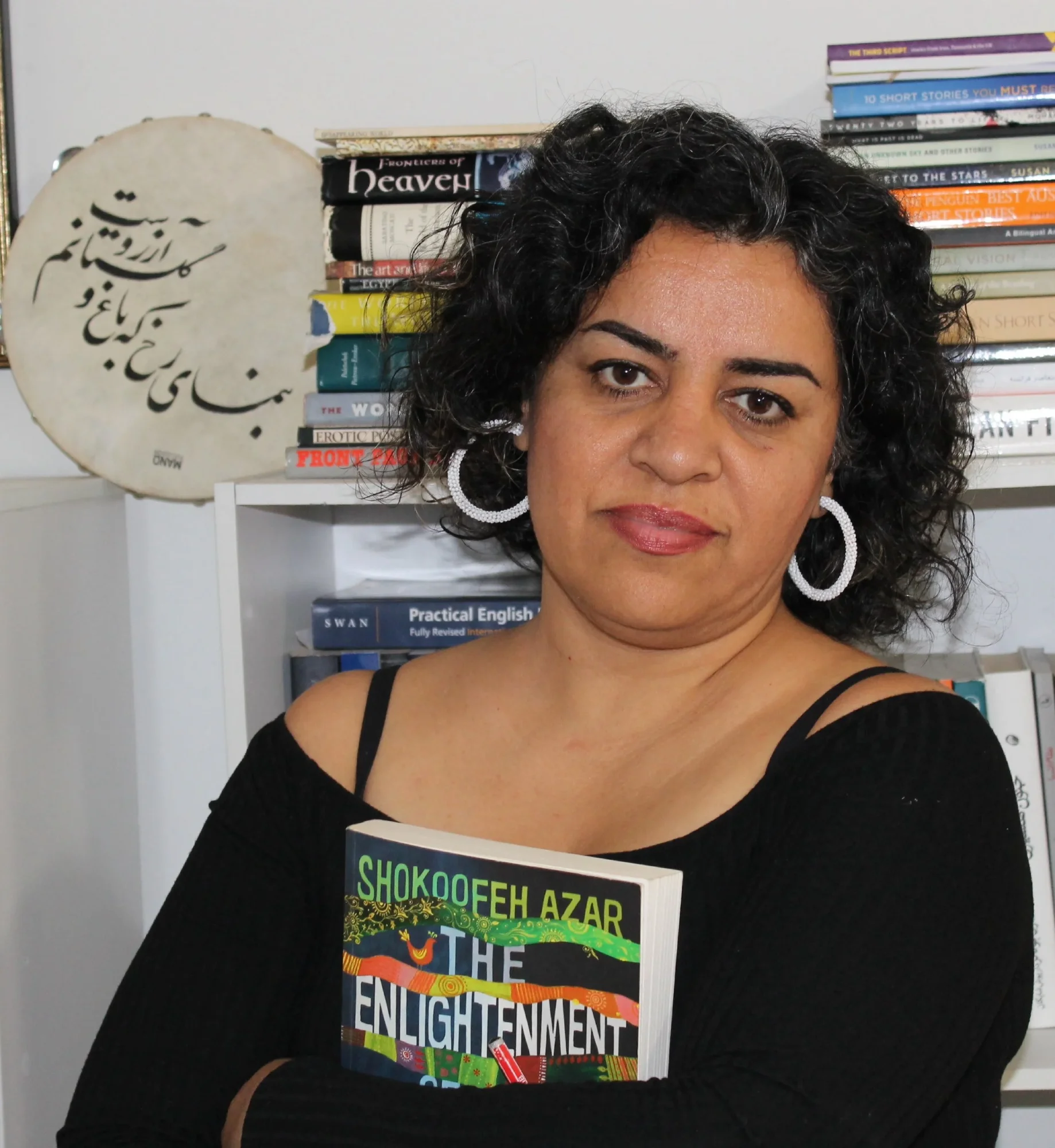
Azar is the writer of the first Persian-language novel to reach the shortlist of the International Booker Prize. In a prefatory author’s note to this work, The Enlightenment of the Greengage Tree, Azar’s independent travels through Iran and its neighbouring countries, including Pakistan and India, are made note of – indeed, she is styled as the first Iranian woman to have ever hitchhiked on the ‘Silk Road’. In other words, she is not an Iranian woman with a life-experience limited to Tehran, but one who is thoroughly exposed, grounded; her novel is not some hodgepodge of magical realist absurdity, but speaks more deeply to the social realities of the Iranian people. If she is the one suggesting, in The Australian, that the videos of Tehran’s streets on fire be disregarded, or that the portraits of the Minab school-girls be regrettably considered but ultimately moved past, her opinion carries a moral weight – with the clout to redefine morality, transcend facts. In her vision of reality, ordinary Iranians caught in the war can be shaped into unfortunate collateral, a sacrifice in ridding the world of an insidious regime.

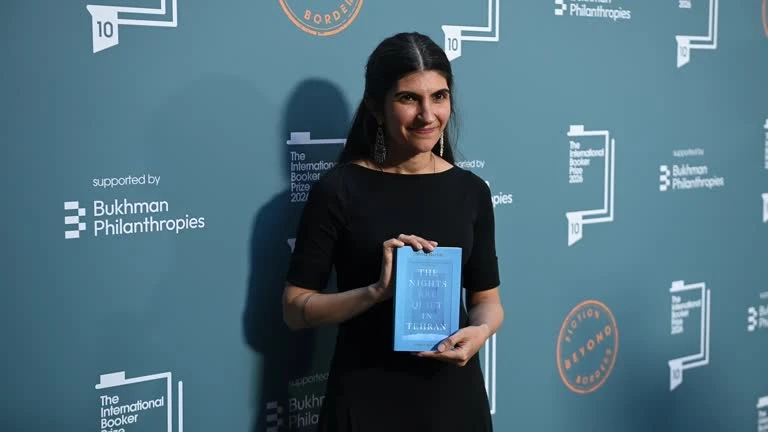
Among these exilic, opposition writers of Iranian origin, Azar of course preceded the 2026 literary success of Shida Bazyar in The Nights Are Quiet in Tehran. Towering over both is the legacy of Persepolis, the late Marjane Satrapi’s genre-defining bestseller.
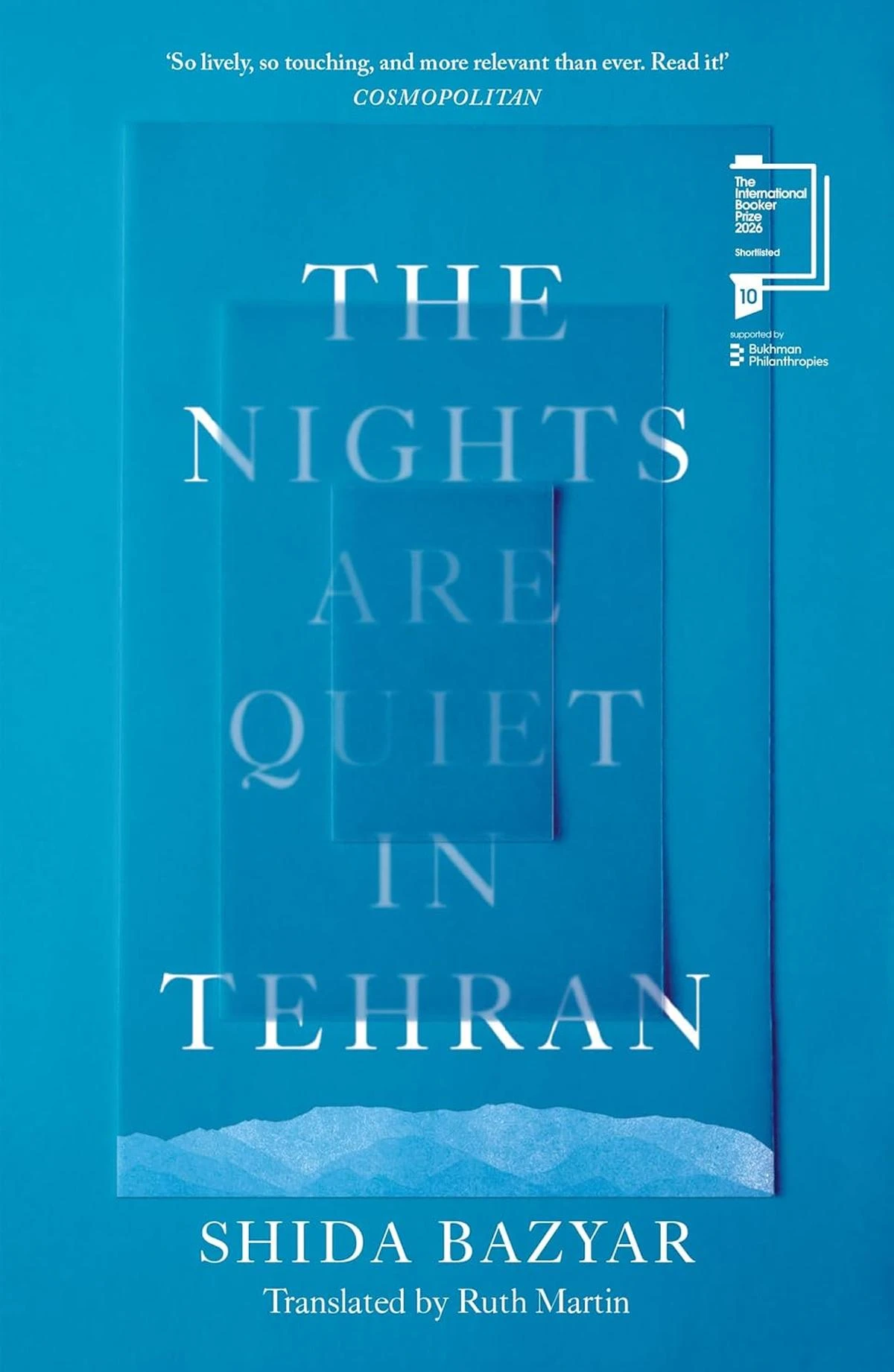
But unlike Azar or Satrapi, Shida Bazyar is at an even greater remove from post-revolutionary Iran, encountering it only through summer vacations and family lore: she was born and brought up in Germany. Her novel, originally published in German, is drawn from interviews she conducted with her revolutionary parents and their contemporaries, as well as the diary entries she accumulated in her childhood visits to Iran’s largest metropolis. Thus emerges a work which details Iran’s tumults through different characters from the same family, each granted first-person narrations segmented into individual chapters.
These chapters are additionally framed by particular decades in Iran’s history, in a span which begins with the year 1979. It is only in this beginning chapter that Tehran – featuring so prominently in the novel’s title – is the primary location in which the storytelling unfolds: in all four other cases, the city remains mostly in retrospect, a spectre of that which was abandoned. There are fleeting visits to the city, marking it as a space of unease, traumas rendered incomprehensible by narrators too diasporised to speak Persian confidently. But they are only brief encounters, and a distance opens up between Tehran and Bazyar’s characters. At times, this leads to naive musings; wondering if her religious cousin and her boyfriend have had sex, one reaches the conclusion: “...even if [she] and her boyfriend did secretly sleep together, it would just be one more secret on the list of secrets that this country has racked up. A secret that carries the death penalty.”
[I]n presenting opposition against the Iranian government as a marginalised politics overseas, Bazyar weaves a deeply dishonest substance into the exercise of testimony in her novel.
Bazyar does not write opinion pieces in English like Azar does. She also has not acquired the celebrity status of Marjane Satrapi, not yet a part of panels imagining freer futures for Iran. But The Quiet Nights in Tehran is filled with such asides, functioning to remind the reader of the horrors casually rife in the Islamic Republic.
Bazyar’s characters do not believe the world is aware of them. In the aftermath of the Green Revolution in 2009, another narrator rages against a German journalist, Claus Kleber. “Why does Claus Kleber never say what’s actually going on? Why do they show images and say, This is what it looks like, and then say, No reliable figures…And no one says that totally normal people are disappearing. That parents are noticing their children haven’t come home. No one says how often this happens.” Directly, the character accuses European media of aligning with the Iranian government, softening its crimes against humanity by casting doubts on what activists experience on the ground.
In a novel in which so much grief for lost comrades and the costs of a cruel, repressive government claw at its reader’s conscience, the atrocities of Israel are made conceptually overwhelming, too complicated to make meaningful – explicitly, they are pushed beyond the bounds of the empathy Bazyar is demanding from her reader.
This echoes an earlier sentiment in what is perhaps Bazyar’s most effective and interesting chapter, written in the voice of a revolutionary woman disenchanted by its gains. Describing the humiliating ordeal of asylum applications in West Germany – the sanitised listings of atrocities, the banal conversations with well-meaning but clueless Germans – Nahid shares her conviction that if the German government put all Iranians through a “psychological evaluation,” they would be so horrified by their findings that “we would all get our asylum applications approved.” So fanatic and unimaginably irrational are the new rulers of Iran that an exhausted Nahid tells the reader: “They [the Islamic government] even class Saadi and Hafez as counter-revolutionary.” She then proceeds to an anecdote of how her mother-in-law burned a book of poems from the Third World internationalist poet, Ahmad Shamlou, to protect herself and her family from the purges occurring in the revolution’s aftermath. Nonetheless, her family’s first application is rejected, and the ridiculousness of European policy is made plain.
But these references to Hafez, Saadi, Shamlou – they invite scrutiny. It is certainly possible that these censorships of Persian letters’ greats refer to true memories: Shamlou’s poetry seems to have officially been republished only in the 90s; one can also imagine that readings of Hafez or Saadi in earlier stages of post-revolutionary Iran might have exclusively emphasised the most religious interpretations of their work. But it’s also formulated just vaguely enough: Bazyar does not exactly state that Hafez or Saadi were banned by the government, or that Shamlou’s poetry was the cause of summary executions – there is enough room to suggest a milder take-away. Fiction does not, in any case, aspire to reproduce historical fact, and what is to be gleaned here is that this is how Bazyar and her characters understand post-revolutionary Iran.
More difficult to allow is Bazyar’s more charged, consistent allegation: that the system of the Islamic Republic persists because of Western indifference.
Beyond the successes of Iranian cinema, explosive flashpoints like the Green Revolution, the excesses of the government crackdowns which follow, the dissidents executed, the young women shot dead – these are the fundamentals of how Iran’s international image is defined, that establish the Islamic revolution’s legacies in Berlin, New York, London. Iran may have devoted sympathisers among Shia populations in Lebanon and Iraq; its pariah status and unabashed anti-imperialist messaging may have made it an admired international actor in others. But when Ayatollah Khamenei was assassinated with his family – when the very first day of this year’s aggression also culminated in such an enormous massacre of school-children – Bazyar’s characters’ worldview of an international order eager to justify and defend the Islamic Republic’s existence does not hold. Europe, in fact, was happy to watch Iran collapse, its channels platforming images of celebration and dance; with The Australian, Shokoofeh Azar is its only Iranian columnist, there being no pretence of providing another perspective from a writer more aligned with the government. And considering the amount of capital pumped into spotlighting an uncharismatic prince, into disseminating pro-Zionist media in Persian, in funding anti-Iranian government channels operating from Dubai, Riyadh, D.C. – in presenting opposition against the Iranian government as a marginalised politics overseas, Bazyar weaves a deeply dishonest substance into the exercise of testimony in her novel.
Peppered within these testimonies is the evidence that all her characters are, at worst, partial to Israel; taken more generously, these may be signals to Bazyar’s original, German readership that the destructive ambitions of the Ayatollahs do not dwell within her characters. At one point, Nahid says that Persian-language newspapers are too expensive, that she learns information about Iran from radio broadcasting from “America, London, Israel;” that she and dissidents like her are all “also waiting for letters, also waiting for familiar handwriting, also listening to Radio Israel and the BBC.” It may be overly sensitive of me to mind the casual interchangeability of ‘London’ and ‘Israel’ or the ‘BBC’ and ‘Radio Israel’ in Nahid’s narration. But when, in the novel’s 1999, her daughter Laleh is put in a model UN and is made to perform the role of Iran, Laleh is embarrassed to admit: “We don’t accept the existence of Israel.” In the session, there is a dispute about secularism, and a German classmate representing Syria demands to know why this ethic of separating religion and state never extends to Israel. Laleh stops listening. “I think I don’t really care,” she says. “I still don’t get what the thing is about Israel. A soup of information, of suicide bombings, of old men, of attacks, of news items, for about the last hundred years, at least.”
In a novel in which so much grief for lost comrades and the costs of a cruel, repressive government claw at its reader’s conscience, the atrocities of Israel are made conceptually overwhelming, too complicated to make meaningful – explicitly, they are pushed beyond the bounds of the empathy Bazyar is demanding from her reader.
Implicitly, Bazyar endorses the atrocities of Israel. In its fantastical ending, set in an indeterminate future in which Iran’s Ayatollah rule suddenly ends, the new government is called “an anti-terrorist beacon in the region. So say Israel and America and Syria.” In this vision of restoration, Bazyar makes the move of granting Israel the right to style a country “an anti-terrorist beacon,” and in a single sequence, her novel’s unseemly poetics is condensed and delivered with an astonishing clarity. Upon reading these headlines, Bazyar’s relieved narrator goes further, characterising the emotional response of herself and the Iranian people in exile so: “A euphoria that is already a few days old and has just been sitting there, waiting for us.”
Even as Iran is a vast country of 93 million, ethnically heterogeneous peoples, those who are granted the power to speak on behalf of the entire Iranian nation are these scarce few, these writers like Bazyar and Azar – those whose supreme aspiration is to witness Iran join hands with Israel and America in their cause of exterminating ‘terrorists’ from the ‘region’. In its utter sheepishness, it is a pitiful dream to have; in its barely concealed revulsion for the peoples of the Middle East, it is a dream which must be repudiated.

Rana Saadullah Khan is a writer from Lahore and Islamabad. His work has been published in Lakeer, Jamhoor, The Aleph Review, as well as through UNESCO Pakistan and by the history education platform, Hashiya.