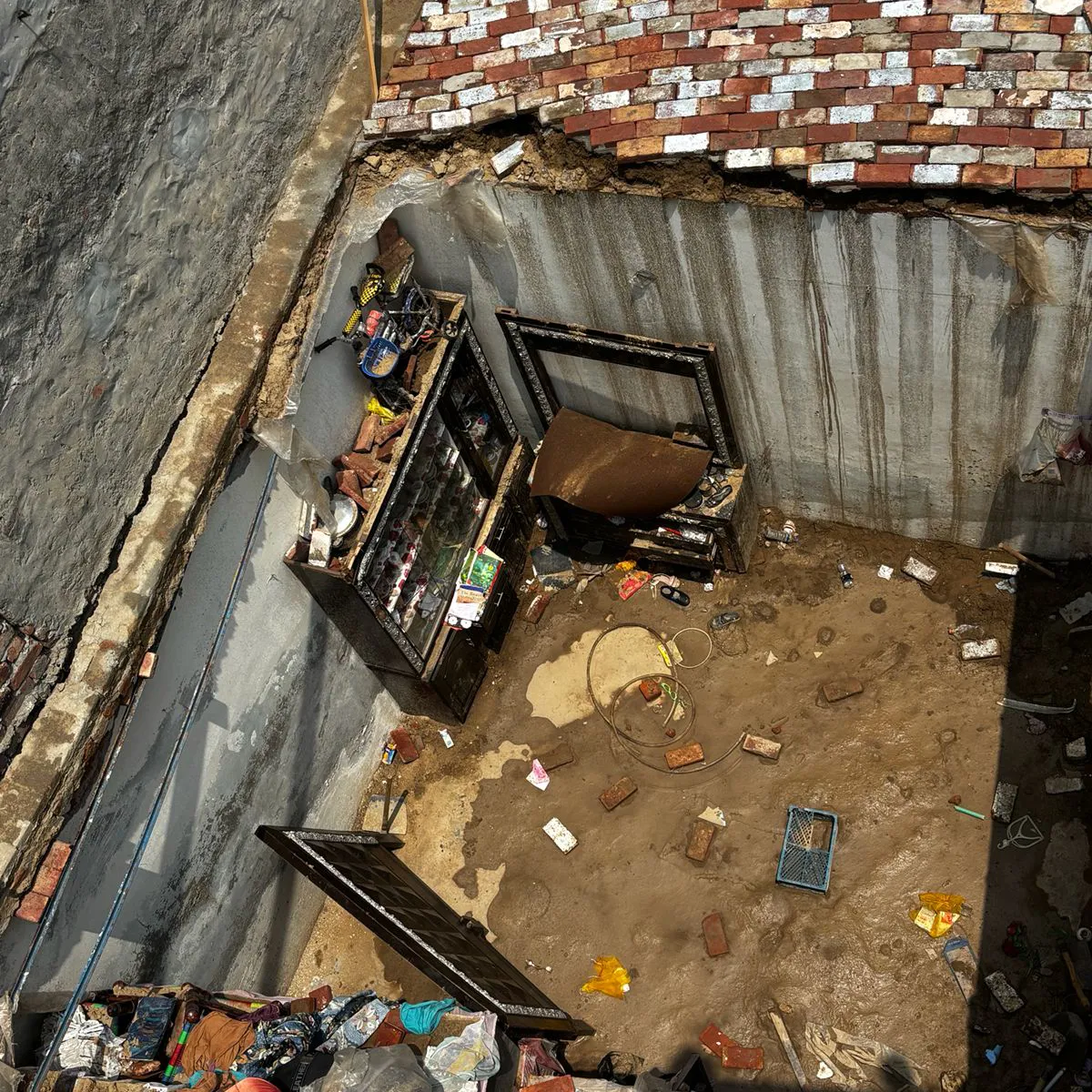
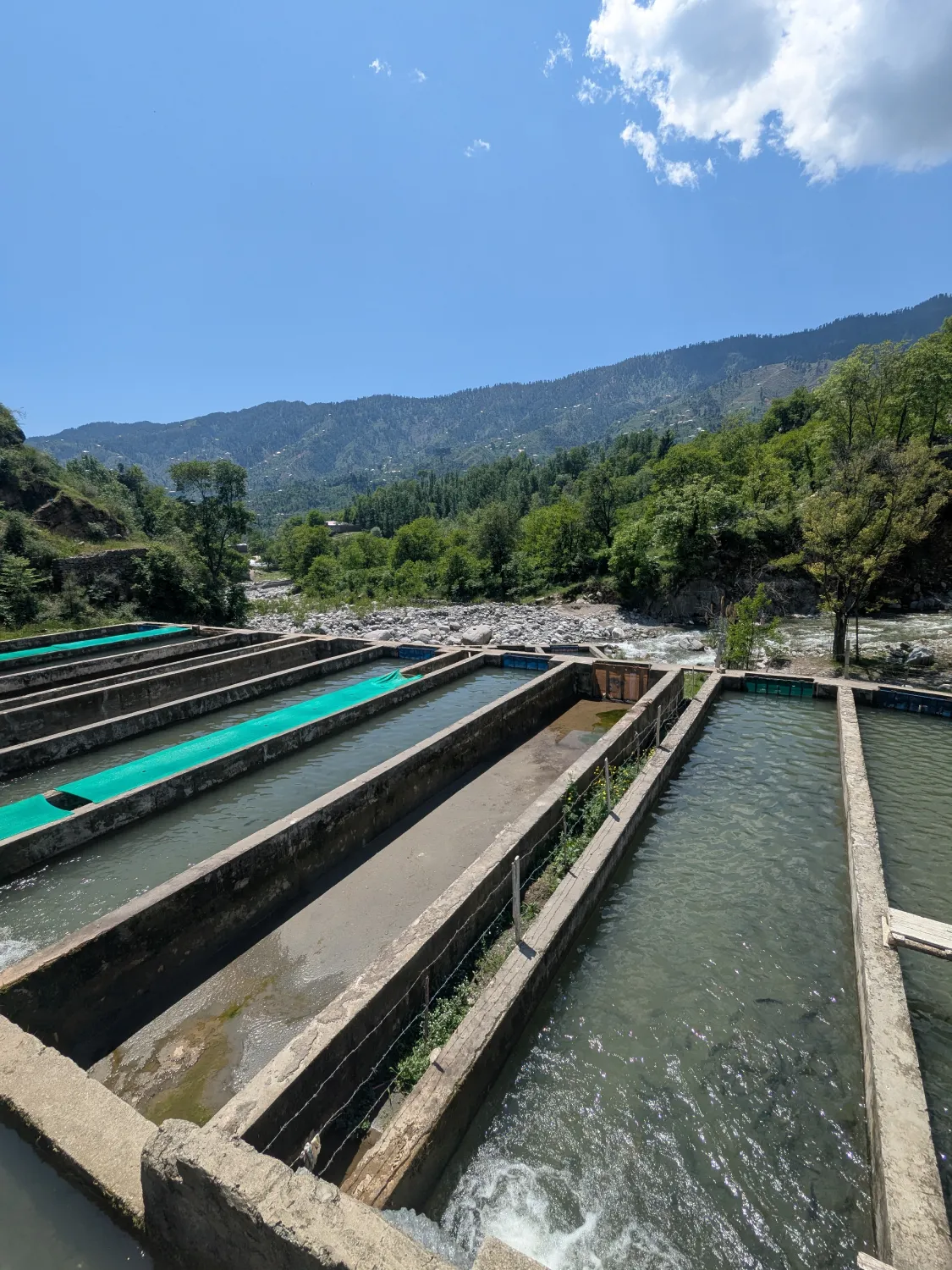
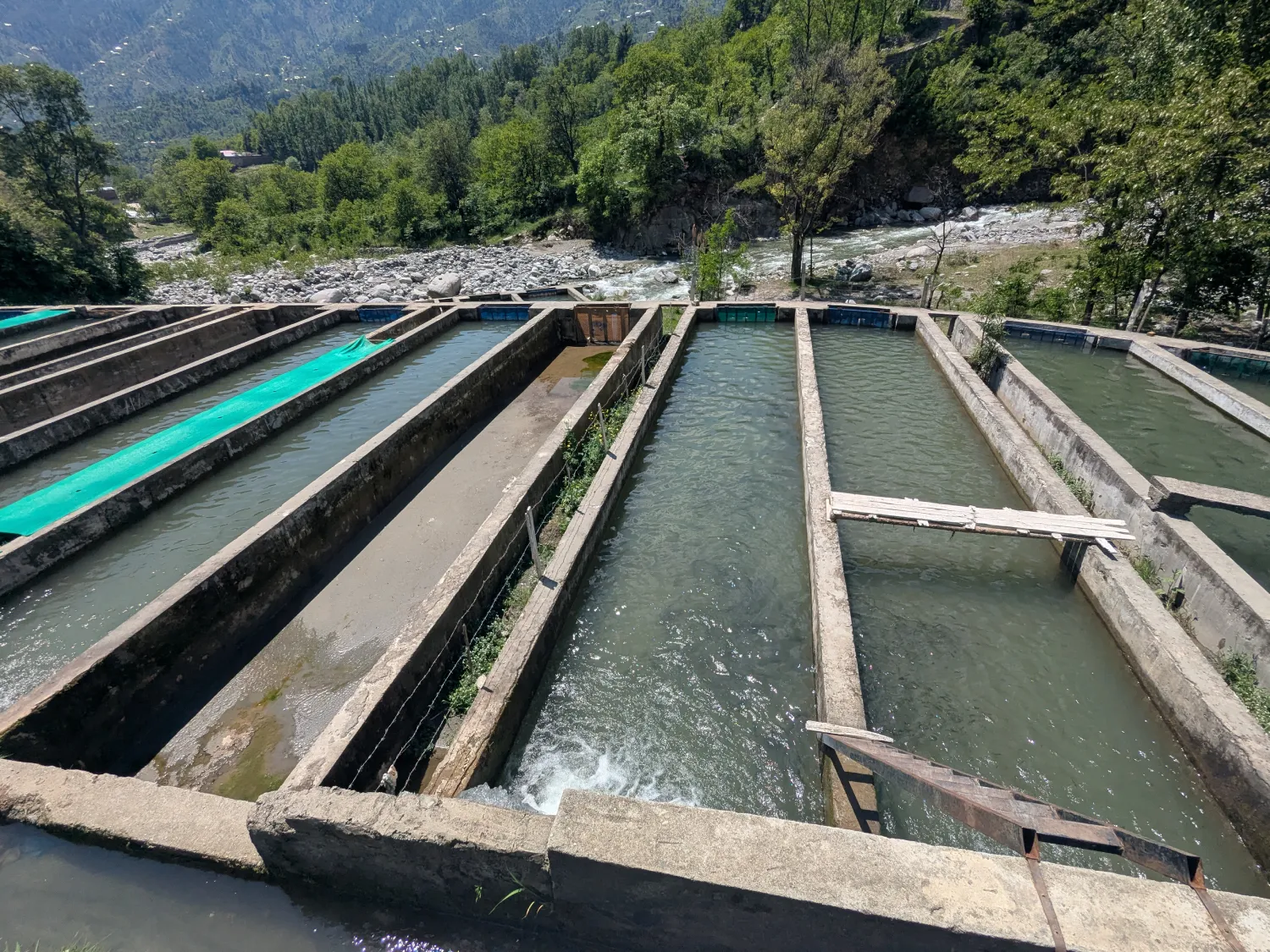
During the hottest weeks of summer, it is easy to imagine everyone prays for rain – until one meets the trout farmers in the valleys of Swat. “When the rain starts, our sleep vanishes,” says Rahim*, a veteran trout farmer in Swat (the names of all farmers throughout this article have been changed to protect their privacy). He is listening for changes in the water, and wonders whether the walls around his ponds will hold. “We have built protection, but it cannot withstand a major flood.”
At the government fisheries facility in Madyan, a group of veteran trout farmers have gathered for a consultation on the problems facing the industry. Aside from the danger of the river water breaching the farm, the farmers around the table have to contend with mud, debris, contamination, power cuts, or temperature shifts that can disrupt water flow, rapidly depriving cold-water fish of essential oxygen supplies. Bashir, another long-time trout farmer, recalls, with unbearable sadness in his voice, that he has lost almost all of his stock after water stopped entering a pond during the night. “There were 1,800 kilograms of fish in it,” Bashir says. “When the watchman came in the morning, around 1,450 kilograms had died within three hours.”
The trout farmers of Swat are caught in a vicious cycle. It seems the water both giveth and taketh away; the river helps sustain production, but one devastating flash flood or rain can wash everything away, as they threaten channels, ponds and oxygen levels. Worse still is the fact that even if the harvest fails, the costs persist, because feed must still enter the water each day, whether the farm is earning or sinking further into debt each season. “The business has finished, but we are compelled to keep feeding them,” Rahim tells me. His frustration hardens into something heavier. “We are raising living creatures,” he says. “If I do not have enough money to feed them, why have I kept them enclosed? We should lift the pipe, remove the net and release them into the river. We cannot do that either. We carry that sin, and the debt keeps piling.”
This is the life for all that remains of Swat’s surviving trout farmers: fish they cannot abandon, farms they cannot secure, and debts the banking sector seldom refinances. One of the oldest farmers in the group entered the business in the late 1980s. The flood of 1992 washed away two ponds, along with a wall and water channel. In 2005, someone poisoned his farm, killing fish worth around PKR 300,000. The 2010 floods destroyed the business again. “I did not lose courage,” he tells me repeatedly, while recounting each disaster. Trout farming paid for his children’s education and helped send them to universities abroad, and as a balancing act, it also demanded that he rebuild his life every few years.
Another farmer, Karim, can map the trajectory of the 2022 floods through the farms he lost due to them. Two were on one side of the valley. One stood in Madyan, another further ahead in Chail, two near Jargon and one opposite Mingora. “All seven farms were washed away,” he says, pointing out that he also had incubators. He had spent years building farms that supplied fish and seed, yet no reconstruction support at the governmental level followed the flood, despite promises. “No help came,” he tells me, “Whatever we are doing is through our own efforts.”
“The business has finished, but we are compelled to keep feeding them,” Rahim tells me. His frustration hardens into something heavier. “We are raising living creatures,” he says. “If I do not have enough money to feed them, why have I kept them enclosed? We should lift the pipe, remove the net and release them into the river. We cannot do that either. We carry that sin, and the debt keeps piling.”
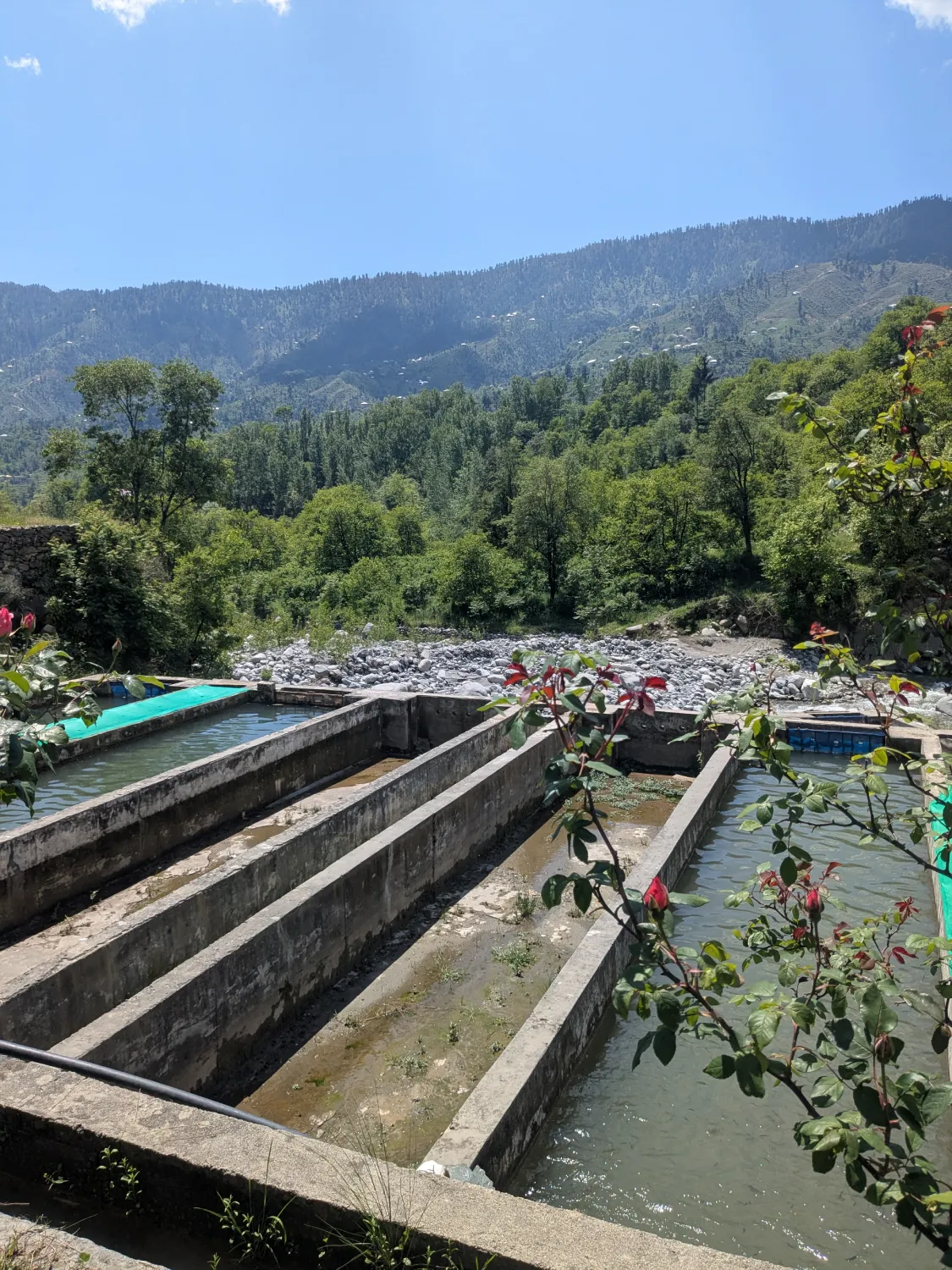
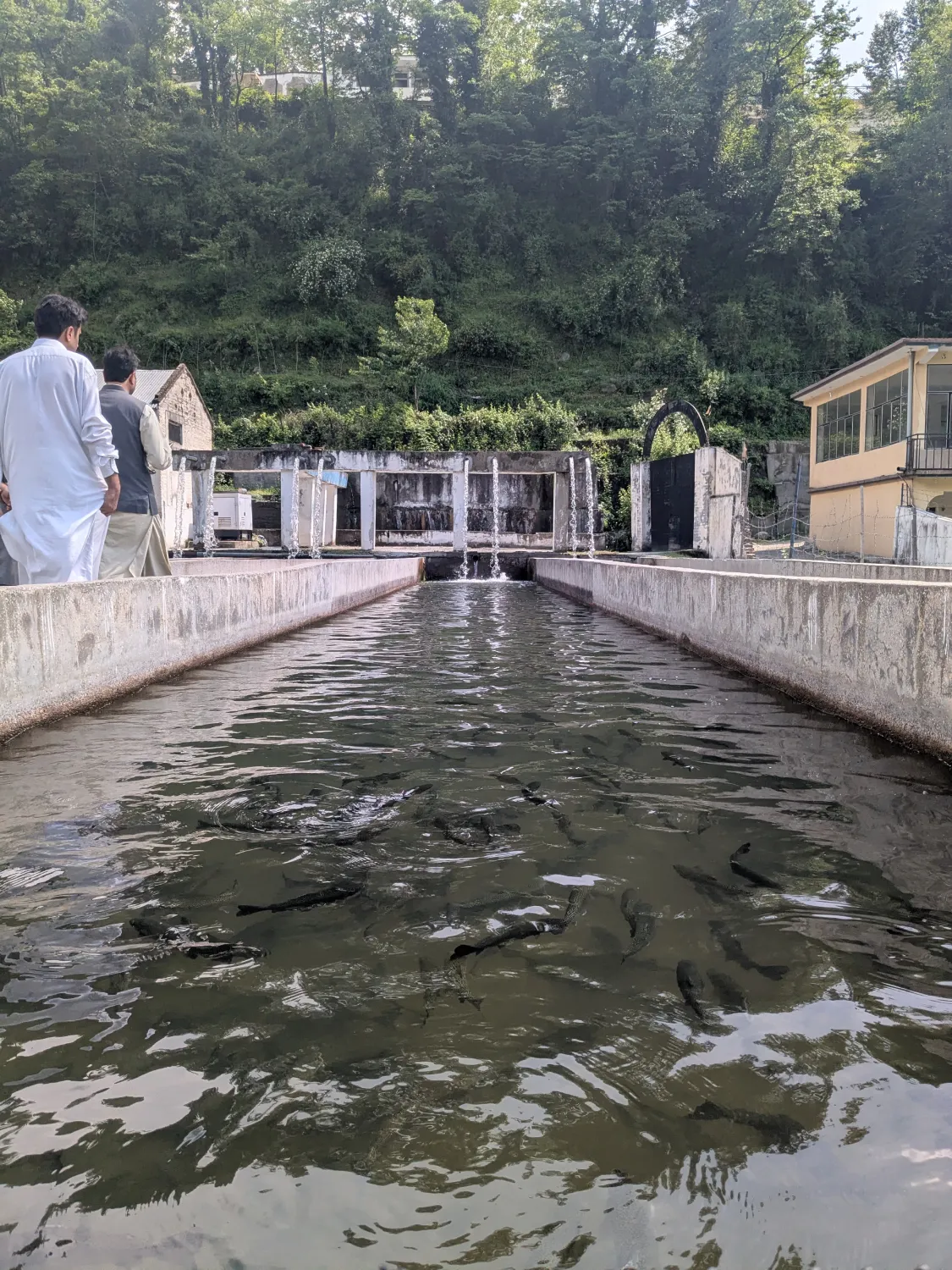
Bashir shared a list of farms lost in the 2022 floods in Swat, research he had undertaken on his own and travelled across the valley for. Before the floods, 321 farms were registered; now, only 42 to 45 reportedly remain. The flat land near the river is dotted with empty ponds, and broken channels show the devastation which forced farmers to sell homes and land, and instead resort to driving rickshaws in Mingora.
When the group of 8 to 10 farmers is asked whether those who lost their farms would like to return, there is a resounding and unanimous yes. Unfortunately, that proposition is easier said than done, because the floods have upended the landscape, leaving gravity-fed channels above farms, making repairs costly and too extensive for an individual farmer: damaged channels can run hundreds of metres upstream and cross several privately owned plots.
“I can manage the channel up to my own farm,” Karim explains. “Upstream, for half a kilometre or a kilometre, I cannot do it alone.” A Fisheries Department official proposes that future farms be placed farther from the river, and supplied through longer water channels. Such proposals are rejected roundly and used as evidence that outsiders do not understand Swat’s land. “This cannot be done,” Karim says, and elaborates that his land ends beside the farm. Reaching a safer plot would require taking a channel across several privately-owned properties. “People will not allow even a small pipe through their land. How will they allow a water channel?”
Even if by a small miracle, the farm is moved, the make-up of the water also changes the longer it travels: a longer, warmer channel can alter its temperature, pH and dissolved oxygen before it reaches the fish. “We have to farm close to the river,” Rahim says. “If the channel becomes too long, the water quality deteriorates. The pH changes and the dissolved oxygen level does not remain what the fish require.”
Rainbow trout depend on cold, clean and oxygen-rich water, with early-stage fish particularly vulnerable to temperature shifts and declining water quality. That vulnerability is worsening as extreme rainfall intensifies.
Research on Pakistan’s 2022 floods links human-caused warming to heavier rainfall, alongside weak infrastructure and exposure. Farmers need no models to recognise the change. They see it in warmer winters, sudden downpours, hail and broodstock behaving differently. Survival rates for trout eggs have fallen, making each hatchery cycle more uncertain and each season harder to predict. Rahim now sees mortality reaching 90 to 95 per cent during the earliest stages. At his farm, he produced around 500,000 fry during the 2026 breeding season. “I think perhaps 100,000 remain, perhaps even fewer,” he said. He expects only 10,000 to 15,000 to survive the 18 to 24 months required to reach market size. During the most severe episodes, death moves through the hatchery with astonishing speed. “Ten thousand fry can die in ten minutes,” he tells me. When asked what treatment is available, his answer is immediate: “We have no treatment.”
Farmers blame microorganisms, poor feed, contaminated water, temperature shifts and weak breeding protocols, but no local diagnostic system can identify the cause before stocks die. One farmer proposed his own safeguards: a settling and filtration tank, temperature and oxygen sensors, and a separate water supply for vulnerable fry. “If we install the filter, there is a possibility they will survive,” he said.
Research on Pakistan’s 2022 floods links human-caused warming to heavier rainfall, alongside weak infrastructure and exposure. Farmers need no models to recognise the change. They see it in warmer winters, sudden downpours, hail and broodstock behaving differently. Survival rates for trout eggs have fallen, making each hatchery cycle more uncertain and each season harder to predict.
He estimated that a concrete tank, sensors and the accompanying filtration setup for young fish could cost around PKR 1 million to PKR 1.2 million. The investment sits beyond the cash available to many farms after years of constant rebuilding. Yet it is small when measured against the value of stock lost across repeated production cycles.
The same farmer has already built part of an emergency system. He generates electricity through a turbine powered by flowing water and uses pumps to circulate water when the main channel fails: “By the grace of God, I’ve made my own electricity.”
The turbine shields him from an unreliable grid, but not from failures at the river intake. He still needs tanks, sensors, oxygen equipment and a backup supply to keep fish alive while blocked channels are being cleared. Given this climate, farmers must now act as biologists, hydrologists, electricians and emergency responders. Feed is another strain: a 25-kilogram bag costs PKR 7,200 to PKR 8,000, trusted suppliers are few, quality is hard to verify, and imported feed often makes the final fish commercially unviable.
“If you raise something for PKR200 and the market price is PKR150, how will the business work?” Karim asked.
The high cost shapes every decision. Established farmers have estimated total daily operating expenses between PKR20,000 and PKR50,000, depending on the scale and stage of production. A local feed plant is among their most repeated demands. They want lower transport costs, a consistent high-protein formulation and collective procurement. Credible testing and governance would be essential.
Market demand offers little relief because the valley currently has too few fish. Before the floods, Karim, who lost seven sites, supplied fish to the Serena Hotel in Islamabad, and sold it through Metro. He sent trout to other cities using ice boxes and passenger transport. Requests still arrive from Islamabad, Lahore, Chitral and Balochistan, while restaurants across Swat compete for limited supply.
“Talking about transport and markets is useless for us right now,” he said. “We do not have enough production for even the local restaurants.”
Falling production has pushed up prices across Swat’s trout economy, while farmers bear most climate and biological risks. Formal finance remains limited; Bashir’s PKR 3 million investment vanished in the 2022 floods. “I sold land and some of my property and repaid it,” he said.
Banks prefer financing feed to living stock, which is difficult to insure and often raised on leased land with incomplete records. Standard approval models also misread Swat’s smaller farms, while repayment schedules ignore trout’s two-year cycle. They also apply the same metrics to mountain holdings that they do to expansive farming estates in Punjab, despite vastly different spatial scales and yield expectations.
During the most severe episodes, death moves through the hatchery with astonishing speed. “Ten thousand fry can die in ten minutes,” he tells me. When asked what treatment is available, his answer is immediate: “We have no treatment.”
Meanwhile, farmers insist on Shariah-compliant finance with low mark-up, longer tenures and tailored recovery plans. “One farmer needs feed. Another no longer has a farm because it was washed away,” a farmer said. “Someone will buy fry, someone will rebuild the hatchery and someone will strengthen a wall. Every person has his own story.” They are also wary of programmes that distribute cash without setting technical milestones. “Tell me that I must do this work and that this amount will be released when I complete it,” Rahim said. “If the intention is to hand out cash, everyone wants cash, and the work may never happen.”
Their recovery plan is practical. Farms need site-specific retaining walls, protected channels, desilting points and alternative intakes. Hatcheries need filtration, spring-water access, oxygen cylinders, sensors and diagnostic support. Broodstock need emergency tanks on safer ground. Finance needs to provide disaster clauses, insurance and repayment periods aligned with trout’s biology. “People come, take advice from us and go back,” one of the valley’s earliest trout farmers said. “We are working through our own help. Come and see what the flood did to us.”
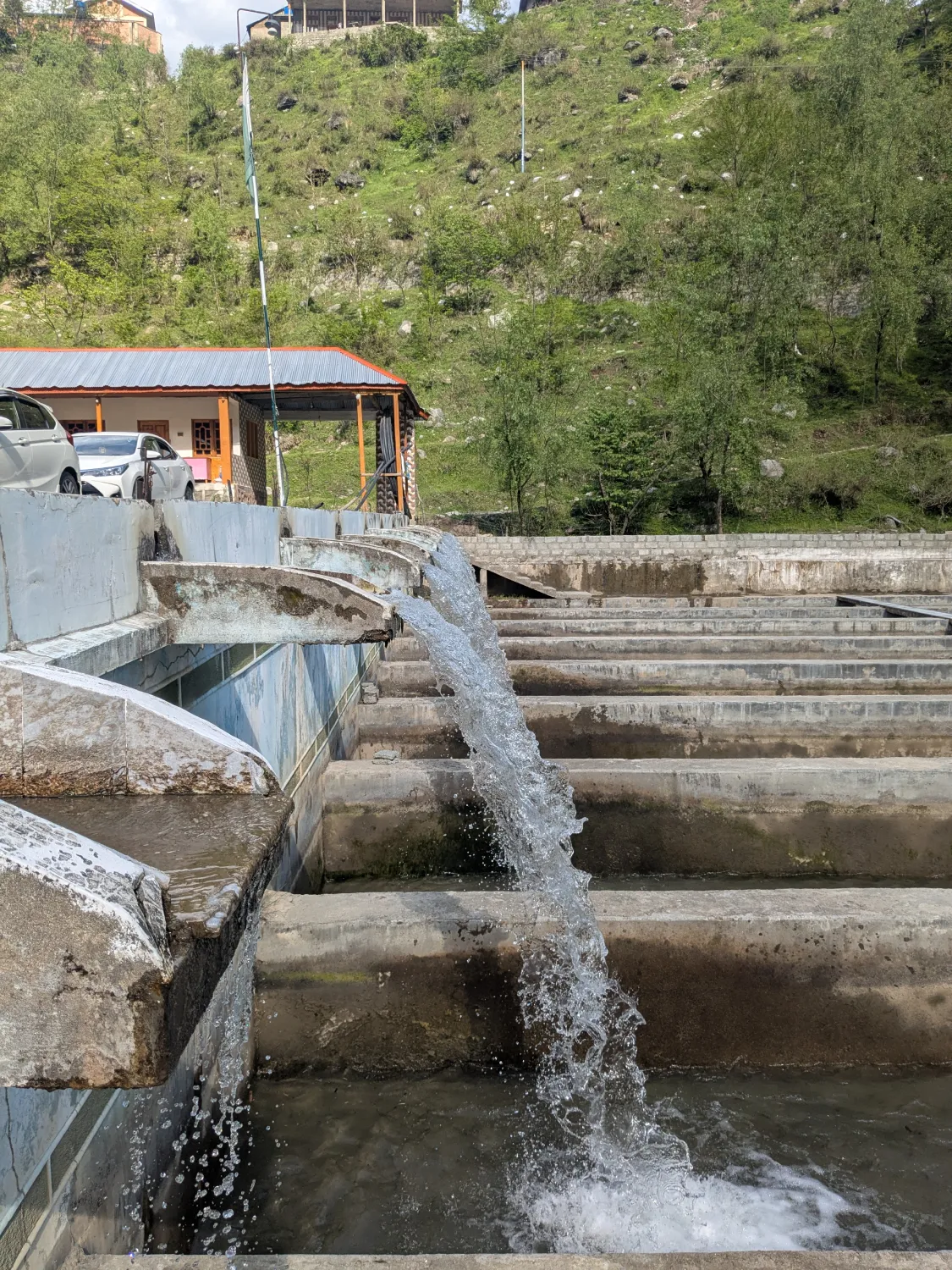
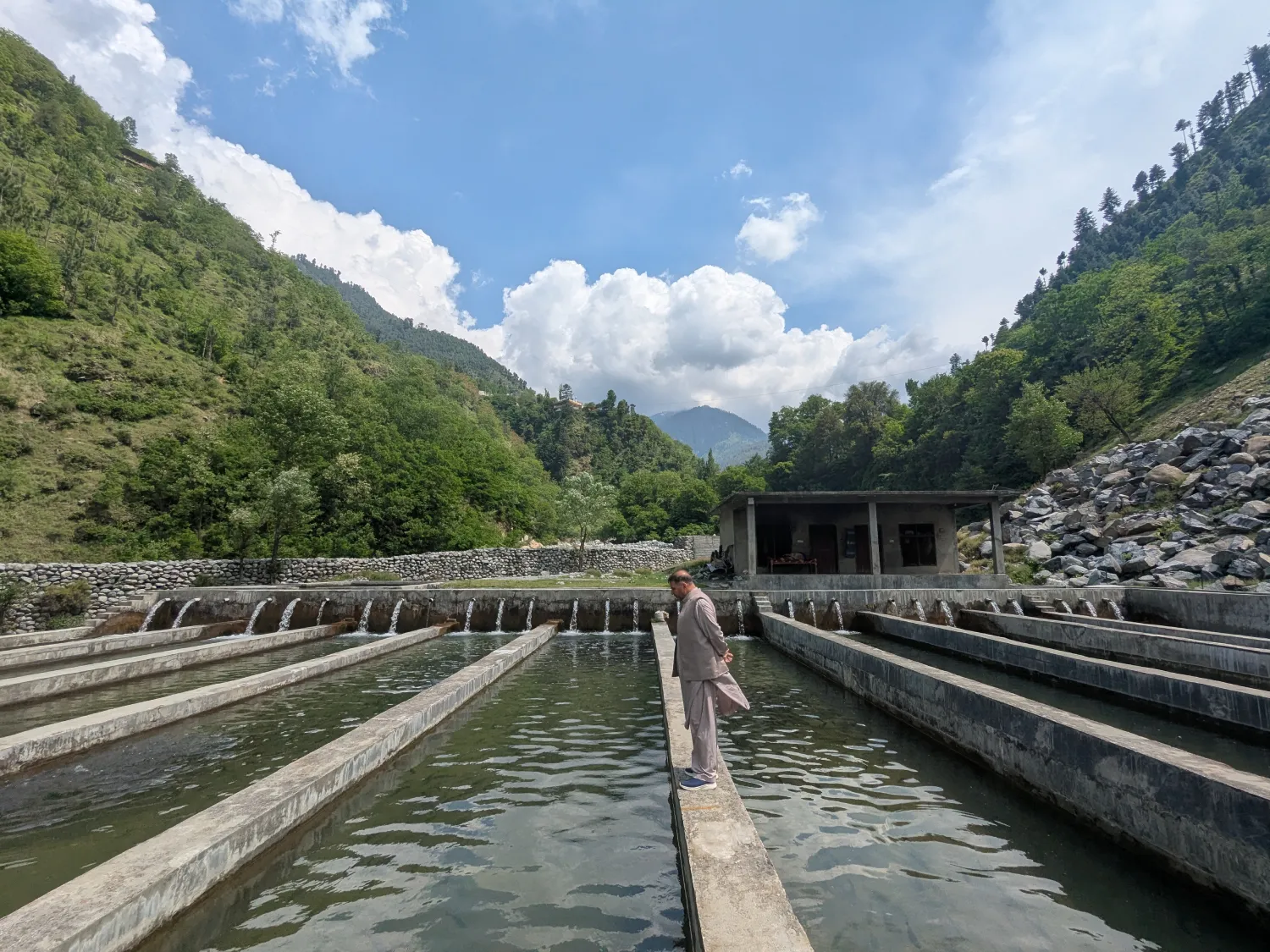
Their skepticism remains. Ponds depended on exposed channels, hatchlings still died without diagnosis, and feed still arrived on credit. Outside, water moved through the raceways, marking whether a farm was alive. When it weakened, farmers had minutes to start a turbine, switch on a pump or run upstream to clear a blockage. Every solution still began beside the pond.
The veteran who rebuilt after 1992, 2005, 2010 and 2022 believes survival begins with ownership: “If I understand that this is my work, the flood will not destroy it. If I do not treat it as my own, even a little water will wash it away.” Another farmer was more critical: “The flood followed its path,” he said, blaming those who approved unviable sites.
Between those two views lies Swat’s trout future. Farmers accept responsibility for their ponds and stock, but they want institutions to carry what no household can alone: scientific diagnosis, resilient channels, feed standards, insurance, and enough financing to be able to survive the next monsoon. Until that happens, summer rain will continue to divide the valley. Children will pray for relief from the heat only to be hushed as trout farmers watch the clouds, listen to the water and prepare for another sleepless night.
Click images to view in full screen
Hasan Saeed works as a Research Analyst at Karandaaz Pakistan, and is a long-suffering Pakistan cricket and Manchester United fan.