Sometime this summer, two of my friends and I went to visit a pair of our friends at their home in Islamabad’s F6. It was midnight when we pulled up, and it was immediately announced that all four of my friends were starving. True to those of us who have lived for long in Islamabad, there was really no question of ordering anything besides KFC at this hour.
Some minutes and two failed online application orders later, I suggested we might as well go and pick it up. I mean there are two KFC’s literally outside this house, guys. It’s important to mention here that these friends of mine are two married couples, and almost wordlessly, it was decided that the three of us guys would go and fetch the order.
The first KFC, the one with a Drive Through, was already closed when we reached there at 12:30 AM, and we turned towards the one in Super Market, arguably the best Markaz in the city and definitely the oldest and poshest.
There was a time when Islamabad would be dead at 10 PM, but that’s now a story of the past, something those of us who grew up here now hold fondly and are excited to pass down as legend if we decide to have children of our own in this city. Nowadays, well past midnight, all major fast food restaurants remain open, as do most pharmacies and shopping centres, and enough niche cafes and chai spots that there are pretty much always people to be seen on the streets.
This week though, it was different. Government-ordained austerity measures were in place, and every shop and store had to be closed by 11 PM. 12:30 AM now mimicked closely the Islamabad we generally knew at the 3 AM hour. Only takeaways were allowed at restaurants, and in this part of F6, the only place that was open was the lone KFC.
There was something distinctly small town about Super Market at this hour, and it was quickly apparent that this markaz — in the heart of the city — was much smaller and far less grand than it appears in the daytime. In fact, there really are only a handful of proper parking spaces, and once you take out all the illegal and double parking you can see it’s not meant for the influx of people it’s now begun to receive. When we parked the car outside the KFC, there was just one group of guys all sitting on the footpath in a circle. Our age, in their late 20’s or early 30’s, laughing and dicking around. We were still in the middle of the heatwave then, and the Real Feel was over 40 degrees. Most of these guys were in shorts and vests, and as we watched, some of them took off their vests and sat shirtless in the night.
We went up to the entrance where the barrier was down, and the security guard stood in front of the restaurant. The staff inside were rushing out and hopping on bikes, and we stood waiting for one to take our order. It took us five minutes to finally flag a server down.
Each of these places are some of the poshest neighbourhoods of the three major cities in Pakistan, but something unites all of them, in the same way it also unites underserved areas in all the same cities too. After hours, there is one culture. Boys and boysing. Laundas and bachodi.
Another guy also came at this time, visibly annoyed that his phone order wasn’t being dispatched. He looked towards us and said he was out of naswar and cigarettes, and could we offer him something. I told him we only had Monds, and if that worked. Anything works right now, he said, taking one, and lighting it.
The three of us waited, leaning against the car, smoking our own Monds, and the minutes ticked by. Around 10 minutes passed, and a Black Vigo pulled up, absolutely choking with rich teenagers. It parked close to us and around 15 boys got out, dressed in linen button downs, shorts, and Nike slides. One of them rolled up to the KFC door, and the rest began to arbitrarily make noises as they took over the parking lot. We finally got a hold of our server and asked him where the order was and he told us that they hadn’t placed it, and we had to order online and put in the pick up option.
We did that while a motorbike pulled up next to our car. A man in his late 30’s was driving and there was a woman in an abaya behind him. They also went up to the KFC door and I could see that she was very tall and, despite the mask covering her mouth, had a full face of makeup on. A man then knocked on our window, jolting us out of our stupor. He had a medical file in his hand and was begging for money. Running around his feet was an unrelated small kid, no more than 9 years old. His shirt was open all the way showing his skinny chest as he too tried to make some money at this time.
Across from the KFC, the main School Road was completely abandoned save for the occasional Prado zooming past at a 100 kilometres. As we stared at the road and the tiny roundabout in the middle of it, everyone in the KFC parking lot turned to where we were looking. There was the distant noise of a roaring engine getting louder and louder, and then suddenly, as always happens with these cars, an old BMW, rear wheel drive, barrelled onto the little roundabout, and started doing donuts. It completed one 360 and drifted for another, then another, spinning more skilfully than some of the guys on Tokyo Drift. It burnt rubber for almost two straight minutes, as all of us watched transfixed. Then, as suddenly as he’d appeared, the guy skidded back into the darkness from which he’d emerged.
There’s a small clock tower on this mini roundabout, barely 8 feet in height. All four clock sides are paused at different incorrect times.
By now, fifty minutes had passed and KFC still proved incapable of managing our order. We went back in to check, and the man with the tall woman was ambling out of the building. The man got back on his bike, and the woman got in the back of a Honda City that had just arrived and parked next to us. I’ve lived long enough in Pakistan to recognise casual sex work when I see it.
The server said 5 more minutes. Resigned, we returned to our car and put the World Cup on a phone. Outside, the Vigo teens were now hooting and jumping around, and close by them, the shirtless group of guys was doing the same. All excited and thrilled at some mysterious, magical thing. My friends’ wives called asking where we were. It was 2 AM now. We told them just a bit longer as the server finally came out with our order.
It seems to me this is always the story of this country regardless of which city I’m in. It’s the same when I’m at Bukhari at 4 AM in Karachi, waiting on the only café that’s open, smoking with my group of friends outside: three guys and one girl. Vigos with guards loaded in the back zoom past all around us. Two modded Mercs have a race off; we watch on and collectively grimace as they hit all the potholes on the boulevard.
Women in this Pakistan disappear entirely. If they’re at all present, they’re worried wives waiting on their husbands, or they’re that rare, rare friend who’s made it out here too because of the huge group of guys she knows; they’re the sex workers moving from streets to bikes to cars across MM Alam, Super Market, Zamzama.
It's the same when I’m at Main Market in Lahore’s Gulberg right before Fajr. There are three of us guys waiting on breakfast and chai from the What a Paratha that seems to exist only to do business at this ungodly hour. The only sight is other guys on different tables. Cigarettes and chai are heavily in circulation.
Each of these places are some of the poshest neighbourhoods of the three major cities in Pakistan, but something unites all of them, in the same way it also unites underserved areas in all the same cities too. After hours, there is one culture. Boys and boysing. Laundas and bachodi.
There’s so much to be said about what a country can be, what Pakistan means to its people. What do you see when you close your eyes? For most of us from the three big cities, this could be anything from Islamabad’s neat sectors, and sunsets over the Margallas, to Lahore’s narrow throbbing old city, to Karachi’s business hubs and the intermingling of every conceivable ethnic group. Put a constraint on the question though: what do you see at 4 AM Pakistan?
It’s sometimes easier to see what something really is at night, when the performance of the day ends and the curtain comes down. This country then dissolves into one unified subculture. Laundas racing cars, one wheeling, playing snooker, smoking cigarettes, dealing cards, making noise for the sheer fuck of it as they have some totally bewaqt ka khaana. They’re at the back of a Vigo if they’re well to do enough. Otherwise, they’re on the footpath, shirtless, playing cards. But they’re all still there in a strange case of a gendered unity overcoming class boundaries. They stand sharply against the buildings that show their age and dilapidation with the lights off. Women in this Pakistan disappear entirely. If they’re at all present, they’re worried wives waiting on their husbands, or they’re that rare, rare friend who’s made it out here too because of the huge group of guys she knows; they’re the sex workers moving from streets to bikes to cars across MM Alam, Super Market, Zamzama.
These are the small hours of the country, seemingly accessible to only 40 percent of Pakistan who are under 40 and men, but represent 100 percent of the cultural imagination of this time. Put on some Talha Anjum. Play all three tracks. 4 AM in Karachi. 5 AM in Lahore. 6 AM in Islamabad.
And I’m here too, with my own boys, cigarette in hand, taking in the blue hours. I think about it a bit. I wonder what this says about this country.
Then I put the Mond out, grab the KFC and fuck off.
***
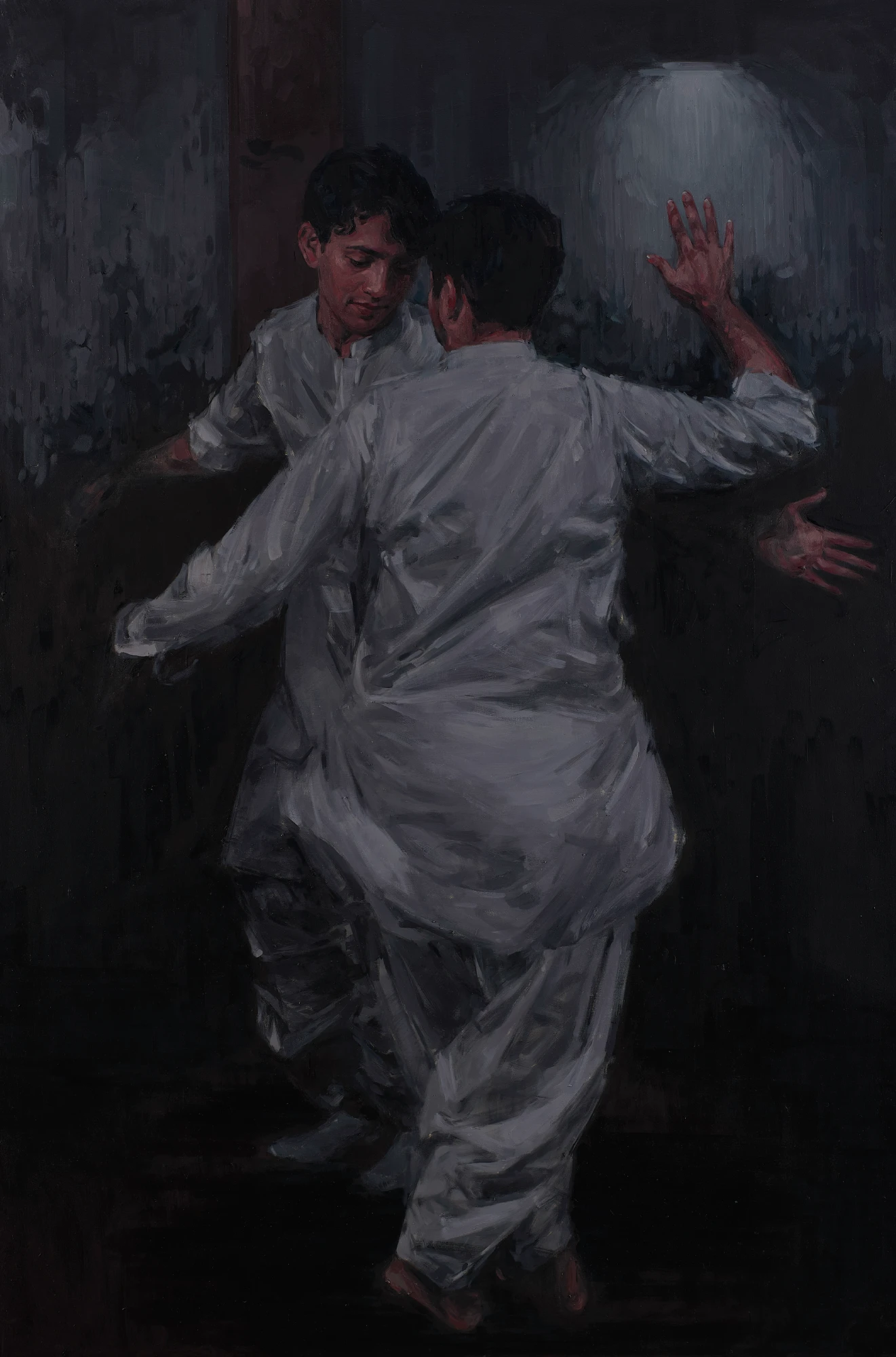
About the artist: Farishta Mirza is an artist from Quetta, currently residing in Lahore, and holds an undergraduate in Fine Arts from the National College of Arts, Lahore. Working primarily in painting, her practice explores the ambiguities of the human experience, focusing on spaces where certainty dissolves and meaning remains unsettled. Her work has been exhibited in Lahore, Islamabad, London and Miami. The featured painting was recently displayed at the artist’s first solo show at Numaish Gah in Lahore.
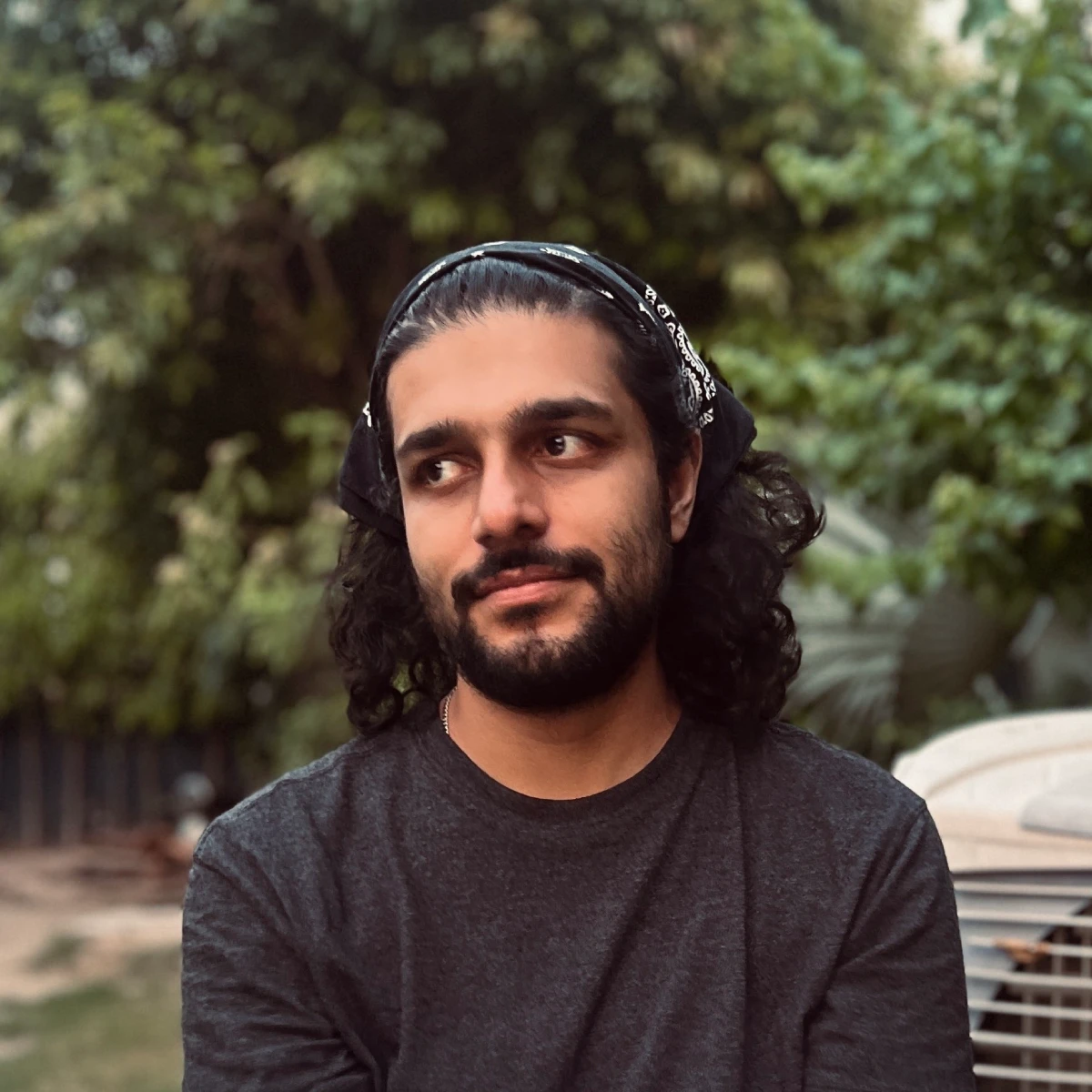
Younis B. Azeem is an essayist, memoirist and cultural critic born and raised in Islamabad. He is currently faculty in the English Department at LUMS, where he teaches various courses on Creative Nonfiction. He holds an MFA in Creative Writing from The New School in New York City, which he attended as a Fulbright scholar.