As I bow down in ruku during Zuhr prayer, my eyes follow a constellation of debris, dust and hair strands spread across the wooden floor around me. I make a mental note to clean it up after I finish my namaz. From the corner of my eye, I notice the ugly, black vacuum cleaner sitting expectantly in the corner, its long, twisted wire curling around it in unruly loops. I suddenly feel the urge to disentangle the wire to make it look a little less unsightly. It also, for some reason, reminds me that the fridge needs to be cleaned. Still making mental notes, I decide to clean out the fridge first so I can throw all the gunk on the floor and then clean the floor afterwards. I also decide to make a grocery list while cleaning the fridge to get a head start on the week ahead. The only open question being: should I take a shower before or after this cleaning spree?
I stand up from ruku, pause and reflect briefly on the words I am reeling off mechanically under my breath, then finish the rest of my prayer at lightning fast speed to get to my hyper-optimized cleaning plan for the day.
I have entered a phase of my life where I need my house to look like no one lives there. Among other mental illnesses, my body has apparently developed a tendency where it starts considering self-annihilation if things in my living space are no longer arranged in the exact way that I have chosen for them. For example, the number of creases I see on my sofa covers at any given point during the day has a direct correlation with the number of hours I will spend questioning my life choices during that day. The fact that they are covering a sofa, which is a place for people in my home to sit on and use regularly, is completely irrelevant to my very reasonable expectation for them to be crease-free at all times.
Inevitably, never have I gone through any phase of my life marked by strange obsessions without over-intellectualizing it. The first straw that I will grasp at to debunk the myth of my total insanity is that I get the same relief from organizing and decorating my house as most people get from doom-scrolling; my coping mechanism is just a little healthier.
[M]y body has apparently developed a tendency where it starts considering self-annihilation if things in my living space are no longer arranged in the exact way that I have chosen for them. For example, the number of creases I see on my sofa covers at any given point during the day has a direct correlation with the number of hours I will spend questioning my life choices during that day.
You see, there is hard, irrefutable science behind it. Human beings have a structure called the amygdala in their brain’s limbic system which is responsible for scanning threats, self-preservation and triggering the release of cortisol, the stress hormone. When we scroll endlessly, our bodies release a chemical called dopamine. Dopamine is the way our brain rewards itself to reduce the anxiety caused by the high cortisol. Together, they create a complex, yet highly susceptible feedback loop. Exposing ourselves to an onslaught of rapidly changing content, the good and the bad, becomes the source of both cortisol and dopamine release in our brain. We doom-scroll because we are anxious, but we keep scrolling to push away intrusive thoughts about situations we feel we do not have enough control over, so we endlessly flick our little thumbs on an illuminated screen to achieve some semblance of control.
In a similar vein, with a bit of hand-waving and a little sleight of hand, I can claim that I get the same kind of dopamine kick and a sense of control, without the additional unwanted cortisol surge, when I rearrange, decorate and declutter the physical place I inhabit. I convert (or aspire to convert) my living room into a highly aesthetic, catalog-worthy, Instagram-esque vignette of “perfect mess”: a colorful, crochet throw blanket casually draped across the sofa, lush, vibrant vines spilling over the rim of a suspended planter by the window; the kitchen exuding an air of pristine minimalism with no greasy dongas and chaotic stack of plates in sight, maintaining the necessary illusion that no one cooks there and yet somehow the food magically appears in the clean, organized shelves of the refrigerator; all my books neatly stacked in the bookshelf, all of them the right size, arranged in the right order. The warm lights are on, the floors are clean, the walls showcase art I have created, and I am standing in the middle of my glorious, orderly kingdom, marvelling at the sight of inanimate objects resting peacefully in their designated spots. No one moves. No one breathes. My mind can finally rest.
Another factor behind my obsession to make everything look nice all the time is men. All my life, I have only ever lived in a household shaped by women (and incidentally, my father, but since he is an ally and a valuable contributor to the creation of aesthetic spaces, I am compelled to put him in the same category). When you live with women, the aesthetic curation of that space becomes a collaborative exercise. One does not need to explain the necessity of having a travertine bowl filled with sweet-smelling potpourri and dehydrated rose petals infused with essential oils on the tank lid of a toilet. A woman will never question its existence in the bathroom. A woman will nod at it. A woman will add to it.
However, when you share a space with a man, even if the burden of everyday, domestic chores is somewhat fairly distributed, you inadvertently become the sole custodian of maintaining, upholding, explaining and curating the visuals of that lived space, to a point that can drive you crazy. A greasy ladle placed on the kitchen counter instead of the pretty, hand-painted talavera spoonrest I procured specifically for that purpose, or a sin far more dire such as socks materializing in an unaesthetic conformation on the floor when I have specifically put a rattan basket as a tactical hiding place for all such mess, can unleash a level of raw, untethered fury in me that I did not know existed. It makes me furious when people in my house do not follow protocol while benefitting from, but contributing nothing to, the thoughtful aesthetics of the space I have curated.
Of course, I realize that unleashing a volcano of rage over aesthetics is the complete antithesis of effective marital communication, so I resort to somewhat covert digital passive aggressive behaviour instead. This entails frequently sending my partner carefully selected Instagram reels where men give science-backed evidence of their own weaponized incompetence as the biggest driver of their wives’ general unhappiness.
When you live with women, the aesthetic curation of that space becomes a collaborative exercise. One does not need to explain the necessity of having a travertine bowl filled with sweet-smelling potpourri and dehydrated rose petals infused with essential oils on the tank lid of a toilet.
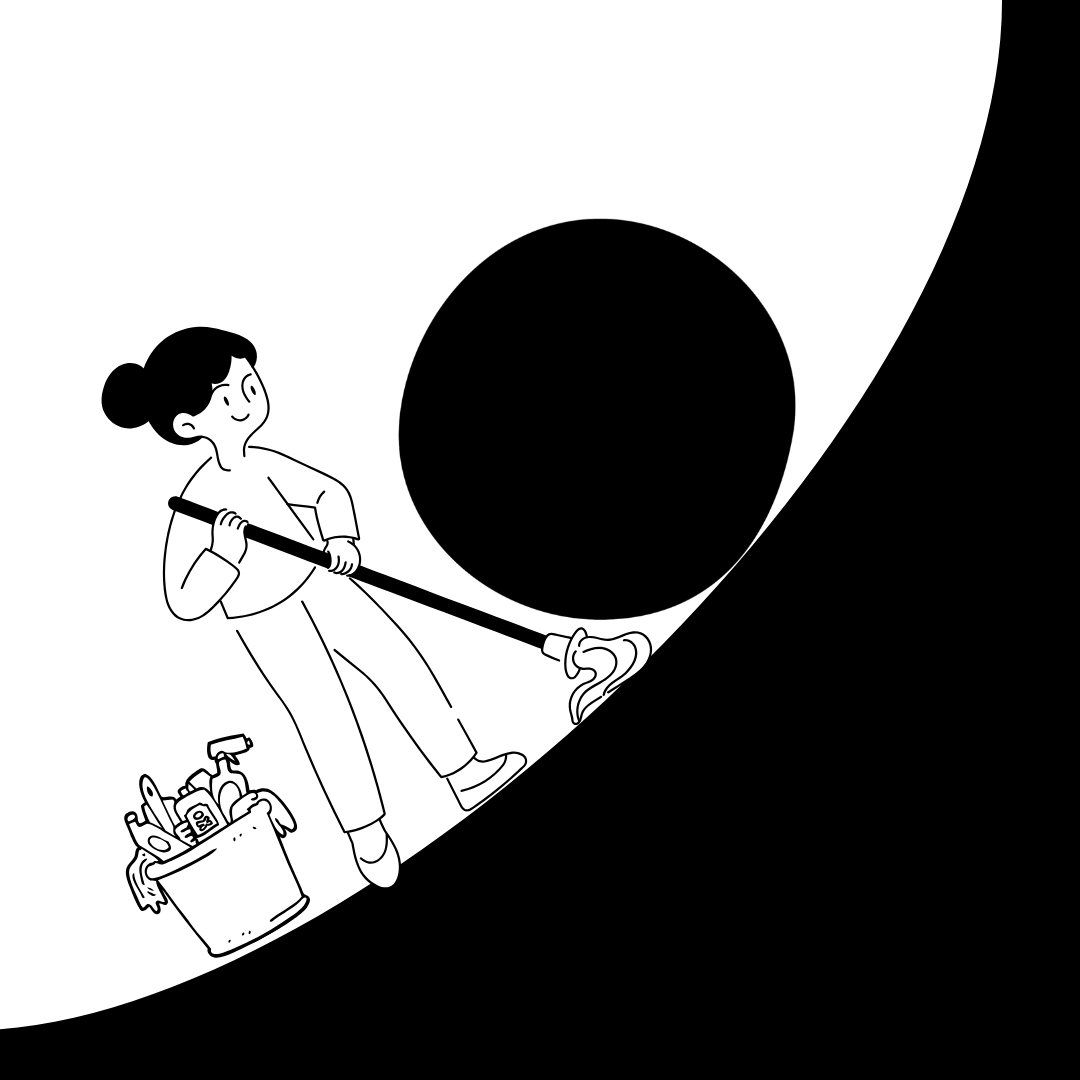
I might be slightly downplaying the exhaustion that comes with this obsession though. The other day, I was on a call with a long-distance friend of mine, as I packed for a much-awaited, much-needed road trip. I was telling her how I was moving to a new apartment a couple of weeks later, and that I was trying to pack for my vacation and pack for the move at the same time, just so that I can optimize my workload and have everything in order before I leave. I heard my tired, breathless self say that out loud, and in turn, received a sharp, unfiltered scolding from my friend, begging me to relax and focus on the vacation and not turn into a hyper-efficient-chore-optimizing-robot. It made me realize how my inability to relax unless my space is in order, and my compulsion to clean before relaxing together create a grueling cocktail. This, and my conviction that all my personal treasures that I have arranged in my physical space to make it look nice do not deserve to be in an unclean, disorderly environment, ensure that I am perpetually exhausted and forever overstimulated. I am Sisyphus, rolling a self-catalyzing, ever-expanding boulder uphill, in hopes that I will get to the top, sit on that boulder, drink my chai and enjoy the view, only to find out that the boulder keeps beating me back to the bottom. Older, wiser women have told me that having an aesthetically pleasing house at all times is a logistical impossibility; it is a fool’s errand, and I will eventually give up. I think they might be right.
Perhaps this is just a phase, and I am overanalyzing. In my head, I have raised this concern to my imaginary therapist during multiple imaginary therapy sessions: that I have locked myself in an eternal, nightmarish cycle and will never in fact be able to clean and decorate my way to emotional regulation and contentment. In my head, my therapist tells me that I should not worry, that everyone is entitled to some degree of insanity and eccentricity in this life, and so I should learn to be more self-compassionate. In addition to imaginary therapy of course, I am actively trying to embody the quintessential masculine indifference to a messy house by ensuring my socks land outside the rattan basket when I toss them from the comfort of my (uncovered) couch.

Hadia is based in Toronto and works in tech. Between reading and painting, she occasionally writes about life and culture. She shares her thoughts at @readwithhadia on Instagram.