“The inventor of the mirror poisoned the human heart” - Fernando Pessoa
For long, fears of femininity have defined what self-care has meant for Pakistani men: a haircut, routine shave, occasional deodorant, and for the hip naujawan, a swipe of hair gel.
But the mirror fogs.
Across internet subcultures, an emerging phenomenon has repackaged beauty as optimisation: Looksmaxxing. In doing so, it exposes young men to a culture of relentless scrutiny and insecurity, long geared towards women. Though the term may be foreign to Pakistan and largely confined to its urban digital spheres, the anxieties it captures are not: those of Desi masculinity in negotiation with itself, and with an increasingly unforgiving mirror.
As the name suggests, looksmaxxing is predicated on the idea of “maximising” one’s appearance. Individuals aim to construct the most attractive version of themselves, calculated through facial symmetry, proportions and harmony – a feat called ‘ascension.’ Its ethos, or lack thereof, lies in collapsing beauty into metrics through pseudo-scientific practices such as mewing and bone-smashing, and then packaged through its distinct anatomical jargon to project perceived legitimacy, such as ‘canthal tilt’, and ‘mandibular projection.’
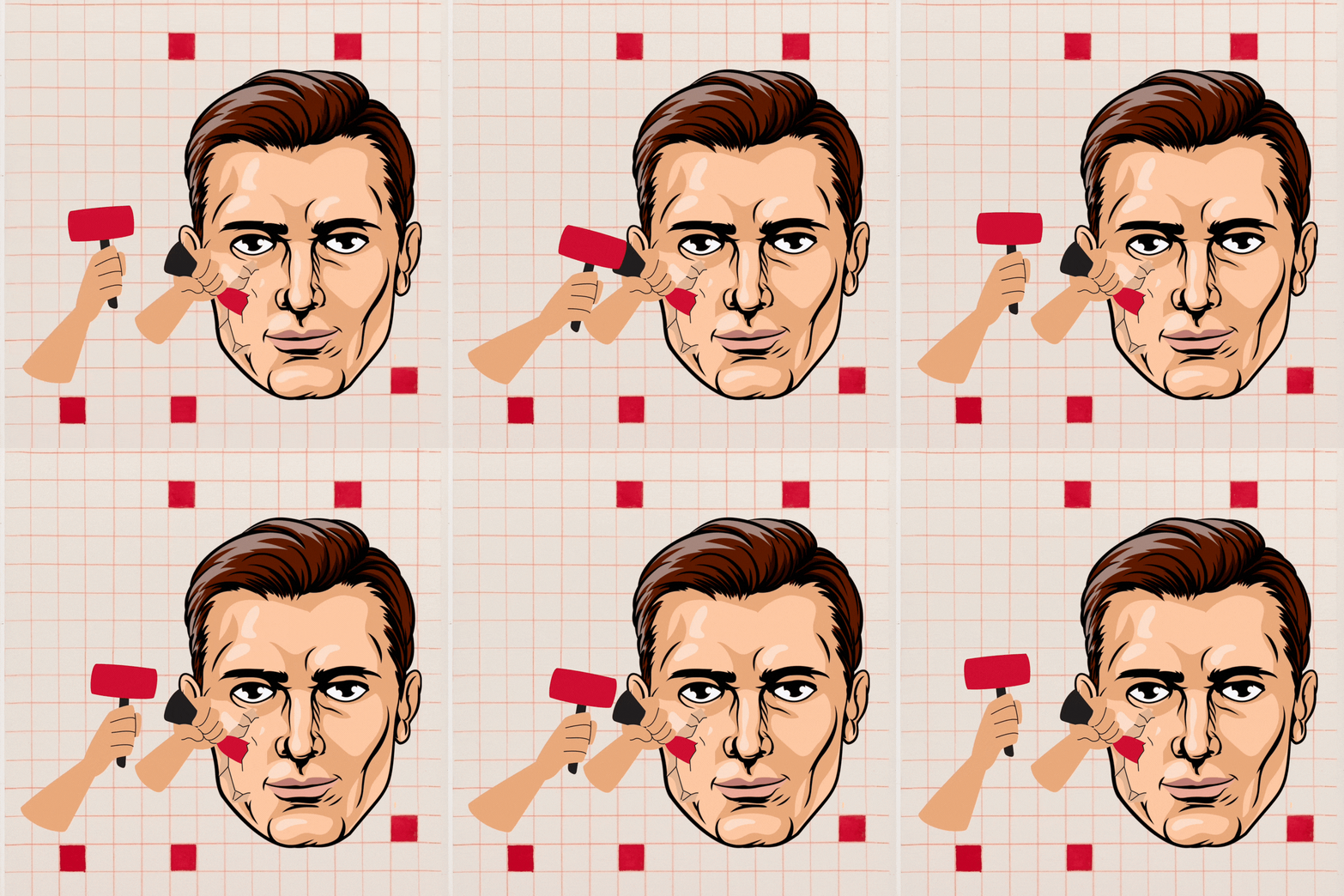
What begins with ‘softmaxxing’ – relatively tame practices such as mewing, skincare, and better grooming – can spiral into obsessive rituals that consume hours daily. At its extreme end, ‘hardmaxxing’ crosses into dangerous territory. Some teenagers apply brute force to their cheekbones with hammers for a sharper jawline, or pump themselves with steroids and fillers.
Toxic masculinity is hardly foreign to young men; what is new is its fusion with their physical desirability. Notions of competition and dominance have long defined manhood, but as economies crash and screen times skyrocket, the traditional arenas in which men have been taught to compete become increasingly obsolete. There are no more seven seas left to conquer. This leaves only the most treacherous frontier, the self; self-improvement, self-surveillance, self-hate.
Looksmaxxing is perhaps the psychological hypnosis of this moment. It takes the pressures of competition and redirects them inward, convincing men that if they cannot control the world around them, they can at least control the contours of their own faces. The body becomes the last available territory to conquer.
What has changed is not the gym itself, but rather what it represents. Today, it is one of the few socially sanctioned spaces for young men to pursue aesthetic labour, where sculpting the male body increasingly takes precedence over simply training it.
These notions are quantified through the PSL scale; not to be confused with the Pakistan Super League, it refers instead to “Perceived Sexual Market Value.” An internet taxonomy of male attractiveness, ranking men from 1 to 8, with 1 earning the title of “sub-human.” Though the underlying premise is familiar: optimise your rank, aur ab khel jamay ga.
Perhaps that is looksmaxxing’s genius (forgive the oxymoron.) It reframes one of humanity's most subjective experiences into the certainty of numbers, giving young men the opportunity to pursue beauty under the veil of optimisation.
In Pakistani society where young men and women often have more limited interactions when compared to Western contexts, deterministic narratives of a “formula” for attractiveness can prove especially seductive. While explicitly engineered to attract this imagined female patronage, with fewer opportunities to test these assumptions, it instead becomes a cycle of male self-surveillance and self-congratulation. There are now dedicated forums, apps and websites where men present, evaluate and scrutinise one another through the same unforgiving mirror.
Khadija, a young woman I interviewed, notes that looksmaxxing has become difficult to avoid. “[Young guys] constantly start mewing every time a camera is in their face,” she observes. “In my opinion a man doesn’t need to make certain faces to look good.”
But the mirror was not built overnight.
Looksmaxxing first gestated in the so-called manosphere, online peripheries where incel and hypermasculine communities have long festered. But internet subcultures rarely travel intact. A decade on, algorithmic feeds have propelled it into mainstream discourse, diluted through memes, reels and jokes, to be absorbed by the most impressionable.
When I asked six year-old Hamza if he knew about looksmaxxing, he shyly shuffled and shrugged. Yet moments later, he instinctively slanted his head, and with pouted lips swiped his finger across his jaw – a memetic gesture associated with mewing. In response to what a sharp jawline would achieve, Hamza exclaimed, “face perfect hojaega!”
Hamza knew not of the jargon. Yet he had managed to internalise its aspirations of perfection. His understanding of beauty was not learnt in front of a bathroom mirror. The mirror has long escaped these confines. Today’s mirror is portable. It lives in our pockets and in our hands: the smartphone, or, in Hamza’s case, his iPad.
But this mirror does not simply reflect; now, it instructs.
In Pakistan, the gym has been one of the principal sites for men to heed these instructions. From pehlwan traditions to neighbourhood bodybuilding clubs plastered with posters of Arnold Schwarzenegger in skimpy chaddis, physical strength has long been celebrated. What has changed is not the gym itself, but rather what it represents. Today, it is one of the few socially sanctioned spaces for young men to pursue aesthetic labour, where sculpting the male body increasingly takes precedence over simply training it.
Haider, 18, a regular gym-goer, says the shift has been impossible to ignore. “Ever since the looksmaxxing era started, every guy around me has wanted the most chiselled face possible. People started using fancy terms like ‘negative canthal tilt’ or ‘long ramus’.” Before then, he says, nobody seemed to care whether they had the “perfect” facial ratios. “All of this has made people around me more insecure.”
Notions of competition and dominance have long defined manhood, but as economies crash and screen times skyrocket, the traditional arenas in which men have been taught to compete become increasingly obsolete. There are no more seven seas left to conquer. This leaves only the most treacherous frontier: the self.
For Hashir, who only recently began going to the gym, these pressures were harder to ignore than expected. His family had long encouraged him to get active, but it was watching friends embrace looksmaxxing trends and the relentless stream of sculpted physiques online that left him feeling dissatisfied with his own body. The gym became as much about keeping up as it was about getting healthy.
This pursuit cuts beyond the gym. A local barber with two decades of experience says young men once came in asking for little more than a “fauji cut”. Today they arrive flashing photos of celebrities on their phones, wanting what can only be described as a Frankenstein concoction. “They want a beard like Parmish Verma, fade like Karan Aujla’s,” he says. “Everyone looks different but they all want the same,” he tells me. Hairstyles cannot be cookie cutter for the masses, he explains, but they are all in pursuit of “slimmer faces” and requests like “textured cuts, fades, buzz cuts.” In modest establishments such as this, looksmaxxing does not arrive with blazing trumpets, but rather intruding through its aspirations.
In a 2020 analysis of 1,000 Instagram posts featuring men, behavioural scientist Thomas Gültzow, then a researcher at Maastricht University, and his colleagues found that most portrayed highly muscular and lean bodies, while posts depicting that body type received significantly more likes and comments.
This inflation has been fuelled largely by the demands of a digital world. Fitness and lifestyle creator Ali Raza Rizvi, better known as ARRLifts to his over 300,000 followers on Instagram, observes this fog from within Pakistan’s online fitness scene. Rizvi sees value in grooming, hygiene and fitness. He does not dismiss self-care outright, but he is critical of reducing self-improvement to physical appearance alone. “There are so many other ‘maxing’ things you should do: personality maxing, kindness maxing. Looksmaxxing should not be on the top of your list,” he says. That hierarchy is what Looksmaxxing threatens to invert.
To Rizvi, appearance should be one part of self-improvement, not its entire purpose. The problem then is not skincare or the gym, but the obsession with optimisation that looksmaxxing amplifies, with aesthetics eclipsing health. In online looksmaxxing spaces, years of progress are compressed into an endless stream of “false dreams”, encouraging young men to measure themselves against curated physiques, flattering angles, performance enhancing drugs and misleading timelines. “People see someone who’s been training for seven years and want that instantly,” he tells me.
Ultimately, Rizvi says, “Fitness should add to your life, it shouldn’t subtract from your life by giving you more stress.”
The problem is not young men simply seeing attractive people online; it is that they are being taught to see themselves in relation to them. The connection is not entirely abstract in Pakistan. A 2026 study by Bakhtawar Latif and colleagues surveyed 511 Pakistani social-media users aged 16 to 25 and found significant positive correlations between body dissatisfaction, internalisation of appearance ideals, anxiety and depression. Similarly, a 2025 MPhil study at the University of Management and Technology, Lahore, surveyed 200 Pakistani boys aged 11 to 16 and found significant associations between social-media use, unattainable beauty standards and mental-health problems.
For some young men, that line has already blurred. Zubi (who chose to be identified by his nickname) describes an experience with looksmaxxing mirroring a Faustian bargain. “Nothing about it appealed to me,” he says. “It was just self-improvement, or I guess self-hate.” This toxic relationship with the self is not founded by looksmaxxing, rather targeted and enhanced. Learning this vernacular of facial ratios and asymmetry did not alleviate his insecurities, but instead sharpened them, “Learning things like that made me even more self-aware about my flaws.” Improvement became an obligation and healthy habits a necessity. “If I wouldn't,” he says, “then I’d just be self-sabotaging.”
Yet Zubi does not believe looksmaxxing is inherently harmful, “People portray looksmaxxing in a bad way but it’s just a bunch of dudes trying to become their best versions.”
This is a view that Aun, another teenager who has tried out looksmaxxing, echoes. “I believe it is okay to some extent,” he said, “but after a certain point it makes others feel bad about themselves, maybe even depressed.”
Pakistan’s changing relationship with male self-care need not be a bad thing. But the boundaries between self-improvement and self-surveillance are increasingly blurred. Looksmaxxing has not invented male insecurity, only bolstered it, and given it a painstaking vocabulary. It offers ‘ascension’, yet leaves many feeling permanently ‘sub-human.’
The young man becomes Victor Frankenstein and the monster both, endlessly sculpting the self. The mirror no longer waits above the sink in the bathroom. It follows young men into their schools, their gyms and their barber shops, appearing on the screens in their hands and speaking through the voices of strangers online. It does not simply reflect an image; it instructs them on what the image should be. And if the promise of looksmaxxing is that every flaw can be corrected, then the most dangerous possibility is that as soon as one so-called flaw is corrected, there will always be another one waiting.
Husnain Kalyar is a student, writer and visual storyteller, with ancestral roots in Guldakot. He works across writing, illustration, archives, and digital media, with a focus on stories from Pakistan.