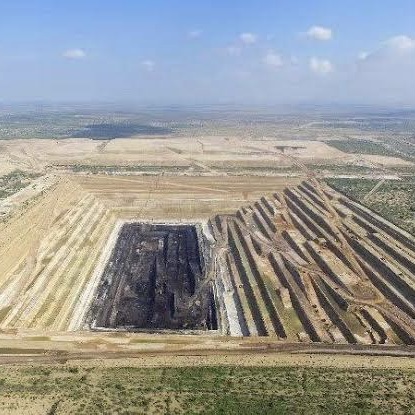
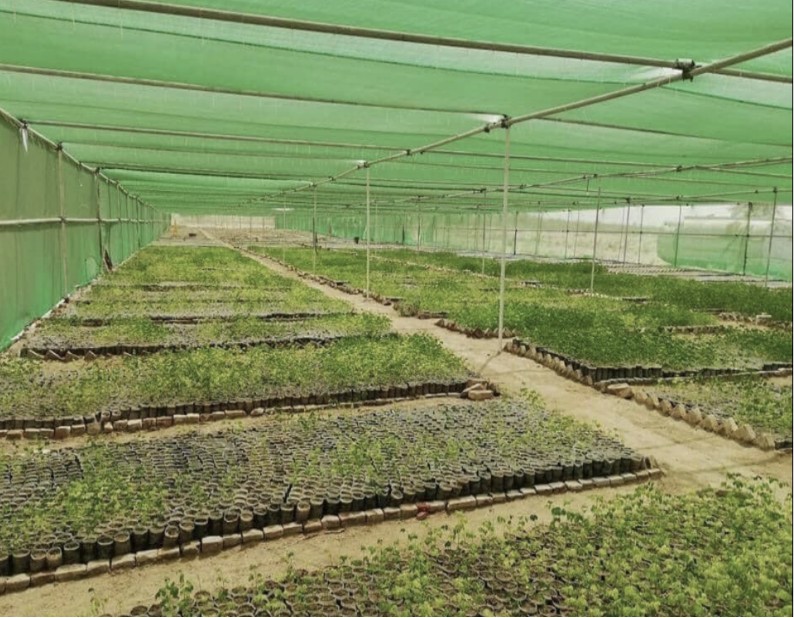
Within the walls of the Sindh Engro Coal Mining Company’s (SECMC) corporate enclave in Tharparkar, 2.3 kilometres from the SECMC coal mine, is a 100-acre nursery with a capacity of half a million saplings. When I took the guided tour of the enclave in 2022 as part of a university trip, this nursery was the first stop. It covered a large enclosed area with long rows of saplings planted in prepared soil beds, covered by a large green shade. White drip-irrigation pipes ran along the ground, delivering water to each plant. Small placards were placed beside several plants, each listing the name and designation of a business executive or state official who had planted the sapling during an official visit. The space was orderly and quiet, with labeled plants, visible infrastructure, and clear pathways guiding movement through the nursery. As the tour’s opening site, the nursery foregrounded environmental care before visitors even encountered the mine itself.
Geographers center space and place in their understandings of power, arguing that relationships to place matter, that space is a result of power relations, and how we represent the world makes the world. With this in mind, I focus on the space of the nursery and the specific configurations of power that make its existence possible. This includes examining how the space is materially constructed and, equally importantly, how it is discursively produced through narratives that justify, naturalize, or obscure the operations that underpin it
Green spaces created in close proximity to the coal mine function as both physical and discursive instruments that obscure the violence of extractive coal mining. These landscapes operate through a logic of comparison: they first require the land to be framed as barren, degraded, or empty, and only then can it be represented as “redeemed” through industrial intervention and state-led initiatives such as forestation. In this way, greening can be seen as a strategy that legitimizes extraction by framing destruction as development and renewal.
[T]he most common ideas about the desert are that they are empty and absent of life. This misleading conceptualization of the desert has served to legitimize its transformation, manipulation, toxification, and destruction. Contrary to this imaginary, however, the Tharparkar desert in Pakistan is not devoid of life, and is in fact the most populated desert in the world.
When one thinks of a desert, what kind of images come to mind? Deserts are often understood through ideas of emptiness, barrenness, and unproductivity. They are imagined as spaces where little can grow, where human activity is limited, and where resources are scarce. According to architect and historian Samia Henni, the term "desert" stands in for a complex locus of imageries, imaginaries, climates, landscapes, spaces and histories. While imagined otherwise, the territories of both hot and cold deserts embody various forms of anthropogenic exploitation, such as colonial dispossession, resource extraction, and civil and military occupation. Yet, the most common ideas about the desert are that they are empty and absent of life. This misleading conceptualization of the desert has served to legitimize its transformation, manipulation, toxification, and destruction. Contrary to this imaginary, however, the Tharparkar desert in Pakistan is not devoid of life, and is in fact the most populated desert in the world, with a population density of 83 people per square kilometer, and a total estimated population of over 16 million people. It is also home to more-than-human life, including native grasses and drought-resistant vegetation, livestock such as camels, goats, and cattle, and desert-adapted wildlife like peacocks, foxes, and migratory birds.
If that is the case, one must ask why deserts have always been imagined as empty and lifeless, and who benefits from the discursive construction of the desert as empty. Even though the presence of life in a desert seems evident, to this day, we hear and read the same old colonial platitudes. This is because industrialized subjectivities and exploitative authorities are searching for so-called “empty” spaces to be “filled” through extraction and mining. In this context, an onslaught of mainstream media representation of Thar as “barren” and “arid” similarly creates a representational criterion by which ideas of the land have been formed in the national imaginary, and the desert becomes a spatial signifier that renders its environment and the bodies that inhabit it as pollutable.
This process – of rendering a land pollutable – is conceptualized by environmental historianTraci Voyles, who highlights that the wasteland discourse is a mode of representation of particular spaces as uninhabited, barren and marginal. This works as a state and corporate strategy to position them as predisposable to deterritorialization and pollution. Landscapes of extraction are forms of representation as well as empirical objects, emphasizing the idea that how we represent the world makes the world. In other words, by deeming a desert empty, any sort of toxic harm and pollution can be justified to that space and its people.
Anthropologist Arturo Escobar in his book Encountering Development talks about how the discourse of development has historically been used as a way to appeal to non-Western countries to incorporate capitalist culture by framing it as a way to end local developmental problems, such as food scarcity, disease, low economic prosperity and poverty. Development frames capitalism, science and technology as ingredients that would make these problems go away, when in fact it does the opposite: creates massive underdevelopment and impoverishment, as well as untold exploitation and oppression as a result of the restructuring of so-called “underdeveloped” societies to fit capitalistic ideals.
The SECMC coal mine in Thar is owned in equal parts by the Sindh Government and China under the China Pakistan Economic Corridor (CPEC). This article published in Dawn is an example on how the spatial construction of Thar as empty and in need of development is mobilized. Since 2019, there has been an onslaught of similar news articles on the topic of Thar and the mining project in the region, many of them aligning themselves with the corporate agenda.
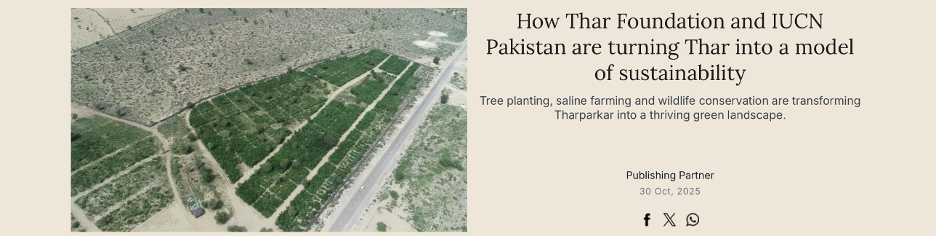
In this article, the climate of the desert was put in contrast to the climate of the forest, placing a condition where the desert “has the potential” to be a “thriving green landscape” with the right processes. Through this comparison, the desert is deemed a space with a fundamental lack, thereby legitimizing processes of extractive afforestation that are not suitable to its climate, but also legitimizing extraction of the space. There is a long history of afforestation practices being used as colonialist conquests, according to Israeli architect Eyal Weizman. He states that the threshold of the desert is a delicate and unstable environment, which is sensitive to over-farming and over-grazing, and therefore needs to be treated and lived in carefully. Afforestation in Thar is one such example of how corporate interests are the basis for this violent practice.
The displacement of Thari families, the contamination of groundwater, and the creeping loss of biodiversity occur not in dramatic bursts but through extended, cumulative harm. Such violence is difficult to represent in the spectacular language of development and progress, which thrives on images of growth and greenness.
This kind of discourse is employed similarly for the legitimization of extraction and mining processes in Thar. ‘Development’ is presented as a way to end the problems that have long troubled the region. The development of coal mining and its related infrastructure changes however are violent and toxic, and people remain worse off. According to the Thar Monitor (2024), since the development of the SECMC coal mine in 2019 and its adjoining power plant, there has been forced displacement of indigenous people with inadequate compensation, of only one lakh rupees per year provided to the male head of the household. Already scarce water resources have become heavily polluted with power plant industrial waste, resulting in outbreaks of water-borne diseases such as cholera and typhoid. Air quality has worsened with coal ash polluting the air. The local ecology has suffered as well, with a sharp decline in the population of peacocks and other species, and an increase in lightning strikes reportedly linked to mining activity. Promises of infrastructural development, such as healthcare and education for local communities, remain unfulfilled. Despite approximately 1.5 million dollars of investment into the region, the people of Thar remain worse off. According to civil society organization Business and Human Rights Center (2025):
The expansion of coal mining has led to the extensive pollution of natural flora and fauna, resulting in the degradation of local ecosystems. Groundwater resources are being overextracted, with further risk of contamination from the disposal of saline wastewater posing long-term risks to freshwater aquifers. Furthermore, coal dust pollution has become a rising health hazard for adjacent villages, contributing to lung illnesses and degrading air quality. Perhaps the most damaging of all is the cultural disturbance, as the damage of inherited lands causes indigenous people to undergo obligatory relocation, thus eroding old traditions. The accurate cost of coal is not just measured in megawatts and megaprojects but in the damage to Thar’s land, air, groundwater, and the dignity of the people who have called it home for generations.
This is a kind of slow violence that has unfolded over the last seven years in Thar – a relatively invisible violence which Rob Nixon in his book calls a violence of delayed destruction which is static and invisible. It does not have the representational weight of being deemed a disaster. The displacement of Thari families, the contamination of groundwater, and the creeping loss of biodiversity occur not in dramatic bursts but through extended, cumulative harm. Such violence is difficult to represent in the spectacular language of development and progress, which thrives on images of growth and greenness. Corporate green spaces, in this context, function as aesthetic screens that hide the slow, ongoing violence occurring just beneath the surface.
While the conjoined state and corporate interests of the SECMC and the Sindh Government employ these discursive strategies to legitimize extraction in Thar, questions of environmental and social harm of coal mining and industrialization are inevitable. One tactic to representationally neutralize the environmental harms of coal mining is the strategic employment of green spaces, such as the SECMC nursery.
In recent years, the creation of green spaces has become a strategy through which corporations seek to legitimize environmentally destructive projects. Presented under the guise of sustainability and ecological care, these initiatives often function as tools of image management rather than genuine environmental restoration. The SECMC has used afforestation and “greening” projects to rebrand its extractive operations as sustainable development. These initiatives operate discursively to neutralize the visible harm caused by coal mining. Conducted on indigenous Thari land, these corporate practices mimic the logics of extractive colonialism.
The creation of green spaces such as the SECMC nursery in Thar thus becomes a strategic corporate performance, a visual and discursive tool designed to obscure the violence of extraction. Through these initiatives, SECMC and the Sindh Government reframes Thar’s identity through the language of rehabilitation and progress. One million tree plantations, public performances of state and corporate actors planting trees in the desert, the goal to transform a ‘barren’ space into a ‘thriving green forest’ all function as language of environmental and ecological care.
The act of “greening” Thar paradoxically depends on first defining it as barren; only then can it be “redeemed” through industrial intervention such as forestation. Forestation and other development objectives such as job creation and energy sovereignty are framed as positive consequences to legitimize environmental harm through coal mining in Thar.
Within this framework, SECMC’s afforestation project is not an act of ecological care but a symbolic performance of environmental stewardship—a visual counter-narrative meant to conceal the environmental damage caused by coal extraction. These green initiatives function as a form of corporate greenwashing, allowing the company to present itself as sustainable while continuing to pollute Thar’s scarce water resources and contribute to global carbon emissions. The afforestation projects, in particular, are used to “neutralize” pollution—both literally, by claiming to offset emissions, and discursively, by shifting attention away from the slow violence of environmental degradation.
Moreover, these practices reproduce colonial logics of environmental control. The idea that Thar’s land must be “improved” or made “productive” through technological and industrial intervention echoes the colonial view of deserts as empty and awaiting transformation. Afforestation can be thought of as ecological manipulation and also a tool for political domination—a way of asserting authority over land and redefining it through capitalist and developmentalist frameworks. The paradox is that the very language of greening, sustainability, and care is mobilized to deepen extraction. What appears as ecological restoration is, in fact, a continuation of extractive colonialism under a new, environmentally friendly guise—one that allows corporations to profit from destruction while claiming to heal it.
By invoking the language of environmental stewardship, the SECMC constructs a narrative in which coal mining and ecological restoration are presented as compatible pursuits—where planting trees ostensibly offsets the pollution and social upheaval generated by extractive industry. This reframing not only obscures the material violence of displacement and ecological collapse but also reproduces colonial logics that imagine arid landscapes as empty, unproductive, and in need of transformation. The desert, in this narrative, becomes a canvas for developmental experimentation: a “wasteland” to be redeemed through corporate saviours. Thus, the strategic employment of green spaces in Thar exemplifies how the aesthetics and rhetoric of environmentalism can be co-opted to advance extractive capitalism, transforming sites of devastation into spectacles of progress.

Shanzeh Afzal is an Environmental Justice Researcher currently based in Karachi. She works at Alternative Law Collective and holds an MA from Carnegie Mellon University. Previously, she was a Research Associate at The Knowledge Forum.