What defines the birth of a country? Is it the day that it comes into being on paper? Or the day that it begins to exist as a fully formed state with clearly defined borders?
On the evening of 14th August 1947, Karachi’s Governor House was the site of a gathering organized to celebrate the inception of a new country: Pakistan. Filled with music, dance, and speeches full of hope for the new country, the evening was attended, among others, by Lord and Lady Mountbatten, and the Viceroy’s press attaché, Alan Campbell-Jones. The latter’s observation of the mood in the city of Karachi, which was filled with expectant optimism, contrasted starkly with the mood of the host of the evening, Muhammad Ali Jinnah, who “cut a lonely figure.” It is ironic, however, that the promised land being celebrated would come into being on paper at midnight, but neither its founders hosting the celebration, nor the many civil servants in attendance that it would inherit, knew exactly where the country begins or ends. The borders would become somewhat clear two days later, when the infamous Radcliffe Award would be announced and implemented. But they would not be fully defined until a year later, when the Accession of Princely States would be completed. So, what defines the birth of a country?

Sam Dalrymple’s first book, Shattered Lands: Five Partitions and the Making of Modern Asia, commits itself to a single, audacious reframing. The 1947 Partition, with a capital P, the one with the trains, and the Radcliffe award, and the midnight tryst with destiny, was not the first or the only territorial restructuring of its kind in Colonial India. It was, in fact, the third of five. Off the bat, such an argument destabilizes national histories across the Indian Subcontinent, where the carving of territory along religious lines is often understood to be rooted in Muslim Nationalism. Dalrymple places the origins of the idea in the 1937 Partition of the North-eastern region of Burma and the Indian Ocean enclave of Aden from British India, engineered to satisfy Hindu nationalists who wanted Hindustan to resemble the ancient holy land of Bharat, stretching from the foothills of the Hindukush to the Bengal. The effective conversion of Hindustan into Bharat, according to Dalrymple, crystallized Jinnah’s fears for the future of India’s Muslims.
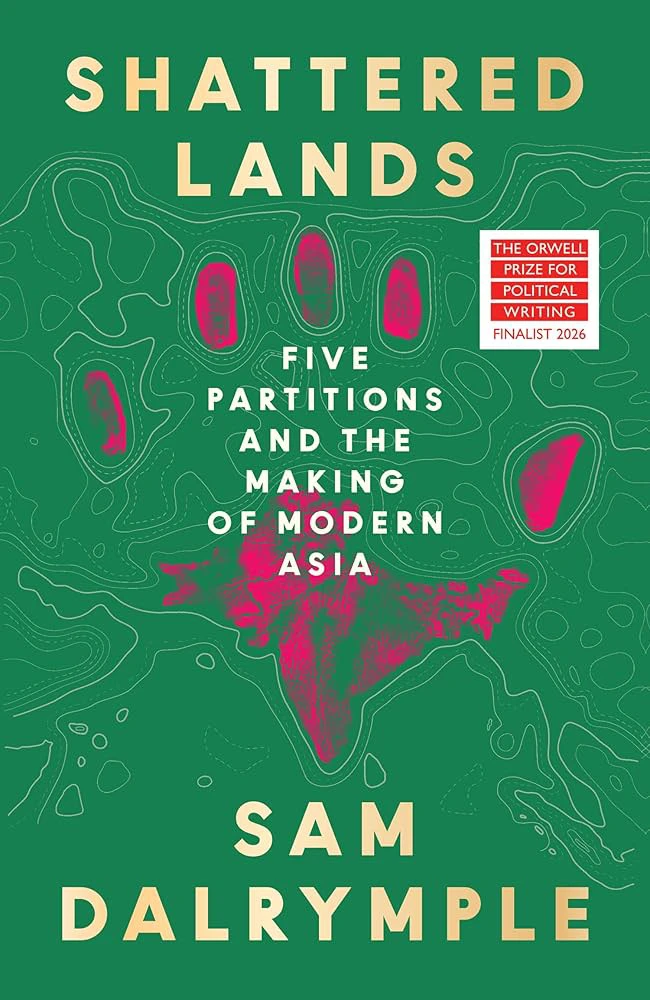
Dalrymple records Burma’s Partition in all its gory and violent details. The Second Partition, that of British India’s Arabian territories is recorded in the opposite manner: an administrative transfer so unremarkable that nobody in Delhi seems to have noticed they were giving away the oil wealth of Kuwait, Qatar, Bahrain, and the UAE. The Third, the Great Partition of 1947, was followed immediately by the Fourth, i.e. the absorption of over five hundred princely states into India, Pakistan, and Burma. The Fourth Partition, as covered by Yaqoob Bangash in A Princely Affair, determined more of the India-Pakistan border than the Radcliffe Line itself. Indeed, Dalrymple’s anecdotal accounts of the accession of Jodhpur to India will appeal to the curiosity of readers interested in the ways in which individual actions determine major historical events. Jodhpur’s accession to India had a domino effect, whereby other princely states were effectively cut off from mainland Pakistan, making their accession to the latter unrealistic. And finally, in 1971, the fifth partition: the one that broke Pakistan in half and gave the world Bangladesh, and effectively concluded the 34 year long process of crystalizing the borders of Modern Asia.
Dalrymple's argument is that none of these can be understood in isolation, because each one created the conditions for the next. We are used to thinking of "Undivided India," i.e. roughly today's India, Pakistan, and Bangladesh, as the natural unit that colonialism then carved up. Dalrymple shows that this "Undivided India" never actually existed except for about five months in 1947, after Burma and Arabia had already been sliced away. The India that Jinnah and Nehru fought over was itself the product of an earlier partition. Thus, the 1937 separation of Burma, in other words, pre-loaded the demographic and ideological terms on which the 1947 separation of Pakistan would later be fought.
We are used to thinking of "Undivided India," i.e. roughly today's India, Pakistan, and Bangladesh, as the natural unit that colonialism then carved up. Dalrymple shows that this "Undivided India" never actually existed except for about five months in 1947
This is where the book earns its keep for a Pakistani reader, because it relocates Jinnah's trajectory within a much longer and more structural story than the usual "secular lawyer turned Islamic nationalist" arc. We meet him in 1928 as a Bombay barrister married to a Parsi girl, hailed by Sarojini Naidu as the "Ambassador of Hindu-Muslim Unity." The book does not flinch from the personal tragedy that shaped him, his wife Ruttie's ostracism, her descent into addiction, her suicide on her twenty-ninth birthday, her final letter ("I love you — and had I loved you just a little less I might have remained with you"). But Dalrymple is careful not to let psychology substitute for politics. Jinnah's slide toward separatism tracks almost exactly with the slide of "India" toward Bharat: the 1937 elections, in which the Muslim League failed to win a single seat in Punjab and Jinnah declared he would "never come back" to the province; the adoption of Vande Mataram, with its invocation of the goddess Durga, as the national song the same year Burma was cut loose; Congress's refusal of a coalition, which the civil servant Penderel Moon called "the prime cause of the creation of Pakistan." None of this excuses or explains away what followed. Rather, it shows Pakistan's creation as the product of a system already partitioning itself, rather than as a sudden eruption of religious difference into an otherwise harmonious whole.
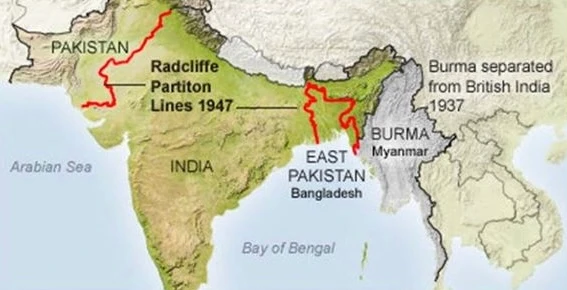
The Rohingya crisis, similarly, stops being a contemporary news story and becomes legible as the unfinished business of 1937 and 1942. When Burma separated from India, and 600,00 Indian civilians marched on foot over the Patkai Hills by 1942, the question of who counted as "Indian" and who as "Burmese" was left deliberately vague in the borderlands of Arakan. The Muslim Rohingya, who had spent the colonial period as subjects of the same Indian Empire as everyone else, found themselves on the wrong side of an increasingly racialised line. During the Second World War, Japanese forces in their campaign in Burma reportedly promised Arakan's Muslims "arms, money, food, and the establishment of Pakistan." The promise itself came to nothing but left behind an armed Rohingya movement that, by the 1950s, was literally trying to secede from Burma and join East Pakistan.
And 1971 is where the book's domino logic finally lands. Dalrymple's account of the 1971 war itself is archivally rich, and anecdotally diverse. Archer Blood's "genocide" cables from a besieged American consulate, the surrender at the Dacca racecourse, Indira Gandhi's line about sinking "Jinnah's two-nation theory in the Bay of Bengal," are all vividly highlighted without being triumphalist. It paints a picture of divided loyalties, and treats the Pakistan army’s atrocities with the same seriousness as the Bihari massacres.
Jinnah's slide toward separatism tracks almost exactly with the slide of "India" toward Bharat: the 1937 elections, in which the Muslim League failed to win a single seat in Punjab and Jinnah declared he would "never come back" to the province; the adoption of Vande Mataram, with its invocation of the goddess Durga, as the national song the same year Burma was cut loose; Congress's refusal of a coalition, which the civil servant Penderel Moon called "the prime cause of the creation of Pakistan."
The book is not without its problems. In my opinion, the folding of the Gulf states into a "partition" framework stretches the concept past usefulness. The Raj’s Gulf territories, despite being administered from Delhi and tied into its broader Indian Ocean network, were complex socio-political systems of their own with historical trajectories distinct from Hindustan’s. The lack of in-depth exploration of the British Political Agency system in the Gulf and the aspirations of its own elite paint the picture of a passive Gulf region just there to be transferred between India and Britain. At the same time, the prospect of the Gulf’s oil resources would make it too valuable to leave to Delhi anyway. Thus, Dalrymple’s hindsight, that India unknowingly gave away the control of Gulf’s oil wealth, is problematic at best. The oil wealth was never India’s to give away. It simply transferred from the British to the British.
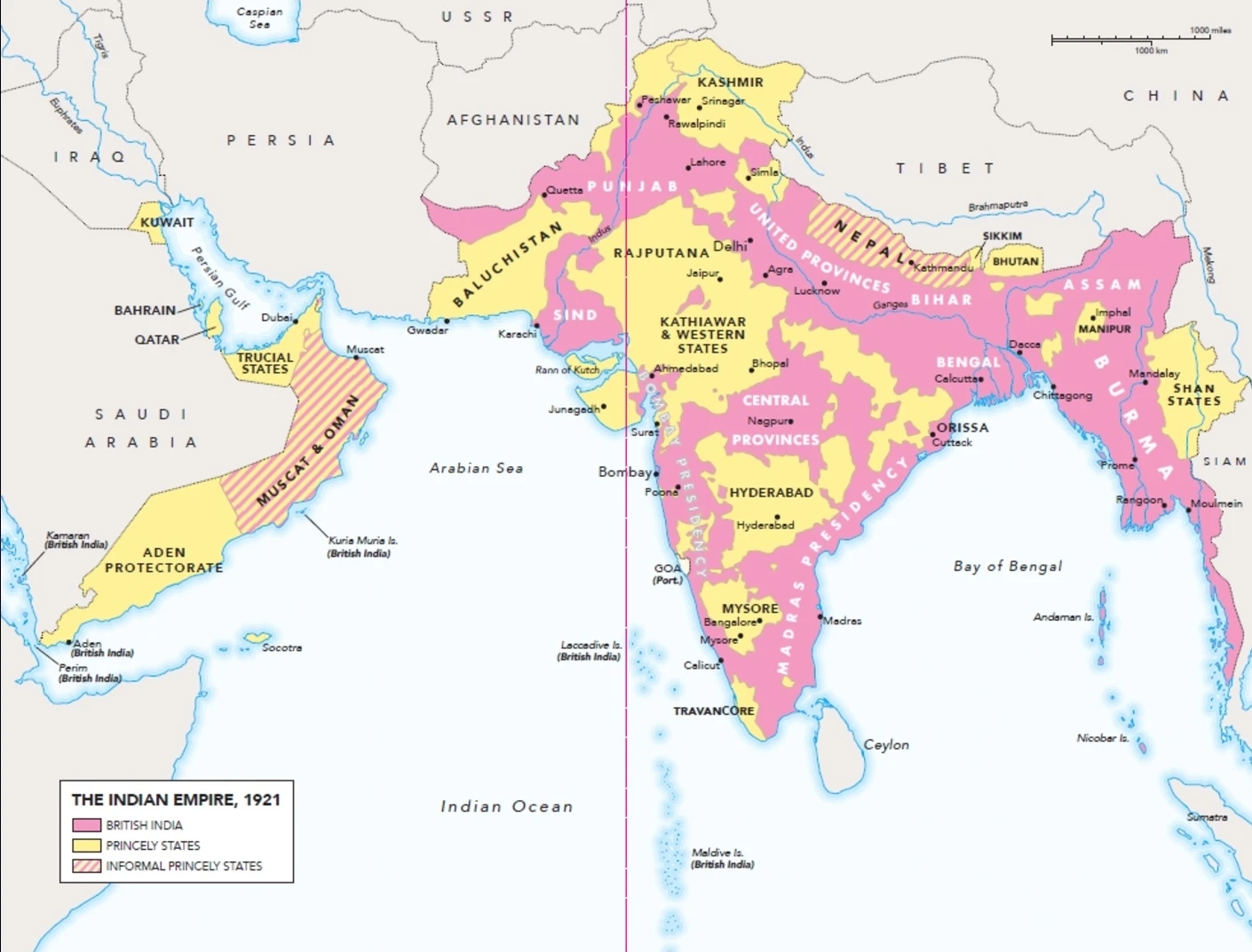
The treatment of the Gulf’s separation as a Partition also brings to light the omission of a much more crucial partition that would have tied well with the overall narrative of the book: the 1905 Partition of Bengal. An earlier and arguably foundational rupture, it goes almost unmentioned through Shattered Lands, an odd silence in a book otherwise obsessed with origins.
None of this, however, dents the book's central achievement. What Shattered Lands ultimately does is take the word ‘Partition’ away from us as a proper noun, and hand it back as a verb. It walks the tightrope well in terms of balancing narrative richness through intimate anecdotes and compelling characters, and broader macro-historical arguments.
Shehroze Ahmed is a Lecturer of History at the Institute of Business Administration. He teaches histories of colonialism, surveillance, and Islam in South Asia and the Indian Ocean Region.