I've spent a lot of Muharrams sitting on a farsh-e-aza (floor of mourning), waiting for something in me to crack open. Walking into Tollinton Block for ‘The 40th Day’ exhibition, I honestly didn't think a white-walled gallery with track lighting could do the same thing a majlis does. I was wrong about that.
The show takes its name from Arbaeen, the fortieth day after Ashura, the point at which grief is supposed to have found some kind of shape. History works in a strange way, though. Karbala survives not just on library shelves but in the majalis, the processions, a living, breathing archive built on tears and the spoken word, and this exhibition seems to know that. What I kept noticing was how many of these artists seem to disagree with that premise. Grief here doesn't settle. It just keeps changing form.
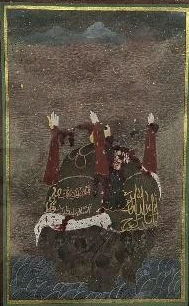
Murtaza Zaidi's Resonance is the piece that opens the show for me, one work in two related parts. Gold leaf on paper turned ashy: three faceless hands rising out of a field of waves, and above the waves, a mass of people, dense and anonymous, the whole crowd rendered in the same muted grey-brown as the water beneath them, like the two are barely distinguishable. I stood there thinking about Hazrat Abbas at the river, reaching for water he never got to drink himself, and how the restraint asks more of the viewer than a literal image would. Beside it, a grid of eight smaller studies repeats the same gesture, gold crescents, wounded silhouettes on grey-black grounds. Each crescent carries a single Urdu letter worked into the gold, spelling out ‘Abbas’ and ‘Hussain’ across the grid one letter at a time, only if you notice. Eight versions of nearly the same image. It reminded me how our own mourning works this way too: the same majalis every year, the same nauha, and none of it ever feels rehearsed. Breaking the two names apart like that, letter by letter, made me think of how we say them in the same breath so often - Ya Hussain, Ya Abbas – as one, inseparable.
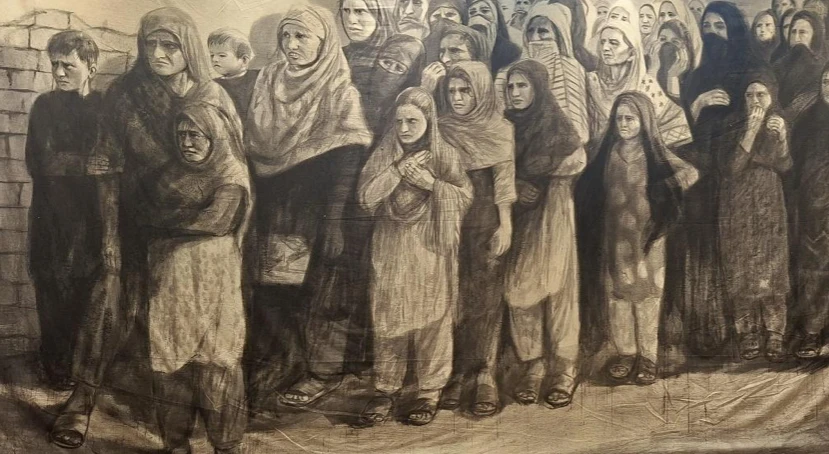
Ali Laraib Rizvi's ‘Mujrae Khalaq Mae’, an unstretched charcoal frieze running nearly the length of one wall, depicts women and children standing shoulder to shoulder, looking straight out at whoever's standing in front of them. No colour. No alams, no procession, none of the imagery we usually associate with Muharram at all. Just the after. I've written before about how the women of Karbala get remembered almost entirely through suffering: Sayyida Zaynab (S.A.), Sayyida Sakina (S.A.), flattened in a lot of popular retelling into grief alone. But they were not merely storytellers. They were poets, mourners, and truth-bearers, and Zaynab's real strength was in channeling her grief into purposeful action, standing up in Yazid's court instead of just weeping in it. This frieze pushes back against that flattening a little. These aren't weeping figures. They are watching figures, and there's a real difference between the two.
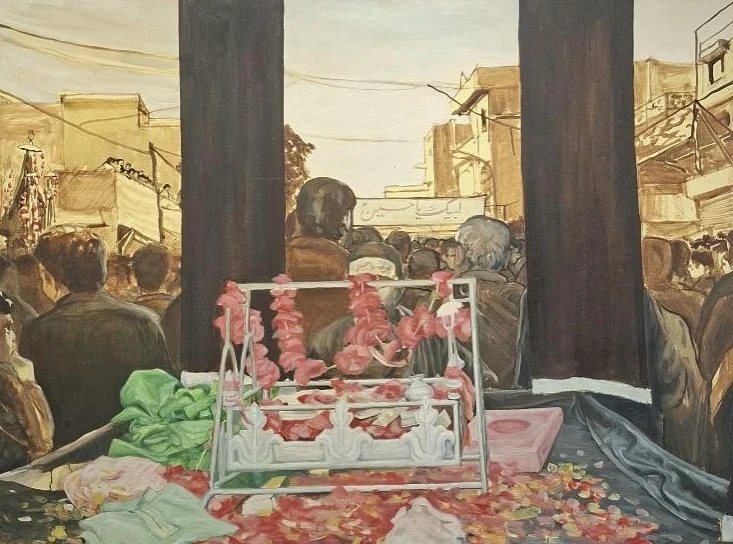
Zahid Mayo's ‘Jhoola’, an oil painting, does something similar but smaller in scale, more domestic. A white metal jhoola (cradle), garlanded, sits in the middle of an actual street of Krishanagar, with petals scattered around it, like a crowd has only just dispersed. You can see buildings behind it, a Labbaik Ya Hussain banner half caught between the painted columns. It felt as if I was transformed inside the procession. It is not an abstraction. A jhoola in an actual gali, decorated by hands that will, later that same evening, fold the cloth back up and carry the flowers home. Practices that we take from our elders and carry on as a legacy, as a duty.
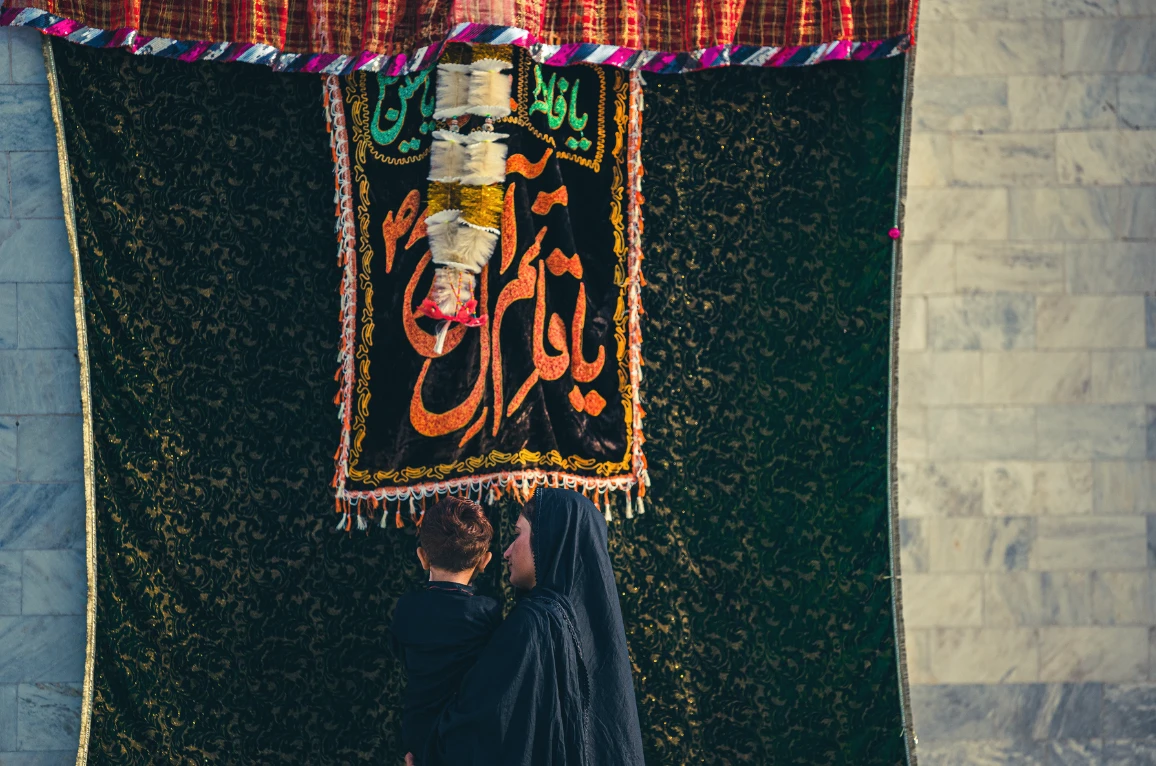
Then comes Moaz Ahmed Bhangu's first piece titled ‘Naqsh 1445’; a mother and child looking up at a green chadar embroidered with "Ya Qaim Al-e-Muhammad," calling on the coming of the twelfth Imam, an invocation most of us find ourselves calling on more often than we probably even notice. The second, titled ‘Agosh’, is quieter and closer to the ground, a scatter of diyas on the floor, six or seven of them against a wall, and someone sleeping beside them. Agosh means an embrace, a lap, a cradling, and that's exactly what the framing does, the way the person is folded down next to the flames rather than standing over them. Diyas aren't really about the light they give off, not in this context. There's a tradition, in most religious/cultural practices, of lighting them as a mannat, a vow, a wish laid down and lit at a shrine or a threshold, health, a prayer answered, something asked for and something given in return. It could hold a different meaning for all of us. However, placing that gesture inside an agosh, something you'd usually hold a child or grief in, makes it feel like a quiet embrace. Neither photograph is trying to make an argument. They just record that this happens, every single year.
Tucked into a wooden display case, easy to miss if you're not looking down, are Nad e Ali's ‘Chelum I–IV’, six small digital c-type prints, barely six by five inches each, dated 2016. They're almost illegible at first glance. Blurred alleyways, a room half-lit, a face dissolving into static. I stood there far longer than the size of the work should have demanded, honestly, because that illegibility felt more honest than a sharp photograph would have. This is closer to what chehlum actually looks like in memory a decade on, not a clean documentary record but whatever's left once the crush of bodies and the noise have blurred the edges of what you actually saw.
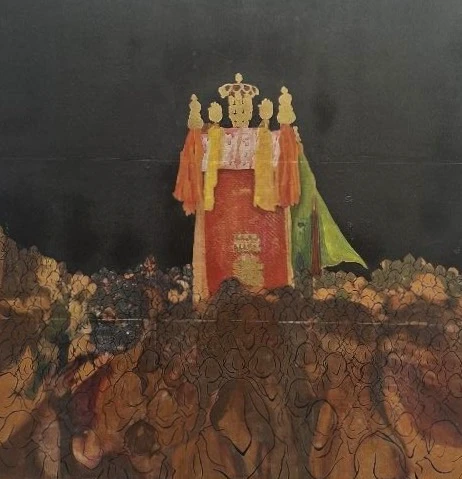
Faariha Kazmi's two pieces are doing almost the opposite thing. ‘Jaloos’, acrylic, photo transfer, gold leaf, shows five burning mashals (torches) held up against a black sky, the crowd underneath rendered as a dense field of outlined heads with no individual faces, closer to a single organism than a gathering of separate mourners. ‘Karvan’ right beside it keeps that same rust-and-gold photo-transfer language, but turns it toward one raised alam, crowned in gold, cloth caught mid-flutter above the same faceless crowd. Where the charcoal frieze insists on individual faces looking back at you, Kazmi's crowds insist on the opposite, the jaloos as one mourning body rather than many people standing next to each other.
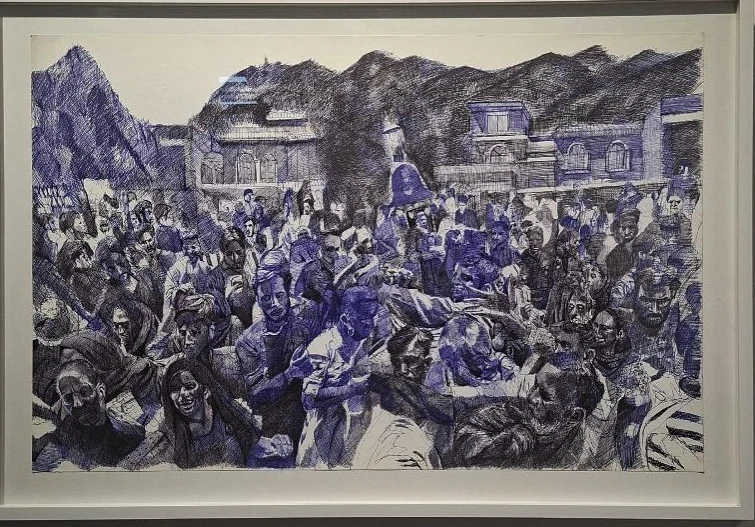
Ghazi Sikander Mirza's ‘Lunar Surface’ etching, is done almost entirely in blue and black cross-hatching, of a crowd pressing forward through a street with mountains and old buildings behind them. Something is raised above the heads near the centre: a tazia or a taboot. What struck me is how physical the mark-making is. You can feel the artist's hand working fast, line over line over line, the way memory itself layers when you're trying to hold onto something that happened quickly and all at once. It sits somewhere between Kazmi's faceless crowd and Rizvi's individually rendered faces; here, you can make out particular people if you look closely enough, but the sheer density of ink pulls you back toward the crowd as a whole before you can settle on any one of them.
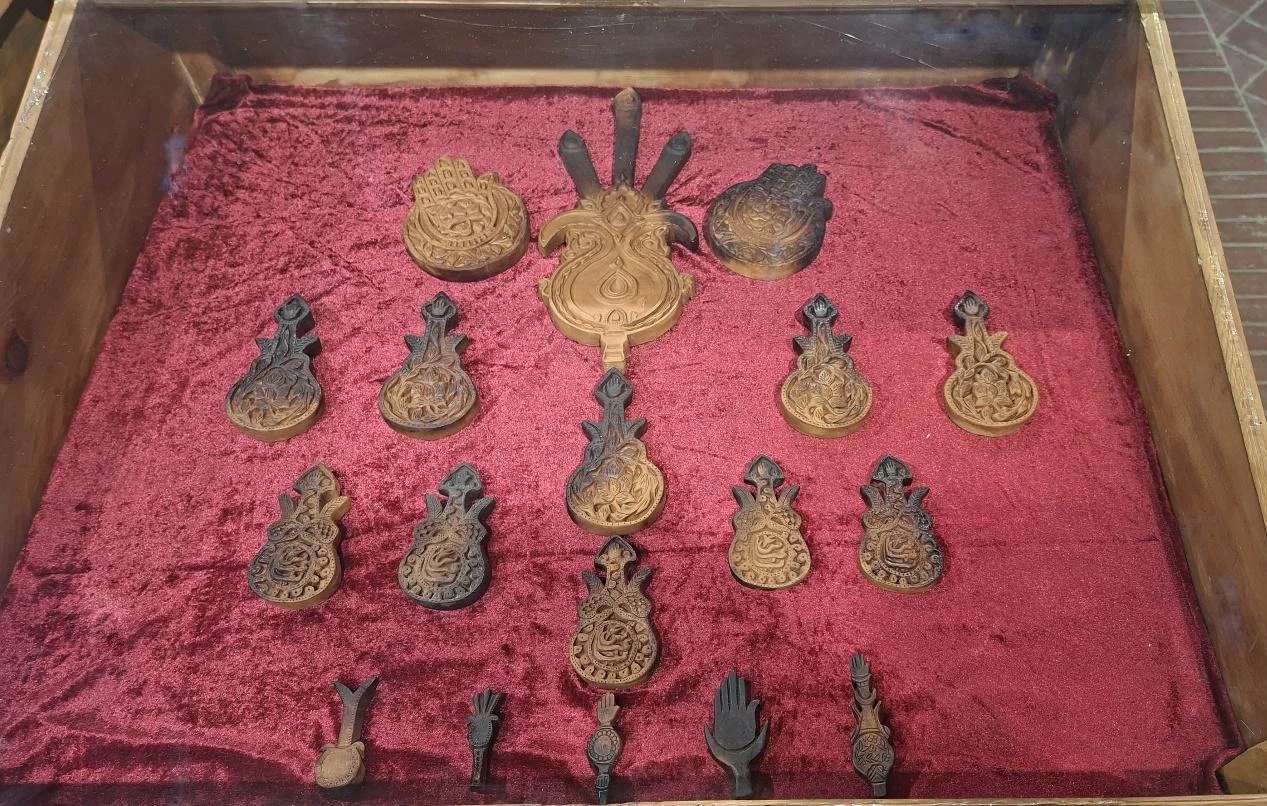
Aalia Naveed's ‘Panja’ sits in a glass case near the entrance, easy to miss if you're moving fast, and it might be the piece that stayed with me longest of all. It's a collection of carved wooden hands, some pale and untouched, others worn dark and almost charred-looking. That shift from terracotta warmth to blackened finish reads to me like hands that once fought, reached, prayed, and were cut down and left to darken with blood, reminiscent of Hazrat Abbas (A.S). No two are carved quite the same way, which is its own kind of truth: different hands across different years, working from the same devotional template, but never copying one another exactly. Laid out together like this, they stop being individual objects and start reading as evidence.
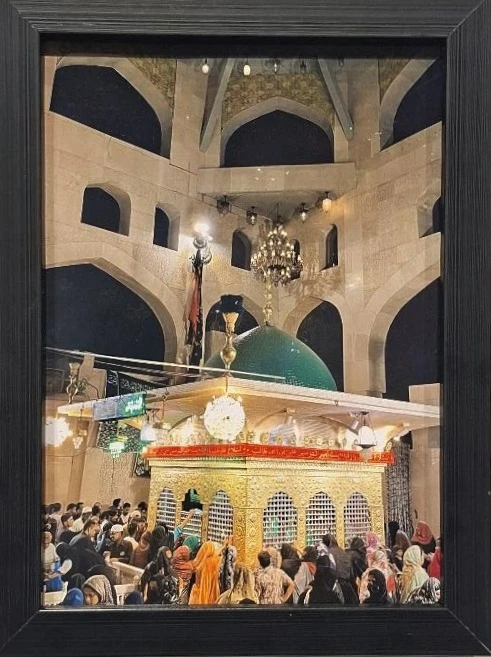
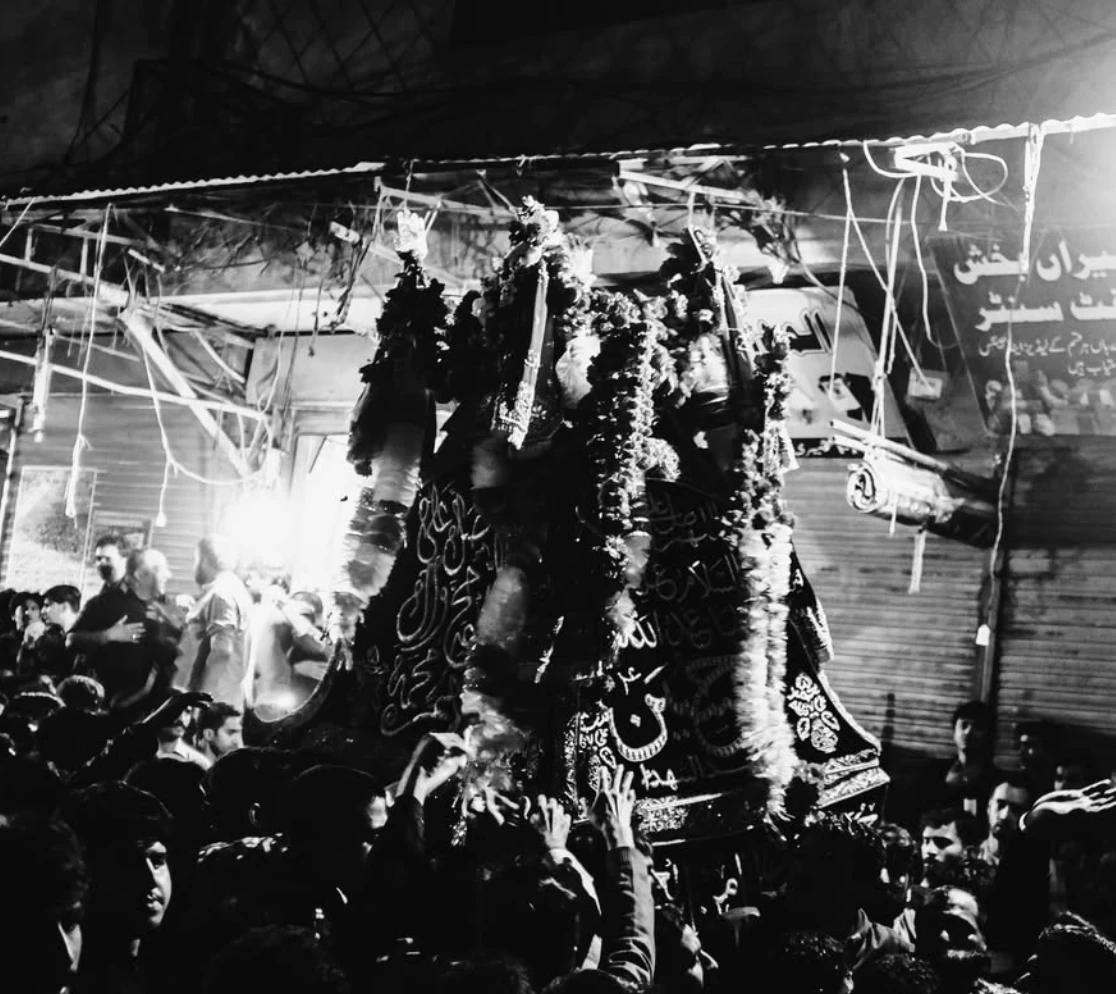
Fiza Jafri's a selection of photographs from Bibi Pak Daman, taken during fieldwork for her ongoing ethnographic research into Lahore's azadari culture, dated Muharram 2026/1448. They don't look like the rest of the show, and that's the point; these aren't compositions, they are documentation. The alams draped with marigold-and-rose garlands strung between poles, a woman's arm reaching up mid-frame to hang another mala, all telltale signs of a traditional devotion and reverence attached to this place. A place where prayers are accepted and sickness is gone. Be it in the form of a mannat or miracles. It's a reminder that everything else in this show, the gold leaf, the charcoal, the careful photo transfers, is drawing from something that is still actually happening, in real time.
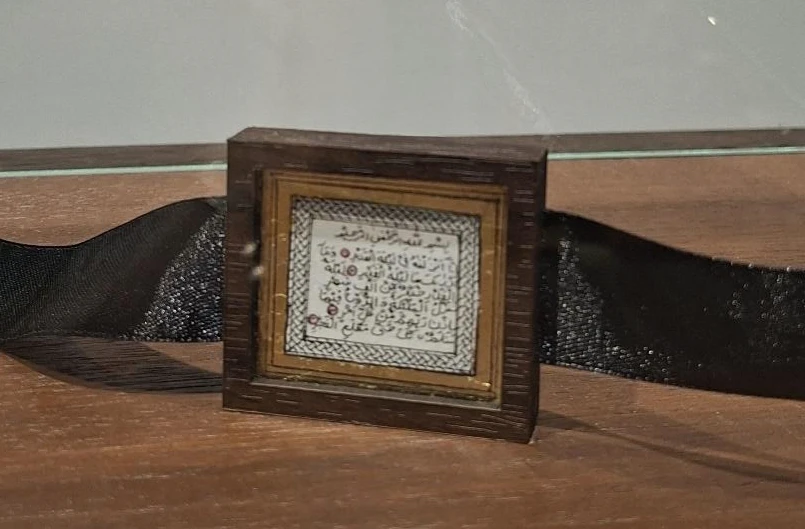
Sana Zahra's ‘Imam Zamin’ is the smallest object in the entire exhibition, and I almost didn't see it. A tiny miniature, gold-bordered and densely calligraphed by hand, sitting low in a case rather than up on a wall. An imam zamin is traditionally tied around the arm of someone setting out on a journey, a small protective vow stitched or written, and given for safekeeping, and the practice traces back to Imam Reza (A.S.). Placed here, at the tail end of a show about grief and its fortieth day, it reads less like an artwork and more like a blessing quietly left behind for whoever walks out of the gallery afterward. It's easy to walk past. I don't think it wants to be looked at for very long. It’s as if it has already been given to you by the time you notice it.
That's the tension the whole show seems to sit inside: the scholar's instinct to source and distinguish, and the mourner's instinct to just feel the thing without footnoting it. The 40th Day doesn't try to resolve that. It doesn't need to. It just lets both live in the same room the way they've always had to, and trusts you to carry both out with you when you leave.
Syeda Farwa Batool is an English lecturer, writer, and art critic based in Lahore, with an MPhil in English Literature and a research background in postcolonial historiography and Islamic cultural history; her writing on Muharram, memory, and history can be found at farwabatool1.substack.com.